
🇴🇲 OMSB
Fachzahnarzt Kinderzahnheilkunde Oman
Fachzahnärztinnen und Fachzahnärzte in der Vorbereitung auf die Prüfungen in Kinderzahnheilkunde bei DHA, DOH, Qatar DHP und SCFHS
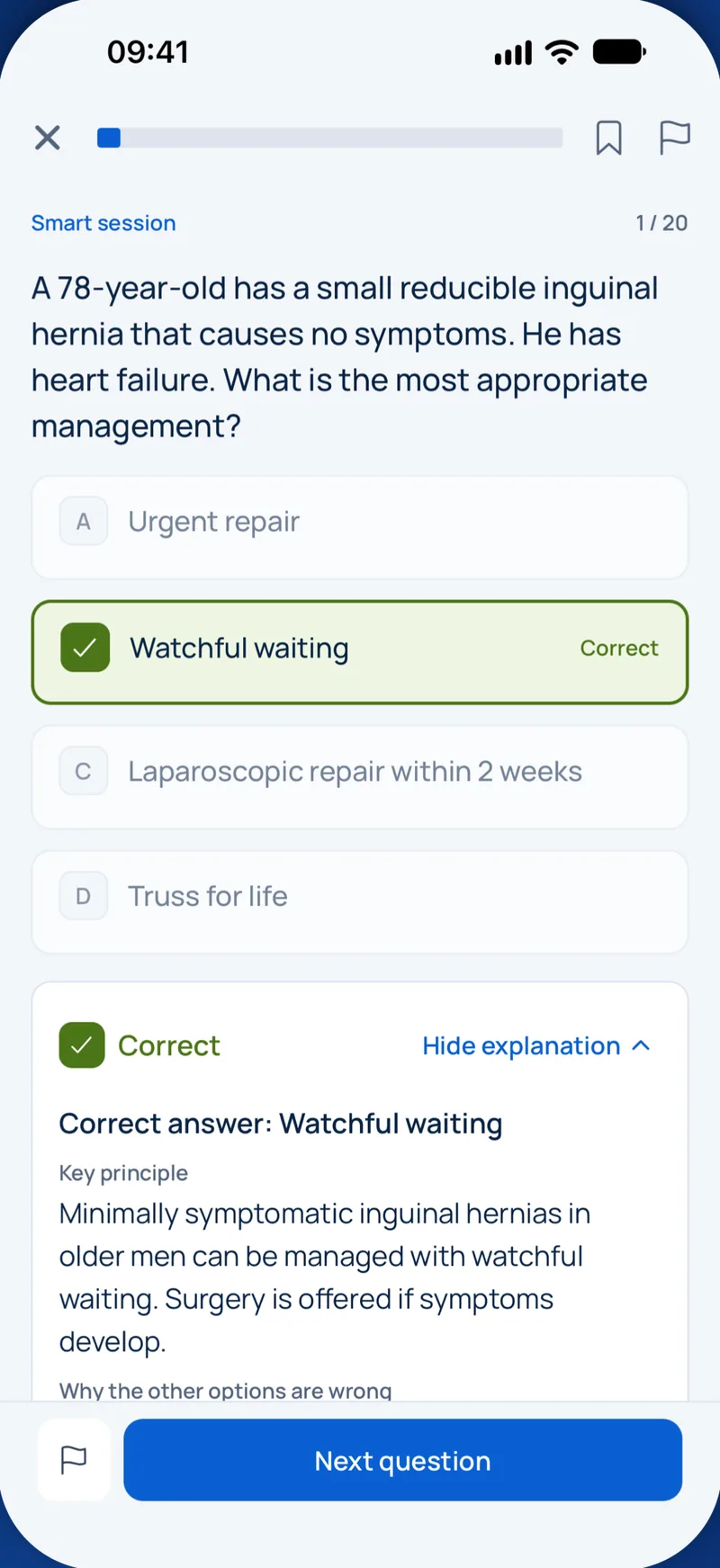
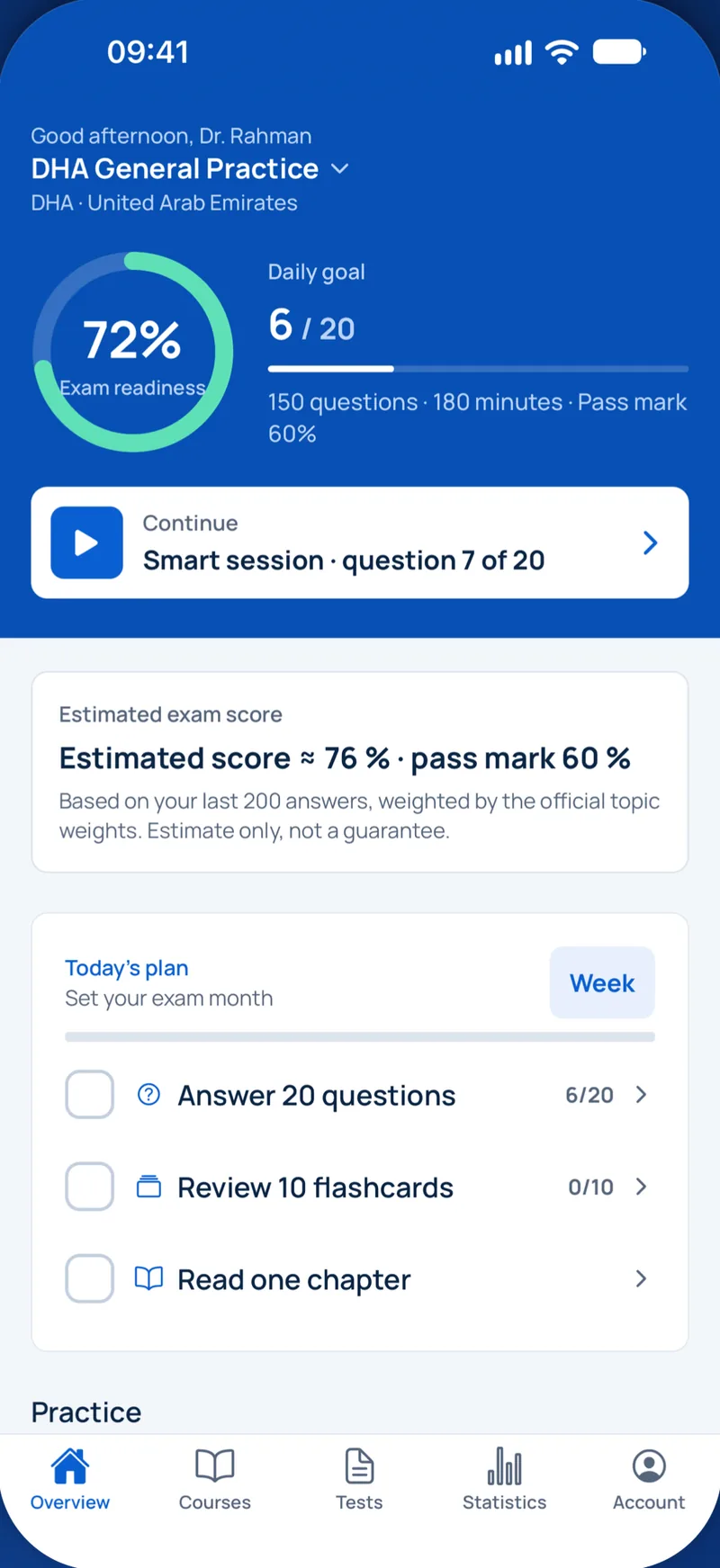
Beispielfrage
At about what stage of intrauterine life does calcification of the primary teeth begin?
Keys: 1–5 or A–E to choose, Enter to check and continue, F to mark.
Original MediFlow content, not official exam questions. Medical review in progress.
Syllabus and high-yield notes
1. Wachstum & Entwicklung · 15 % Anteil in der Prüfung · 5 lessons+
- Der Leeway-Space beträgt nach Proffit etwa 1,5 mm je Seite im Oberkiefer und 2,5 mm je Seite im Unterkiefer; ein passiver Lingualbogen kann damit leichten Unterkiefer-Engstand auflösen.
- Primatenlücken liegen mesial der oberen und distal der unteren Milcheckzähne und ermöglichen die frühe Mesialwanderung der ersten Molaren.
- Eine distale Stufe der zweiten Milchmolaren führt zu einer Klasse-II-Molarenrelation; eine gerade Endebene kann je nach Platz und Wachstum in Klasse I oder Höcker-zu-Höcker übergehen.
- Das „Ugly-Duckling“-Stadium (Diastema mediale und distal gekippte seitliche Schneidezähne mit 8–11 Jahren) ist physiologisch und schließt sich meist mit dem Eckzahndurchbruch.
- Wählen Sie den Lückenhalter nach Zahn und Stadium: Band-Schlaufe bei Verlust eines ersten Milchmolaren, distaler Schuh bei Verlust des zweiten Milchmolaren vor Durchbruch des Sechsjahrmolaren, Lingualbogen bei beidseitigem Verlust im Unterkiefer nach Durchbruch der Schneidezähne.
- Ein ektopischer Durchbruch des oberen Sechsjahrmolaren korrigiert sich oft selbst; eine irreversible Verhakung wird mit Separiergummi, Messingligatur oder Halterman-Apparatur nach distal aufgerichtet.
- Das zervikale Reifestadium CS3 zeigt an, dass der pubertäre Wachstumsgipfel etwa im nächsten Jahr folgt – günstig für funktionelle Klasse-II-Behandlung.
- Syndromhinweise: Hypodontie mit Zapfenzähnen und Hitzeintoleranz spricht für hypohidrotische ektodermale Dysplasie; viele überzählige Zähne mit verzögertem Durchbruch und Klavikula-Aplasie für Dysplasia cleidocranialis (RUNX2).
- Tooth formation, eruption timing and developmental anomalies – Every question about a child's dentition starts with one idea: teeth form on a timetable. If you know when crowns calcify, when teeth erupt and when roots close, you can date a defect, predict a problem and choose a treatment that respects the stage of development. This chapter builds that timetable and then shows how inherited and acquired disturbances change it.
- Occlusal development from the primary to the permanent dentition – Space is the currency of the developing dentition. Permanent incisors are larger than the primary incisors they replace, while permanent canines and premolars are together smaller than the primary canine and molars. Growth, spacing and the order in which teeth erupt decide whether the arch has enough room. Understanding these numbers lets you tell a normal transitional stage from a real problem.
- Space management and interceptive treatment of eruption problems – When a primary molar is lost early, the teeth around the gap drift. The first permanent molar moves mesially and tips, and the space for the premolar shrinks. Space loss is fastest in the first months after extraction, is greater in the maxilla, and is greater after loss of a primary second molar than a first molar. A space maintainer is a passive appliance that holds the gap until the successor erupts. Before placing one, confirm on a radiograph that the successor is present and not about to erupt; if more than about half of its root is formed and only a thin layer of bone covers it, eruption is near and maintenance may be unnecessary.
- Oral habits, crossbites and mixed dentition analysis – The mixed dentition period, from about 6 to 12 years, is when many malocclusions first show and when simple treatment can prevent bigger problems. The paediatric dentist does not need to be an orthodontist, but must recognise which problems need early interception, which can wait, and which need referral. This chapter covers non-nutritive sucking habits, anterior and posterior crossbites, and the space analyses used to predict crowding.
- Oral lesions of infants and children – Many oral lesions in children are harmless and self-limiting, but they worry parents and some need treatment or referral. The paediatric dentist should be able to name the common lesions of newborns, infants and older children, explain their cause, and decide whether to observe, treat or refer. This chapter groups them by age and by site.
2. Verhaltensführung & Sedierung · 15 % Anteil in der Prüfung · 5 lessons+
- Orales Midazolam wird zur Sedierung bei Kindern meist mit 0,25–0,5 mg/kg (maximal etwa 20 mg) dosiert; die Wirkung erreicht nach 20–30 Minuten ihr Maximum und hält unter einer Stunde an.
- Antagonisten: Flumazenil 0,01 mg/kg i. v. (max. 0,2 mg je Gabe) bei Benzodiazepinen, Naloxon 0,1 mg/kg (max. 2 mg) zur vollständigen Opioid-Antagonisierung. Danach weiter überwachen, da eine erneute Sedierung möglich ist.
- Tiefe Sedierung erfordert eine unabhängige Person, die ausschließlich überwacht und pädiatrisches Atemwegsmanagement beherrscht, sowie Kapnografie.
- Lachgas ist bei Vitamin-B12-Mangel, MTHFR-Mangel, kürzlicher Mittelohr-OP, Pneumothorax, Bleomycin-Therapie und im ersten Trimenon kontraindiziert bzw. nur mit Vorsicht anzuwenden; die Konzentration sollte routinemäßig 50 % nicht übersteigen.
- Entlassung nach Sedierung erst bei annähernd Ausgangszustand: freie Atemwege, stabile Vitalzeichen, altersgerechtes Sprechen bzw. Sitzen, ausreichende Flüssigkeit und mindestens 20 Minuten Wachbleiben in ruhiger Umgebung.
- Eine schützende Stabilisierung braucht dokumentierte Einwilligung, eine klare Indikation und die am wenigsten einschränkende Methode; sie dient nie als Strafe oder zur Bequemlichkeit des Teams.
- Laryngospasmus: zuerst Esmarch-Handgriff und Überdruckbeatmung mit 100 % Sauerstoff; bei Persistenz ist eine kleine Dosis Succinylcholin mit Intubationsbereitschaft nötig.
- Sedierung in der Praxis ist im Allgemeinen ASA-I/II-Kindern vorbehalten; ab ASA III oder bei schwierigem Atemweg ist eine Behandlung im Krankenhaus vorzuziehen.
- Child development, anxiety assessment and non-pharmacological behaviour guidance – Behaviour guidance is the continuous interaction between the dental team, the child and the parent that aims to build trust, reduce fear and deliver safe, good quality care. It is not a set of tricks for forcing a child to sit still. The American Academy of Pediatric Dentistry (AAPD) describes it as a continuum: most children respond to communication alone, a smaller group needs pharmacological help, and a few need general anaesthesia. Choosing well depends on understanding how children think at each age and on measuring how anxious or cooperative a child is.
- Sedation in children: patient selection, nitrous oxide and oral midazolam – Sedation reduces anxiety and movement so that treatment can be completed safely, but it is a continuum. A drug given for minimal sedation can produce deep sedation or even general anaesthesia in a susceptible child. The AAP/AAPD guideline (Coté and Wilson, 2019) therefore requires that the team be able to rescue a patient from one level deeper than the level intended.
- Monitoring, sedation emergencies, reversal and discharge – Most serious sedation incidents in children start as an airway problem that was noticed late. The answer is a monitoring standard matched to the intended depth, trained people with clear roles, emergency equipment sized for children, and a practised plan. The AAP/AAPD guideline uses the acronym SOAPME for preparation: Suction, Oxygen, Airway equipment of the right size, Pharmacy (resuscitation and reversal drugs), Monitors, and special Equipment such as a defibrillator.
- Local anaesthesia in children: doses, techniques and complications – Good local anaesthesia is the foundation of behaviour guidance. A child who feels pain during treatment learns that the dental chair hurts, and that lesson is hard to undo. Most problems with local anaesthesia in children come from three sources: giving too much drug for the child's weight, using adult anatomy for the injection site, and forgetting that soft tissue numbness lasts longer than the procedure.
- General anaesthesia for dental treatment in children – Some children cannot be treated safely in the dental chair, even with the best behaviour guidance and sedation. For them, general anaesthesia (GA) allows all treatment to be completed in one session under controlled conditions. GA is never a first choice for convenience. It carries small but real risks, needs a hospital or accredited facility, and does not by itself change the habits that caused the disease. This chapter explains when GA is justified, how the child is prepared, how the treatment plan differs, and what happens afterwards.
3. Karies & Prävention · 20 % Anteil in der Prüfung · 5 lessons+
- Schwere frühkindliche Karies (S-ECC) ist jede Glattflächenkaries vor dem 3. Geburtstag; von 3 bis 5 Jahren zählen kavitierte, fehlende oder gefüllte Glattflächen der oberen Frontzähne oder dmfs-Werte ab 4 (3 J.), 5 (4 J.) bzw. 6 (5 J.).
- 38 %iges Silberdiaminfluorid enthält etwa 44.800 ppm Fluorid; zweimal jährliche Anwendung stoppt mehr Läsionen als einmal jährliche. Weisen Sie auf die bleibende Schwarzfärbung der Läsion hin.
- 5 %iger Natriumfluorid-Lack enthält 22.600 ppm Fluorid und wird je nach Kariesrisiko alle 3–6 Monate aufgetragen.
- Nicht kavitierte Approximalläsionen im Schmelz oder im äußeren Dentindrittel lassen sich mikroinvasiv durch Kunststoffinfiltration stoppen, ohne Füllung.
- Bei tiefen Läsionen vitaler, beschwerdefreier Zähne verringert die selektive Entfernung bis zum weichen Dentin pulpanah bei hartem Dentin peripher das Expositionsrisiko ohne schlechtere Ergebnisse.
- MIH: abgegrenzte Opazitäten an einem bis vier ersten Molaren, oft mit Beteiligung der Schneidezähne; stark betroffene, hypersensible Molaren werden am besten mit konfektionierten Stahlkronen geschützt.
- Die Häufigkeit des Zuckerkonsums ist wichtiger als die Menge; die WHO empfiehlt freie Zucker unter 10 % der Energiezufuhr, besser unter 5 %.
- Fluorid wirkt überwiegend topisch nach dem Durchbruch: Es hemmt die Demineralisation, fördert die Remineralisation und hemmt die bakterielle Enolase.
- How caries develops in children and how to assess risk – Dental caries is a dynamic, biofilm-mediated, sugar-driven disease that causes a net loss of mineral from the hard tissues. Bacteria in plaque ferment dietary sugars to acids; when the pH at the tooth surface falls, enamel loses mineral (demineralisation); when the pH recovers, saliva and fluoride allow mineral to return (remineralisation). A lesion forms only when, over time, loss outweighs gain. This balance view explains why prevention works: every factor that shortens acid attacks or speeds repair tips the balance back.
- Fluoride, silver diamine fluoride and other preventive measures – Fluoride is the cornerstone of caries prevention. For a long time it was thought to work mainly by being built into developing enamel before eruption. We now know that its main effect is topical and after eruption. Low, constant concentrations of fluoride in saliva and plaque fluid are what protect the tooth.
- Detecting lesions and minimally invasive management, including MIH – Modern caries management asks two questions about each lesion: is it active or arrested, and is it cavitated or not? Non-cavitated lesions can usually be arrested without a drill. Cavitated lesions that cannot be cleaned by the patient usually need a restoration or sealing. Accurate detection is therefore the first step.
- Restoring primary teeth: materials, crowns and the Hall technique – Restoring a primary tooth is different from restoring a permanent one. The tooth only needs to last until it exfoliates, the enamel and dentine are thinner, the pulp is large and close to the surface, and the child may tolerate only a short procedure. The best restoration is therefore the one that survives until natural exfoliation with the least burden for the child. This chapter compares the main options and explains how to choose between them.
- Anticipatory guidance, diet counselling and the dental home – Anticipatory guidance means telling parents about expected changes before they happen, so that they can prevent problems instead of reacting to them. In paediatric dentistry, this covers feeding, toothbrushing, fluoride, teething, oral habits, injury prevention and diet at each age. It is most effective when it starts early and is repeated at every visit. The idea behind the dental home is that every child should have one regular source of dental care, ideally established by 12 months of age, where prevention and treatment are coordinated.
4. Pulpatherapie · 20 % Anteil in der Prüfung · 5 lessons+
- Bei tiefer Karies an Milchmolaren ohne Zeichen irreversibler Pulpitis hat die indirekte Überkappung langfristig höhere Erfolgsraten als die Pulpotomie (AAPD-Leitlinie 2017).
- Empfohlene Pulpotomie-Medikamente bei Milchmolaren sind MTA (bevorzugt) und Formokresol; Eisensulfat 15,5 % und Calciumhydroxid zeigen geringeren Erfolg, letzteres mit interner Resorption.
- Milchzahnkanäle werden mit resorbierbaren Materialien gefüllt: ZOE oder Iodoform-Calciumhydroxid-Pasten. Eine anschließende Stahlkrone verbessert die Prognose.
- Extraktion statt Pulpatherapie ist angezeigt bei pathologischer Resorption über etwa ein Drittel der Wurzel, interner Resorption oder nicht restaurierbarer Krone.
- Bei unreifen bleibenden Zähnen erlaubt die Vitalerhaltung (partielle oder vollständige Pulpotomie mit Calciumsilikatzement) das weitere Wurzelwachstum, selbst bei Symptomen irreversibler Pulpitis (ESE 2019, AAE 2021).
- Regenerative Endodontie (AAE): erste Sitzung 1,5 % NaOCl (20 ml je Kanal) und niedrig konzentrierte Antibiotikapaste oder Calciumhydroxid; zweite Sitzung 17 % EDTA, Einblutung bis zur Schmelz-Zement-Grenze, Kollagenmatrix und Calciumsilikat-Barriere.
- Graues MTA und bismutoxidhaltige Materialien verfärben Zähne; verwenden Sie im sichtbaren Bereich bismutfreie Calciumsilikatzemente.
- Elektrische und thermische Sensibilitätstests sind bei Milchzähnen und jungen bleibenden Zähnen unzuverlässig; die Diagnose stützt sich auf Schmerzanamnese, klinische Zeichen und Röntgenbild.
- Pulp biology, diagnosis and case selection in children – Pulp therapy in children is not adult endodontics on smaller teeth. Primary teeth have a limited lifespan, a permanent successor sitting under their roots, and a pulp that reacts differently to caries. Young permanent teeth have wide open apices, thin dentine walls and an excellent blood supply. Every decision in this topic therefore starts with three questions: what is the pulp status, how much longer must the tooth stay, and can it be restored with a good coronal seal?
- Vital and non-vital pulp therapy in primary teeth – Pulp therapy in primary teeth follows a ladder. The least invasive treatment that keeps the tooth healthy until exfoliation is the right one. In order: indirect pulp treatment, direct pulp capping (rarely), pulpotomy, pulpectomy, and extraction.
- Pulp therapy for immature permanent teeth – An immature permanent tooth has an open apex and thin, short roots. Root development continues for about three years after eruption, and it only continues if the pulp stays alive. The goal is therefore to keep the pulp vital whenever possible (apexogenesis, meaning continued physiological root formation). If the pulp is already necrotic, the choices are regenerative endodontics or apexification.
- Odontogenic infection, antibiotics and pain control in children – Pulp disease in a child often ends as an infection: a dentoalveolar abscess, a sinus tract, or a facial swelling. Most of these infections are treated by removing the source, either by pulp therapy or extraction. Antibiotics have a limited, specific role. Because children have less physiological reserve than adults, a spreading facial infection can become dangerous quickly. This chapter explains how to recognise severity, when antibiotics are and are not indicated, and how to control pain safely.
- Outcomes, follow-up and failure of pulp therapy – A pulp treatment is only successful if the tooth stays healthy until it is lost naturally or, for a permanent tooth, for life. Success is judged clinically and radiographically over time, not on the day of treatment. This chapter explains how success is defined, what the evidence shows for the main techniques, how to recognise failure, and what to do when it happens.
5. Trauma · 20 % Anteil in der Prüfung · 5 lessons+
- IADT-2020-Schienungszeiten: Subluxation (falls zur Schmerzlinderung nötig), Extrusion und Avulsion 2 Wochen; laterale Dislokation, Intrusion (nach Reposition), Alveolarfortsatzfraktur und Wurzelfraktur 4 Wochen; Wurzelfraktur im zervikalen Drittel bis zu 4 Monate.
- Bei reifen replantierten Zähnen beginnen Sie die Wurzelkanalbehandlung innerhalb von 2 Wochen, möglichst vor Schienenentfernung; unreife Zähne werden auf Revaskularisation beobachtet.
- Intrudierte unreife bleibende Zähne dürfen unabhängig vom Ausmaß spontan reeruptieren; reife Zähne mit über 7 mm Intrusion werden chirurgisch reponiert.
- Geeignete Lagerungsmedien für avulsierte Zähne sind HBSS oder Milch, danach Speichel oder Kochsalzlösung; Leitungswasser schädigt die PDL-Zellen.
- Nach Avulsion sind systemische Antibiotika optional; unter 12 Jahren Phenoxymethylpenicillin oder Amoxicillin statt Tetracyclinen. Prüfen Sie den Tetanusschutz.
- Bei wachsenden Kindern wird ein ankylosierter Schneidezahn in Infraposition dekoroniert, um Breite und Höhe des Alveolarknochens für spätere Implantat- oder prothetische Versorgung zu erhalten.
- Bei Milchzähnen steht der Schutz des Nachfolgers im Vordergrund; ein disloziertes koronales Fragment nach Wurzelfraktur wird entfernt, das apikale Fragment bleibt zur Resorption.
- Eine Pulpaobliteration nach Dislokation zeigt das Überleben der Pulpa und erfordert keine Wurzelbehandlung, solange keine periapikale Pathologie auftritt.
- Assessment and fractures of permanent teeth – Dental trauma is common in children: roughly one in four schoolchildren injures a permanent tooth, mostly the maxillary central incisors, and children with increased overjet and incompetent lips are at higher risk. The International Association of Dental Traumatology (IADT) guidelines of 2020 are the reference for all treatment decisions in this topic. They are organised by injury type and by dentition, and they emphasise that the outcome depends on the healing of two tissues: the pulp and the periodontal ligament (PDL).
- Luxation injuries and avulsion of permanent teeth – Luxation injuries damage the PDL and the neurovascular bundle at the apex. Two factors predict the pulp outcome: the stage of root development (an open apex allows revascularisation) and the severity of the displacement. Intrusion is the most severe luxation: the tooth is driven into the bone, crushing the PDL and the apical vessels. In mature teeth, intrusion carries the highest risk of pulp necrosis (close to 100 percent) and a high risk of replacement resorption.
- Primary teeth, healing complications and long-term care – Trauma to primary teeth peaks at 1–3 years, when children learn to walk. The anatomy dictates the rules: the apex of the primary incisor lies just labial to the crown of the developing permanent incisor. Any treatment decision in the primary dentition is therefore made with one overriding aim, to protect the successor. The second consideration is the child's ability to cope; many young children cannot cooperate with complex treatment, and the least traumatic option is often right.
- Soft tissue, alveolar and jaw injuries in children – Dental injuries rarely come alone. A fall or blow that breaks a tooth often also cuts the lip, tears the gingiva, fractures the alveolar bone or, less often, the jaw. A child with facial trauma must first be assessed as a whole patient: airway, head injury and other injuries take priority over teeth. This chapter covers soft tissue injuries, alveolar fractures, and fractures of the mandible, especially the condyle, which behave differently in growing children.
- Prevention, documentation and follow-up of dental trauma – Dental trauma is common: around one in four to one in three children injure their primary or permanent teeth by adolescence. Many injuries happen at home, at school, in sport and on bicycles. The outcome depends not only on the first treatment but also on prevention, accurate records and a long follow-up. This chapter covers epidemiology and risk factors, prevention, documentation, the follow-up schedule and communication with families.
6. Besondere Bedürfnisse & Kinderschutz · 10 % Anteil in der Prüfung · 5 lessons+
- Bei Kindern unter Chemotherapie setzt elektive Behandlung eine ANC über 1.000/mm³ und Thrombozyten über 75.000/mm³ voraus; zwischen 40.000 und 75.000 kann eine Thrombozytengabe erwogen werden, unter 40.000 werden invasive Eingriffe verschoben.
- Bei Hämophilie sind bukkale Infiltration und intraligamentäre Anästhesie meist ohne Faktorsubstitution möglich; Leitungsanästhesie am N. alveolaris inferior und Extraktionen brauchen Faktorersatz in Absprache mit dem Hämophiliezentrum; Tranexamsäure unterstützt die lokale Blutstillung.
- Endokarditisprophylaxe (AHA 2021) nur bei Klappenprothesen oder Prothesenmaterial, früherer Endokarditis, unkorrigierten zyanotischen Herzfehlern, korrigierten Defekten in den ersten 6 Monaten oder mit Restdefekt am Prothesenmaterial und Klappenerkrankung nach Herztransplantation.
- Zahnärztliche Vernachlässigung ist das bewusste Versäumnis von Eltern oder Sorgeberechtigten, notwendige Behandlung zu suchen und fortzuführen; bleibt Unterstützung erfolglos, wird der Kinderschutz eingeschaltet.
- Für eine Meldung bei Verdacht auf Misshandlung genügt ein begründeter Verdacht, kein Beweis; dokumentieren Sie objektiv, etwa Bissmarken mit einem Eckzahnabstand über 3 cm als Hinweis auf einen erwachsenen Verursacher.
- Die sekundäre Osteoplastik bei Spaltpatienten erfolgt idealerweise mit etwa 8–11 Jahren vor dem Durchbruch des Eckzahns auf der Spaltseite, wenn dessen Wurzel zur Hälfte bis zu zwei Dritteln entwickelt ist.
- Vorzeitiger Verlust von Milchschneidezähnen mit intakten Wurzeln vor dem 5. Lebensjahr spricht für Hypophosphatasie (ALPL); schwere frühe Parodontitis mit palmoplantarer Hyperkeratose für das Papillon-Lefèvre-Syndrom (Cathepsin C).
- Chemotherapie vor abgeschlossener Wurzelentwicklung kann kurze, V-förmige Wurzeln, Mikrodontie und Nichtanlagen verursachen; dokumentieren Sie diese Spätfolgen und planen Sie eine langfristige Nachsorge.
- Medically compromised children: oncology, bleeding and cardiac disease – Children with serious medical conditions need the same dental care as other children, but the timing, setting and precautions change. The dentist works with the child's medical team, never alone. Three groups appear again and again in exams: children with cancer, children with bleeding disorders, and children with congenital heart disease.
- Disabilities, syndromes and medical emergencies – Special health care needs include any physical, developmental, mental, sensory, behavioural, cognitive or emotional condition that requires adaptation of dental care. The principles are the same for all: a careful medical history, communication adapted to the child, prevention first, and choosing the setting (clinic, sedation, general anaesthesia) that allows good quality care safely.
- Safeguarding: child abuse and dental neglect – Safeguarding means protecting children from maltreatment and acting when it is suspected. Dentists are important because about half or more of physical abuse injuries involve the head, face, mouth or neck, which are exactly the areas dentists examine. Child maltreatment includes physical abuse, sexual abuse, emotional abuse and neglect, and these often coexist.
- Common chronic conditions: asthma, diabetes, epilepsy, sickle cell, kidney and liver disease – Many children seen in a general paediatric dental clinic live with a chronic illness. These conditions rarely prevent dental treatment, but they change risk, timing and drug choice. The key questions for each child are: how well is the condition controlled, what medicines does the child take, what could go wrong during treatment, and how does the condition affect the mouth?
- Patient safety, ethics and professionalism in paediatric dentistry – Children are a vulnerable group. They depend on adults to decide for them, they may not be able to describe pain or harm, and they are more sensitive to drugs and radiation than adults. Patient safety and professional ethics are therefore central to paediatric dentistry, and the specialty examinations test them directly. This chapter covers consent, the prevention of errors, specific hazards in the paediatric clinic, record keeping, referral and conflicts of interest.
Wachstum & Entwicklung
Lesson 1Tooth formation, eruption timing and developmental anomalies
Every question about a child's dentition starts with one idea: teeth form on a timetable. If you know when crowns calcify, when teeth erupt and when roots close, you can date a defect, predict a problem and choose a treatment that respects the stage of development. This chapter builds that timetable and then shows how inherited and acquired disturbances change it.
Tooth development passes through the bud, cap and bell stages. In the bell stage the inner enamel epithelium induces odontoblasts, dentine is laid down first, and ameloblasts then deposit enamel. Calcification (mineralisation of the hard tissue matrix) of the primary teeth begins at about 4 months in utero, roughly 13 to 16 weeks, starting with the central incisors. The first permanent molar begins to calcify around birth, which is why a neonatal line is visible in its enamel and why a systemic insult in the first years of life marks the first permanent molars and incisors together.
| Event | Typical timing | Clinical meaning |
|---|---|---|
| Primary tooth calcification begins | About 4 months in utero (13 to 16 weeks) | Maternal and perinatal illness can mark primary enamel |
| First primary tooth erupts | About 6 months (mandibular central incisor) | Variation of several months is normal |
| Primary dentition complete | About 2.5 to 3 years | Primary root completion about 1 to 1.5 years after eruption |
| First permanent molar and mandibular incisors erupt | About 6 to 7 years | Start of the early mixed dentition |
| Permanent root apex closure | About 2 to 3 years after eruption | A central incisor erupting at 7 closes at about 9 to 10 years |
| Second permanent molars erupt | About 12 years | End of the mixed dentition |
Root development matters in trauma. A permanent incisor that erupted six months ago has a short root with a wide, open apex. Such a tooth has an excellent blood supply and a good chance of pulp survival, so vital pulp therapy (pulp capping or partial pulpotomy) is preferred over pulpectomy, aiming for apexogenesis, the continued physiological growth and closure of the root. Removing the pulp too early leaves a thin, short root that fractures easily.
Eruption is delayed when the tooth bud is late, the path is blocked, or the tissues overlying the tooth resist. A practical rule: if a permanent tooth has not erupted six months after its contralateral partner, or if eruption deviates from the normal sequence, take a radiograph.
An eruption cyst is a dentigerous cyst in the soft tissue over an erupting tooth. It appears as a soft, bluish, fluctuant, usually painless swelling, often over a primary molar or first permanent molar. Most rupture spontaneously as the tooth breaks through, so observation is correct. Uncovering (marsupialisation of the roof) is reserved for cysts that are painful, infected or persist.
Hypodontia is the developmental absence of one or more teeth, excluding third molars. In European populations the mandibular second premolar is most often missing after the third molars, followed by the maxillary lateral incisor. In some Asian populations the order can differ, and mandibular incisors are more often absent. Hypodontia of many teeth (oligodontia, six or more missing) should prompt a search for a syndrome.
| Condition | Key features | Genetics and dental notes |
|---|---|---|
| Hypohidrotic ectodermal dysplasia | Severe hypodontia, conical teeth, sparse fine hair, dry skin, reduced sweating with heat intolerance, frontal bossing | Usually X-linked (EDA gene), boys most affected; early dentures, later implants once growth allows |
| Cleidocranial dysplasia | Hypoplastic or absent clavicles (shoulders can be brought together in front), open fontanelles, broad forehead | RUNX2; retained primary teeth, multiple unerupted supernumerary teeth, delayed permanent eruption |
| Dentinogenesis imperfecta type I (Shields) | Amber or grey translucent teeth, rapid attrition, bulbous crowns, cervical constriction, short roots, pulp obliteration | Part of osteogenesis imperfecta (COL1A1/COL1A2): blue sclerae, fractures |
| Dentinogenesis imperfecta type II | Same dental picture without bone disease | DSPP gene; the old type III (Brandywine) is now grouped with it |
| Regional odontodysplasia | One quadrant or region, usually maxillary; small, yellow-brown, hypoplastic teeth; delayed or failed eruption | Not inherited; radiograph shows 'ghost teeth' with thin enamel and dentine and wide pulps |
| Amelogenesis imperfecta | Enamel defect in all teeth of both dentitions; hypoplastic, hypomaturation or hypocalcified types | Distinguish from chronological defects such as fluorosis or MIH, which follow the timing of an insult |
Sources: Dean JA (ed). McDonald and Avery's Dentistry for the Child and Adolescent, 11th ed. Elsevier, 2022 · Welbury R, Duggal MS, Hosey MT (eds). Paediatric Dentistry, 5th ed. Oxford University Press, 2018 · Proffit WR, Fields HW, Larson BE, Sarver DM. Contemporary Orthodontics, 6th ed. Elsevier, 2019 · American Academy of Pediatric Dentistry. Reference Manual 2024-2025
Zur OMSB Fachzahnarzt Kinderzahnheilkunde-Prüfung
Wie viele Fragen hat die OMSB Fachzahnarzt Kinderzahnheilkunde-Prüfung?+
nicht veröffentlicht. Genaue Fragenzahl, Zeit und Bestehensgrenze stehen in Ihrer Buchung.
Welche Themen haben das größte Gewicht?+
Die größten Themen sind Karies & Prävention (20 %), Pulpatherapie (20 %), Trauma (20 %). Der Kurs umfasst 6 Themen mit insgesamt 30 Kapiteln.
Wie bereite ich mich auf die OMSB Fachzahnarzt Kinderzahnheilkunde-Prüfung vor?+
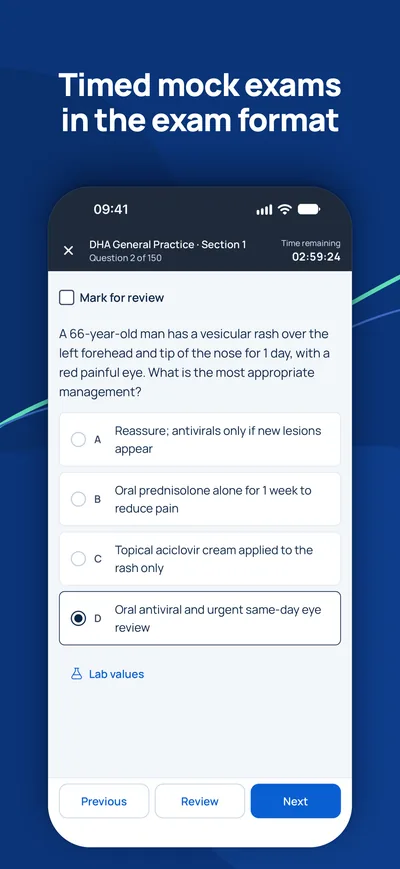
Arbeiten Sie die Kapitel Thema für Thema durch, wiederholen Sie die Lernnotizen und üben Sie dann mit zeitgesteuerten Probeprüfungen im Format Ihrer Behörde.
Fragen
Wie lange habe ich Zugang?+
Der Zugang gilt 90 Tage ab Zahlung für das gewählte Land und den gewählten Beruf.
Welche Geräte kann ich nutzen?+
Jeden Browser auf Computer, Tablet oder Handy sowie die MediFlow-App mit demselben Konto.
Kann ich das Geld zurückbekommen?+
Bitte lesen Sie vor dem Kauf unsere Erstattungsrichtlinie. Erstattungsrichtlinie
iPhone · iPad
GCC Medical Exam Prep
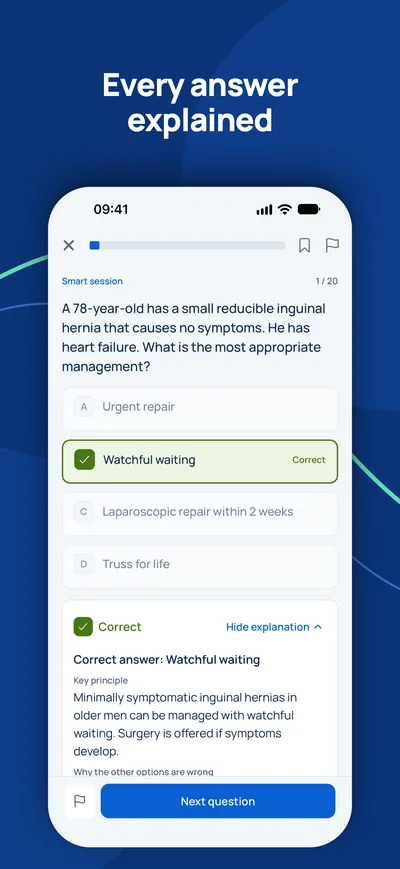
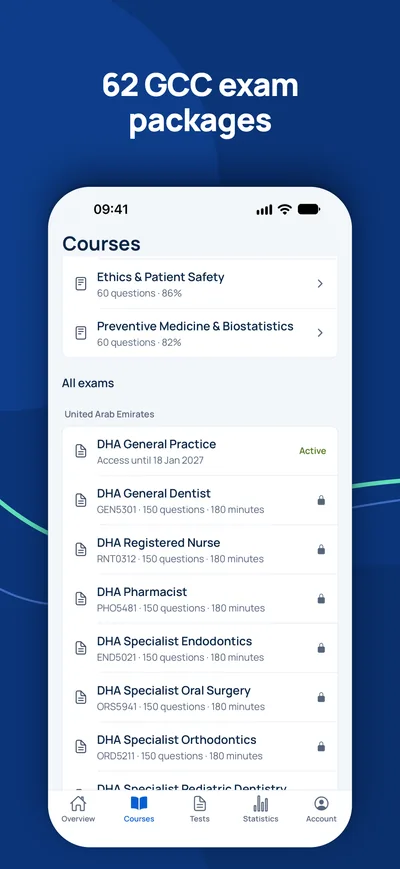
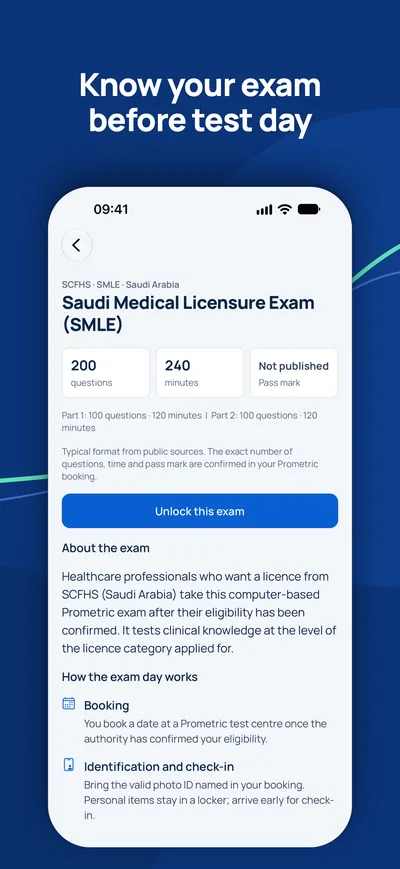
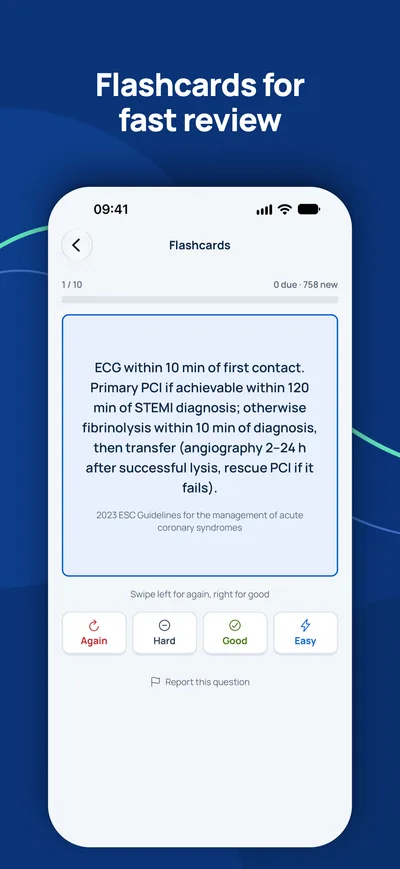
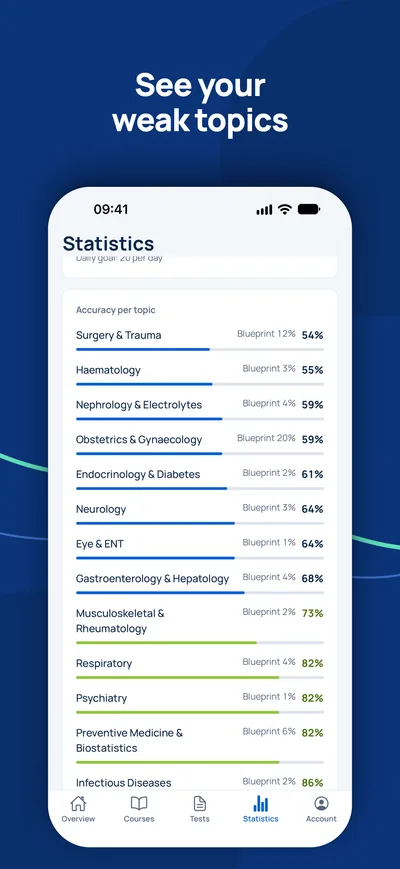
Bereiten Sie sich auf Ihrem iPhone auf DHA, DOH, MOHAP, SCFHS und weitere Zulassungsprüfungen am Golf vor.

Ist die Prüfung Ihr einziger offener Schritt?
Prüfen Sie zuerst, ob Sie die Prüfung überhaupt brauchen und welchen Titel Sie erwarten können. Ein Berater beantwortet Ihre Fragen kostenlos.
Eignungs-Check- 1Kostenlose Beratung per Video, Telefon oder WhatsApp
- 2Eignungs-Check gegen die offiziellen Anforderungen
- 3Ihr Plan mit Festpreisen und klaren nächsten Schritten