
🇸🇦 SCFHS
Specialist Orthodontics Saudi Arabia
Specialist dentists preparing for the Orthodontics exams of DHA, DOH, Qatar DHP and SCFHS
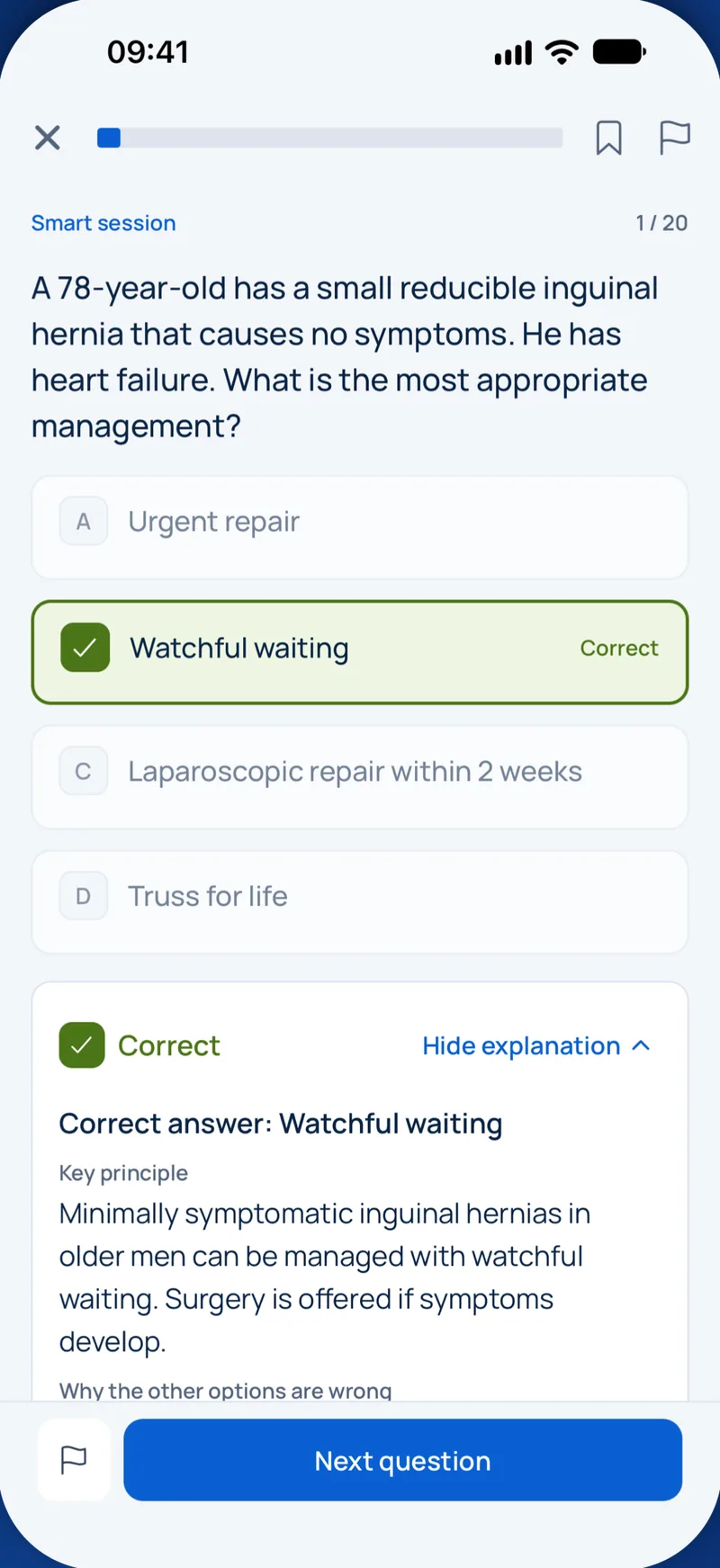

Pregunta de ejemplo
Which structure is the classic example of a secondary cartilage in the craniofacial skeleton?
Keys: 1–5 or A–E to choose, Enter to check and continue, F to mark.
Original MediFlow content, not official exam questions. Medical review in progress.
Syllabus and high-yield notes
1. Growth & development · 15 % peso en el examen · 5 lessons+
- Scammon curves: neural tissue completes about 90 % of growth by age 6–7, lymphoid tissue overshoots adult size before puberty, and general/skeletal and genital tissue follow an S-shaped pubertal curve. The face follows a gradient: width finishes first, then length (depth), then height.
- The mandibular condylar cartilage is a secondary cartilage: it grows adaptively in response to functional and environmental factors, unlike primary cartilages (epiphyseal plates, spheno-occipital synchondrosis) that have intrinsic growth potential.
- The maxilla is displaced downward and forward by growth at the circummaxillary sutures and the push of the cranial base, while its anterior surface remodels by resorption; vertical growth of the alveolar processes and palatal surface remodelling add height.
- Björk implant studies showed that most mandibles rotate forward (counter-clockwise) during growth; much of this rotation is masked by surface remodelling at the lower border. Backward rotators develop long anterior face height and open-bite tendency.
- Skeletal maturity is better judged from hand–wrist (e.g. adductor sesamoid, MP3 stages) or cervical vertebral maturation (CVM, Baccetti stages CS1–CS6) than from chronological age; the pubertal peak in mandibular growth falls between CS3 and CS4.
- Girls reach the pubertal growth spurt about two years earlier than boys (roughly 11–12 vs 13–14 years). Vertical facial growth, especially of the mandible in males, continues into the late teens and slowly into adulthood.
- Leeway space: the sum of primary canine and molars exceeds that of the successors by about 1.5 mm per side in the maxilla and 2.5 mm per side in the mandible; it allows mesial molar shift from flush terminal plane to Class I.
- Intercanine width increases mainly with the eruption of the permanent incisors and canines and essentially stops increasing after about age 12–13 in the mandible; arch length (depth) decreases slightly in adulthood, contributing to late lower incisor crowding.
- Principles of craniofacial growth: patterns, cartilages and theories – Orthodontists treat growing patients, so they must know how much growth is left, where it happens and in which direction. This chapter covers the basic rules first: how different tissues grow at different times, how bone actually gets bigger, and the main theories that try to explain what controls facial growth. Later chapters apply these rules to the maxilla, the mandible, timing of treatment and the dentition.
- Growth of the cranial base, maxilla and mandible, and growth rotations – Once you know the basic mechanisms, the next step is to apply them to each part of the craniofacial skeleton. The cranial base is the platform on which the face hangs, the maxilla grows mainly by sutural growth and remodelling, and the mandible grows mainly at the condyle and ramus. The relation between vertical growth of the face and growth of the condyle decides whether the mandible rotates forward or backward, which in turn shapes the face.
- Timing growth: skeletal maturity, the pubertal spurt and adult growth – Many orthodontic decisions depend on timing. A functional appliance for mandibular retrusion works best during the pubertal spurt. Maxillary expansion is most skeletal when the patient is young. Orthognathic surgery for mandibular prognathism should wait until growth has stopped. Chronological age is a poor guide because children of the same age can be years apart in maturity. Clinicians therefore estimate skeletal age from radiographs and from other biological signs.
- Development of the dentition and dental arches – The dentition develops together with the jaws. Many features that look abnormal in a child, such as a midline gap or a flush molar relationship, are normal stages that resolve on their own. A specialist must know which features are transient and which need treatment. This chapter follows the dentition from the primary stage through the mixed dentition into the adult arch.
- Craniofacial syndromes, clefts and disturbances of growth – Most patients an orthodontist sees have a malocclusion that sits within normal variation. A small but important group have a recognisable disturbance of craniofacial growth: a syndrome, a sequence, a cleft, a joint disease or an injury that changed how the face grew. These patients need the orthodontist to understand which tissue failed, how that failure will play out over the remaining years of growth, and which other specialists must be involved. This chapter gives the growth logic behind the common conditions; the treatment chapter covers the clinical pathway for cleft care in more detail.
2. Diagnosis · 20 % peso en el examen · 5 lessons+
- A problem-oriented diagnosis lists findings by dimension (sagittal, vertical, transverse), by level (skeletal, dentoalveolar, soft tissue) and by alignment/symmetry, then prioritises problems before choosing treatment.
- Wits appraisal measures the distance between perpendiculars from A and B points to the functional occlusal plane; mean about 0 mm in females and −1 mm in males. It avoids the nasion dependence of ANB but depends on the occlusal plane.
- IOTN has a Dental Health Component (grades 1–5, worst single feature by MOCDO: missing, overjet, crossbite, displacement, overbite) and an Aesthetic Component (10 photographs). DHC 4–5 indicates great need.
- PAR index measures how far an occlusion deviates from normal; a reduction of at least 30 % means improvement and a reduction of 22 points or more means "greatly improved".
- CBCT is not a routine orthodontic record. Use it when conventional imaging cannot answer a specific question, e.g. impacted canine with suspected root resorption, cleft alveolar bone, or complex skeletal asymmetry, with the smallest field of view (ALARA/ALADAIP).
- Bolton analysis: anterior ratio about 77.2 % and overall ratio about 91.3 %. A discrepancy above about 1.5 mm is clinically relevant and affects finishing (overjet, overbite, spaces).
- A functional shift (CO–CR discrepancy) must be identified before diagnosis: a pseudo-Class III or unilateral crossbite with shift is often dental, whereas a true asymmetry persists in centric relation.
- Soft-tissue diagnosis guides the plan: nasolabial angle (about 90–110°), lip position to Ricketts E-line (upper −4, lower −2 mm in adults), incisor display at rest (about 2–4 mm) and smile arc. Extraction decisions should respect the profile.
- The problem-oriented approach, clinical examination and records – Orthodontic diagnosis is not the same as naming an Angle class. Angle's classification describes only the sagittal relationship of the first molars. It says nothing about the skeleton behind the teeth, the vertical proportions of the face, the width of the arches, the soft tissues or the patient's concerns. Modern diagnosis is therefore problem-oriented: the clinician collects a database, turns it into a list of problems, ranks those problems, and only then thinks about treatment options. Treatment is chosen to solve the prioritised problems, not to normalise every number.
- Cephalometric analysis: skeletal and dental relationships – A lateral cephalogram is a standardised lateral skull radiograph taken with the head fixed in a cephalostat, the teeth in occlusion and the Frankfort plane horizontal. Its value is that the same landmarks can be identified on every film, allowing measurements to be compared with population norms and with the same patient over time. Cephalometric numbers are aids to diagnosis, not the diagnosis itself. Every value must be interpreted against the clinical picture, and a single abnormal number should never drive treatment.
- Space analysis, tooth size and characteristic malocclusion patterns – Space analysis compares the space available in an arch with the space required for the teeth. The space available is the arch perimeter from the mesial of one first molar to the mesial of the other, measured along the line of the ideal arch. The space required is the sum of the mesiodistal widths of the teeth in front of the first molars. A negative result means crowding, a positive result means spacing. Crowding is usually graded as mild (up to about 4 mm per arch), moderate (about 4 to 8 mm) and severe (more than about 8 mm). These bands are guides; the decision to extract also depends on incisor position, the profile, the curve of Spee and anchorage.
- Treatment need and outcome indices, and putting the diagnosis together – Indices turn clinical findings into numbers that can be compared between patients, clinicians and health systems. Two are essential for examinations: the Index of Orthodontic Treatment Need (IOTN), which ranks how much a patient needs treatment, and the Peer Assessment Rating (PAR), which measures how much a malocclusion deviates from normal and is used to judge treatment outcome. They answer different questions and must not be confused.
- Aetiology of malocclusion: genes, environment and local factors – Before choosing a treatment, it helps to ask why the malocclusion developed. The answer guides prognosis: a problem driven by a persistent habit or a soft tissue pattern will relapse if the cause continues, while one caused by a single local event, such as early loss of a primary molar, can often be fully corrected. Very few malocclusions have one clear cause. Most result from a genetically determined skeletal and dental pattern modified by environmental influences during growth.
3. Biomechanics · 20 % peso en el examen · 5 lessons+
- A force through the centre of resistance produces translation; a force away from it creates a moment (force × perpendicular distance) and rotation. The moment-to-force ratio at the bracket determines the type of movement: about 7:1 controlled tipping, 10:1 translation, more than 10:1 root movement (for a typical incisor).
- The centre of resistance of a single-rooted tooth lies about one third to 40 % of the root length apical to the alveolar crest; it moves apically with bone loss, so the same force gives more tipping in periodontally reduced teeth.
- Pressure–tension theory: on the pressure side, light force causes frontal resorption; heavy force causes hyalinisation (sterile necrosis) and undermining resorption with a lag phase. RANKL/OPG and inflammatory mediators (PGE2, IL-1) drive osteoclastogenesis.
- Wire stiffness is proportional to the fourth power of diameter for round wire (doubling diameter = 16× stiffer) and inversely proportional to the cube of span length; range is the reverse. Rectangular wire stiffness rises with width × height³ in the bending direction.
- Nickel–titanium shows superelasticity (stress-induced martensitic transformation) giving a flat unloading curve, and shape memory; heat-activated wires have an austenite finish temperature near mouth temperature. TMA (beta-titanium) has about 40 % of steel stiffness and is formable and weldable.
- Statically determinate systems (one-couple: cantilever, intrusion arch tied at one point) let the clinician know forces and moments; two-couple systems (a wire engaged in two brackets) are statically indeterminate. Burstone’s geometry classes describe force systems of a straight wire between two brackets.
- Anchorage is resistance to unwanted movement. It is reinforced by more teeth, differential moments, extraoral forces, or skeletal anchorage (miniscrews, miniplates), which gives absolute anchorage when properly placed; primary stability depends on cortical thickness and insertion torque (about 5–10 Ncm).
- Friction in sliding mechanics has classical friction, binding (second-order angulation beyond the critical contact angle) and notching; binding dominates clinically. Self-ligating brackets reduce classical friction with small round wires but not binding.
- Forces, moments and the centre of resistance – Every orthodontic appliance does one thing: it delivers a force system to a tooth. Whether the tooth tips, moves bodily, rotates or moves its root depends not on the appliance type but on the forces and moments it receives relative to one special point, the centre of resistance. If you understand this chapter, most biomechanics questions become simple geometry.
- Biology of tooth movement and force magnitude – Mechanics decides where a tooth wants to go; biology decides whether and how fast it gets there. Orthodontic tooth movement is a remodelling process of the PDL and alveolar bone: bone is resorbed in the direction of movement and formed behind the tooth. Knowing how force magnitude changes this biology explains lag phases, pain, root resorption and the recommended force ranges.
- Wires, materials and friction – Archwires store energy when they are deflected and release it as force on the teeth. Choosing a wire means choosing how much force it delivers per millimetre of activation, how far it can be bent before deforming permanently, and how easy it is to shape. These are three related but different properties.
- Force systems in practice and anchorage – In the mouth, appliances connect teeth to other teeth, so every force system has an active part and a reactive part. Good biomechanics means predicting both, then using or neutralising the reaction. This chapter applies the principles of the first three chapters to real appliances and to anchorage.
- Adverse effects of tooth movement: root resorption, pulp, periodontium, enamel and drugs – Every orthodontic force that moves a tooth also stresses the root, the pulp, the periodontal ligament and the alveolar bone. Most of these effects are mild and reversible. Some are not. A specialist must be able to predict who is at risk, choose mechanics that reduce harm, recognise problems early and explain them to patients. This chapter looks at the tissue side of biomechanics.
4. Appliances · 15 % peso en el examen · 5 lessons+
- Pre-adjusted edgewise prescriptions (Andrews straight-wire, Roth, MBT) build tip, torque and in-out into the bracket; MBT has more palatal root torque on upper incisors (+17°) and less lower incisor torque (−6°) than Roth to compensate for sliding mechanics.
- Torque expression depends on slot play: a 0.019 × 0.025-inch steel wire in a 0.022-inch slot has about 10–12° of play, so full prescription torque is not expressed.
- Functional appliances (Twin Block, Herbst, Activator, Frankel) correct Class II mostly by dentoalveolar change: retroclination of upper and proclination of lower incisors, with a small, clinically variable mandibular skeletal effect (about 1–2 mm).
- Headgear: cervical pull extrudes molars and can open the bite (use in low-angle cases); high pull intrudes molars and helps vertical control in high-angle cases; combination pull is intermediate. Safety features (snap-away release, locking facebow) are mandatory.
- Rapid maxillary expansion (Hyrax, Haas) opens the midpalatal suture with about 0.25–0.5 mm per day activation; a midline diastema appears. Miniscrew-assisted (MARPE) designs extend skeletal expansion to late adolescents and adults.
- Clear aligners move teeth in about 0.25 mm steps per aligner using attachments; predictability is lower for extrusion, rotation of rounded teeth, and bodily movement. Refinements are common.
- Removable appliances: Adams clasp on first molars, Southend clasp on incisors; springs of 0.5 mm steel move single teeth by tipping. Removable appliances cannot produce bodily movement or significant rotations.
- Facemask (reverse headgear) protraction works best before about 10 years, ideally in early mixed dentition; forces of about 300–500 g per side, 12–14 hours daily, directed about 30° downward from the occlusal plane near the canine. Bone-anchored maxillary protraction (miniplates with Class III elastics) works in older children.
- Fixed appliances: brackets, prescriptions and torque – A fixed appliance is a set of brackets bonded to the teeth (and bands or tubes on the molars) connected by an archwire. The wire is elastically deformed when it is engaged into brackets on misaligned teeth. As it tries to return to its original shape, it delivers forces and moments to the teeth. The bracket is the interface that translates wire shape into tooth position, so understanding what is built into the bracket explains most of the mechanics questions examiners ask.
- Removable appliances, space maintenance, expansion and anchorage devices – A removable appliance consists of an acrylic baseplate, retentive components (clasps), active components (springs, screws, elastics) and anchorage from the baseplate and palate. Its great limitation is that it holds a tooth with a single point of force. A single force through the crown, away from the centre of resistance, produces tipping. To produce bodily movement or controlled root movement, a couple (two forces) is needed, and a removable appliance cannot apply one effectively. Therefore removable appliances move teeth by tipping only and cannot correct significant rotations, close extraction spaces bodily or control torque.
- Class II growth modification: functional appliances and headgear – Growth modification aims to change the relationship of the jaws while the patient is still growing. In Class II malocclusion, the typical goals are to restrain forward maxillary growth or redirect it, and to encourage the mandible into a more forward position. Timing is important. Most evidence shows that treatment during the adolescent growth spurt achieves the same result in one phase that early two-phase treatment achieves, with less total treatment time. Early treatment is justified mainly for children with a large overjet who are at risk of incisor trauma or who are teased.
- Class III protraction, miniscrews and clear aligners – Skeletal Class III can result from maxillary deficiency, mandibular excess or both. In many children the main component is a small or retrusive maxilla. The maxilla is attached to the cranial base through circummaxillary sutures, which remain responsive to orthopaedic force in young children. Protraction therefore works best early, before about 10 years and ideally in the early mixed dentition.
- Patient safety, ethics and professionalism in orthodontics – Orthodontic treatment is elective, usually performed on healthy young people, and lasts for years. That combination raises the bar for safety and ethics. The patient is often a minor, the benefit is partly aesthetic and psychological, and harm from the treatment itself, such as decalcification, root resorption or an eye injury from headgear, can be permanent. Licensing examinations in the Gulf now test this area explicitly, alongside the clinical content.
5. Treatment · 20 % peso en el examen · 5 lessons+
- Two-phase Class II treatment (early functional appliance then fixed) does not give better final skeletal results than one-phase adolescent treatment, but early treatment reduces incisal trauma risk in children with large overjet.
- Palatally displaced canines: if the canine is not palpable buccally by 10–11 years, image it; extraction of the primary canine between 10 and 13 years improves the chance of spontaneous eruption when the canine crown overlaps less than half of the lateral root; RME or headgear may add effect.
- Camouflage versus surgery: in Class II, surgery is usually considered with overjet above about 10 mm in adults, severe skeletal discrepancy, or unacceptable profile; in Class III, camouflage is limited when reverse overjet is large and incisors are already compensated.
- Presurgical orthodontics decompensates incisors (removes camouflage), levels and coordinates arches; this temporarily worsens the profile and overjet. Surgery-first protocols use the regional acceleratory phenomenon postoperatively.
- Anterior open bite in adults with a long face: options include molar intrusion with skeletal anchorage, extrusion of incisors only when incisor display is low, or Le Fort I impaction. Tongue posture and habits must be addressed for stability.
- Hypodontia (most often lower second premolars, then upper lateral incisors): decide between space closure (canine substitution) and space opening for implants by profile, canine shape/colour, buccal segment occlusion and crowding; implants should wait for growth cessation.
- Interdisciplinary adult orthodontics requires periodontal stability first (no active pockets), light forces, and often fixed retention; periodontal regeneration may precede tooth movement into defects after at least 3–6 months of healing.
- Cleft lip and palate care is team based: alveolar bone grafting is ideally done before eruption of the permanent canine (about 8–11 years, when the canine root is half to two-thirds formed); maxillary advancement surgery follows growth completion.
- Interceptive and early treatment in the mixed dentition – Interceptive orthodontics means treatment in the primary or mixed dentition that removes a cause of malocclusion or stops a developing problem from getting worse. It is not the same as early comprehensive treatment. The key question for every early intervention is simple: does treating now give a benefit that cannot be obtained later, at lower cost and burden? Examiners test whether you know which early treatments have evidence of benefit and which do not.
- Impacted canines and hypodontia – The maxillary permanent canine has the longest path of eruption of any tooth and erupts late, at about 11 to 12 years. It is therefore often displaced, most commonly palatally (around 85 percent of displaced upper canines in European populations). Palatal displacement is linked with small, peg-shaped or missing lateral incisors and has a familial pattern, which supports the guidance theory: the lateral incisor root guides the canine down. Buccal displacement is more often due to crowding.
- Camouflage, orthognathic surgery and distraction – When a malocclusion has a significant skeletal cause after growth has stopped, there are two broad choices. Orthodontic camouflage moves the teeth to hide the skeletal discrepancy: the jaws stay where they are, and the incisors are tipped to compensate. Orthognathic surgery corrects the jaw positions, combined with orthodontics to place the teeth correctly over the new skeletal base. Growth modification, the third option, is only possible in growing patients.
- Adult interdisciplinary care and cleft lip and palate – Adults now form a large share of orthodontic patients. Compared with adolescents they have no growth to help, more restorations and missing teeth, slower tissue response and more often periodontal disease. Adult treatment is therefore often interdisciplinary: orthodontics prepares the mouth for periodontal, restorative or implant work, or is limited to specific goals.
- Special considerations: medical conditions, TMD, sleep apnoea and pregnancy – Orthodontic patients are not always healthy teenagers. Adults and children with medical conditions, temporomandibular disorders or sleep-disordered breathing increasingly ask for treatment. The orthodontist must decide whether treatment is safe, how it must be modified and which other clinicians need to be involved. The guiding question is simple: does the condition change the risk of treatment, the response of the tissues, or the patient's ability to cope with appliances?
6. Retention & stability · 10 % peso en el examen · 5 lessons+
- Relapse is the tendency of teeth to return toward their original position; causes include PDL and gingival fibre recoil (supracrestal fibres remodel slowly, about a year or more), soft-tissue pressure, and continued growth. Long-term or indefinite retention is the current standard.
- Little’s long-term studies: about two-thirds of extraction cases showed unsatisfactory lower incisor alignment 10 years after retention ended; relapse was unpredictable from pretreatment data.
- Bonded retainers give excellent alignment stability but fail (debond, wire fracture) in roughly a third of cases over several years; unwanted torque (“X” or twist effect) can occur with flexible multistrand wires.
- Vacuum-formed (Essix) retainers and Hawley retainers have similar stability when worn part-time at night; Essix retainers are better accepted aesthetically but wear out faster.
- Rotations relapse strongly; circumferential supracrestal fiberotomy (CSF) reduces rotational relapse, mostly in the maxillary arch, and is done near the end of treatment.
- Lower intercanine width is relatively stable only if not expanded; expansion of the mandibular intercanine width usually relapses.
- Open bite correction relapses in a notable proportion (around 20–35 %) especially with tongue posture; deep bite correction relapses partly; Class III correction relapses with late mandibular growth.
- Patients must be told before treatment that retention is lifelong responsibility, retainer checks are needed, and broken retainers must be repaired quickly.
- Why teeth relapse: the biology of stability and the case for long-term retention – Retention is the phase of orthodontic care that holds the teeth in their corrected positions after active tooth movement ends. Relapse is the tendency of teeth to return towards their original positions. Retention is not an optional extra at the end of treatment. It is part of the treatment plan from the first consultation, because without it a large share of corrections will partly undo themselves.
- Retainers: types, evidence, choice and maintenance – A retainer is any appliance that holds teeth after active treatment. There are two broad groups. Removable retainers are taken out by the patient and depend on cooperation. Fixed (bonded) retainers are glued to the lingual or palatal surfaces of the teeth and work without cooperation, but they need maintenance and good hygiene. No single retainer is best for every patient. The choice depends on the original malocclusion, the movements performed, the periodontal condition, oral hygiene and the patient's wishes.
- Retention tailored to the problem: rotations, spaces, vertical and sagittal corrections, adults and consent – Good retention planning starts by asking which movements are most likely to relapse in this patient. The retainer and any adjunct are then chosen to resist those specific forces. This chapter goes through the common situations that examiners use.
- Retention in special situations: expansion, implants, restorative work, clefts and surgery – The general principles of retention apply to every patient: teeth tend to return toward their original positions, soft tissues and continuing growth push them, and the safest plan is long-term retention. Some situations add specific risks or require coordination with other clinicians. This chapter covers the most common ones and explains how the retention plan should be adapted.
- Retainer failure, relapse management, retreatment and responsibility – Even with a good plan, retainers break, get lost or are not worn, and some teeth move. A specialist needs a systematic approach to these events: identify what has moved and why, decide whether intervention is needed, discuss options with the patient honestly, and prevent the same failure from happening again. This chapter also covers who is responsible for retention over the long term.
Formatos oficiales del examen
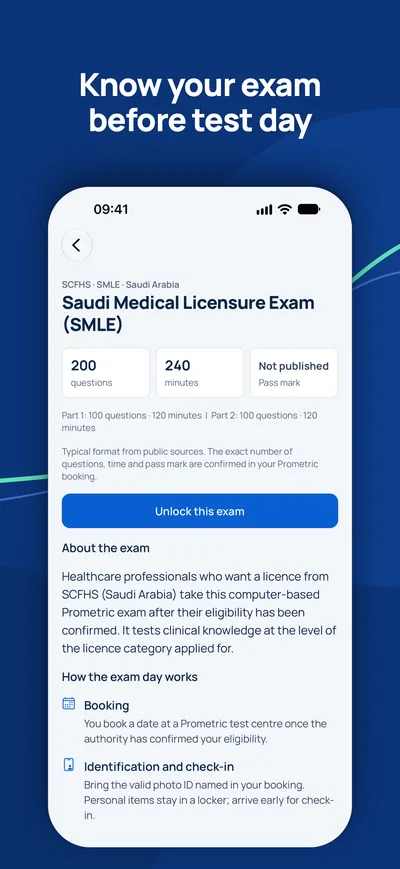
- SCFHS Orthodontics: no publicado preguntas, no publicado minutos, nota de aprobado no publicado
Growth & development
Lesson 1Principles of craniofacial growth: patterns, cartilages and theories
Orthodontists treat growing patients, so they must know how much growth is left, where it happens and in which direction. This chapter covers the basic rules first: how different tissues grow at different times, how bone actually gets bigger, and the main theories that try to explain what controls facial growth. Later chapters apply these rules to the maxilla, the mandible, timing of treatment and the dentition.
Two words are used constantly. Growth means an increase in size or number. Development means increasing complexity and maturity. A child can grow taller without much development, and a jaw can mature without getting much bigger. Exams often test growth pattern (the proportion and direction of growth over time) rather than absolute size.
Scammon's growth curves (1930) show that the body does not grow as one unit. Each tissue type follows its own curve, expressed as a percentage of adult size reached at each age. The curves explain why the skull is large in a baby and the face is small, and why the face catches up during adolescence.
| Tissue type (Scammon) | Curve shape | Practical meaning |
|---|---|---|
| Neural (brain, cranial vault, eyes) | Very early; about 90 % of adult size by age 6–7 | The cranial vault and anterior cranial base are almost finished in early childhood |
| Lymphoid (tonsils, adenoids, thymus) | Rises to about 200 % of adult size before puberty, then shrinks | Large adenoids in children are normal; they regress in adolescence |
| General / somatic (skeleton, muscles, jaws) | S-shaped: fast in infancy, slow in childhood, pubertal spurt, then stop | The jaws, especially the mandible, follow this curve and show a pubertal spurt |
| Genital | Almost flat until puberty, then steep rise | Marks sexual maturation; links to the timing of the facial spurt |
The face lies between the neural and general curves. The upper face, attached to the cranium, finishes earlier. The mandible, furthest from the brain, behaves most like the general skeleton and has the largest and latest pubertal spurt. This is the cephalocaudal gradient of growth: structures nearer the head mature earlier, those further away later.
There is also a dimensional gradient in the face. Width (transverse) is completed first, then length or depth (anteroposterior), and height (vertical) last. Intercanine and maxillary width are largely fixed before the adolescent spurt, while vertical growth of the face and alveolar processes continues into the late teens and, slowly, into adulthood. This order has direct clinical consequences: transverse problems should be corrected early, and vertical problems may relapse late.
How does bone grow? Bone cannot grow by expanding from inside (interstitial growth) because its matrix is mineralised. It grows only by adding bone on a surface (apposition) and removing it elsewhere (resorption). Cartilage, in contrast, can grow interstitially. Facial bones form either within membrane (intramembranous: cranial vault, maxilla, most of the mandible) or by replacing a cartilage model (endochondral: cranial base, limbs).
Three kinds of growth site matter in the face: sutures (fibrous joints between bones, such as the circummaxillary sutures), cartilages (cranial base synchondroses, nasal septum, mandibular condyle) and the periosteal and endosteal surfaces, where remodelling occurs.
A key distinction is between primary and secondary cartilage. Primary cartilage comes from the original cartilaginous skeleton of the embryo. Its chondrocytes divide in organised columns and it has its own intrinsic growth potential; when transplanted it keeps growing. Examples are the epiphyseal plates of long bones, the spheno-occipital synchondrosis and the nasal septal cartilage. Secondary cartilage develops later, from a periosteal-like layer, and grows adaptively in response to local function and mechanical environment. The mandibular condylar cartilage is the classic secondary cartilage. Its prechondroblasts lie in a fibrous covering, it grows by apposition rather than ordered interstitial columns, and it responds to mandibular posture and function. That is the biological reason why functional appliances were thought to be able to influence it, although the clinical effect on final mandibular length is modest.
| Feature | Primary cartilage | Secondary cartilage (condyle) |
|---|---|---|
| Origin | Embryonic cartilage skeleton | Arises secondarily from periosteal-like tissue |
| Growth control | Intrinsic, genetically driven | Adaptive, responds to function and environment |
| Cell arrangement | Columns, interstitial growth | Undifferentiated cells in a fibrous covering, appositional |
| Examples | Epiphyseal plates, spheno-occipital synchondrosis, nasal septum | Mandibular condyle |
The spheno-occipital synchondrosis is the most important growth site of the cranial base after early childhood. Growth here lengthens the posterior cranial base and carries the maxilla forward. It closes in late adolescence, roughly 13–15 years in girls and 15–17 years in boys. The other synchondroses close much earlier.
Enlow described two separate processes that together move a bone. Remodelling (cortical drift) is apposition on one surface and resorption on another, which changes the shape and size of a bone and moves its surfaces. Displacement (translation) is the movement of the whole bone away from its neighbours while it grows. Primary displacement is caused by the bone's own growth, for example the maxilla pushed forward as bone is added at its posterior sutures. Secondary displacement is caused by growth of a neighbouring structure, for example the maxilla carried forward by lengthening of the anterior cranial base.
Enlow's V principle describes how many facial bones grow. Picture a V-shaped region, such as the palate or the coronoid process. Bone is deposited on the inner surface and resorbed on the outer surface. The V therefore moves toward its wide end and enlarges at the same time.
Theories of growth control try to answer one question: what is the primary determinant? The genetic (bone) theory, associated with Sicher, saw all skeletal tissues, including sutures, as primary growth centres. This was disproved: sutures react to tension and do not drive growth themselves. Scott's cartilage theory gave the nasal septum and other cartilages the leading role; septal cartilage does appear to pace midface growth, and septal damage in animals reduces midface growth. Moss's functional matrix hypothesis states that bone growth is secondary. The soft tissues and spaces (functional matrices) grow and function, and the bones respond. Periosteal matrices, like muscles, act directly on bone by remodelling; capsular matrices, like the brain and the oronasopharyngeal space, move bones passively by displacement. Van Limborgh combined these ideas: intrinsic genetic factors, local epigenetic factors such as cartilage and muscle, and general environmental factors all play a part. Most clinicians use this multifactorial view.
Sources: Proffit WR, Fields HW, Larson BE, Sarver DM. Contemporary Orthodontics, 6th ed. Elsevier, 2019 (chapters 2 and 4). · Enlow DH, Hans MG. Essentials of Facial Growth, 2nd ed. Needham Press, 2008. · Moss ML. The functional matrix hypothesis revisited. Am J Orthod Dentofacial Orthop 1997;112:8–11, 221–226, 338–342, 410–417. · Scammon RE. The measurement of the body in childhood. In: Harris JA et al. The Measurement of Man. University of Minnesota Press, 1930.
Sobre el examen SCFHS Specialist Orthodontics
¿Cuántas preguntas tiene el examen SCFHS Specialist Orthodontics?+
SCFHS Orthodontics: no publicado preguntas, no publicado minutos, nota de aprobado no publicado. El número exacto de preguntas, el tiempo y la nota de aprobado se confirman en su reserva.
¿Qué temas tienen más peso?+
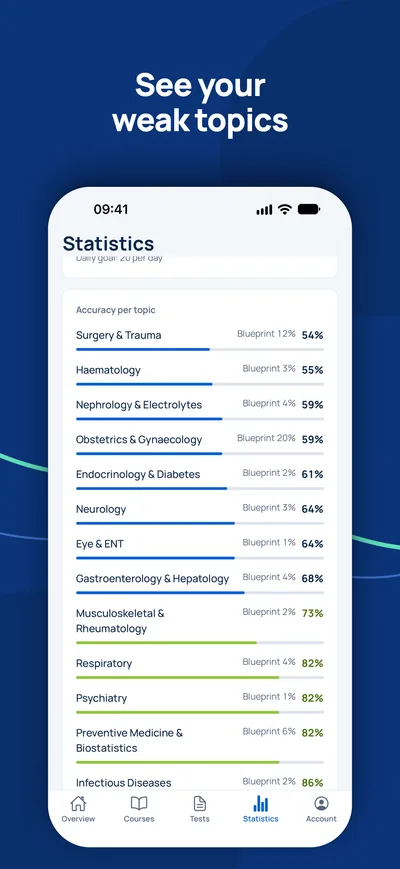
Los temas principales son Diagnosis (20 %), Biomechanics (20 %), Treatment (20 %). El curso abarca 6 temas con 30 capítulos en total.
¿Cómo me preparo para el examen SCFHS Specialist Orthodontics?+
Estudie los capítulos tema por tema, repase las notas clave y practique con simulacros cronometrados en el formato de su autoridad.
Preguntas
¿Cuánto dura el acceso?+
El acceso dura 90 días desde el pago para el país y la profesión elegidos.
¿Qué dispositivos puedo usar?+
Cualquier navegador en ordenador, tableta o móvil, y la app de MediFlow con la misma cuenta.
¿Puedo obtener un reembolso?+
Lea nuestra política de reembolso antes de comprar. Política de reembolso

iPhone · iPad
GCC Medical Exam Prep
Prepárese en su iPhone para DHA, DOH, MOHAP, SCFHS y otros exámenes de licencia del Golfo.

¿El examen es su único paso pendiente?
Compruebe primero si necesita el examen y qué título puede esperar. Un asesor responde sus preguntas gratis.
Verificación de elegibilidad- 1Consulta gratuita por vídeo, teléfono o WhatsApp
- 2Verificación de elegibilidad según los requisitos oficiales
- 3Su plan con precios fijos y próximos pasos claros