🇨🇭 MEBEKO · Switzerland
Swiss federal exam in dentistry (MCQ)
The Swiss federal exam in dentistry (MCQ): 150 questions in a fixed time, and a licence that depends on the result. MediFlow prepares you specifically for this exam: 297 practice questions across 13 topics, an explanation for every answer and timed mock exams in the real exam format.
- CHF 59 · 3 months of access · one payment · no subscription
- 297 practice questions
- 150 questions · 270 minutes

MediFlow Exam Prep
AIAI tutor explains every answer
297 practice questions
The challenge
The Swiss federal exam in dentistry (MCQ): 150 questions in a fixed time, and a licence that depends on the result.
- The exam covers every field of dentistry, from endodontics to oral surgery and practice law. Textbooks do not tell you what MEBEKO actually asks.
- 150 questions in 270 minutes leave about 108 seconds per question. Speed has to be trained, not hoped for.
- The question style is specific: clinical scenarios, best-answer choices and distractors that look right.
- Working full time leaves little room to plan revision, and a retake costs months of waiting and another exam fee.
How MediFlow solves it
- A question bank built on the published content of MEBEKO, organised by topic, so you know what matters.
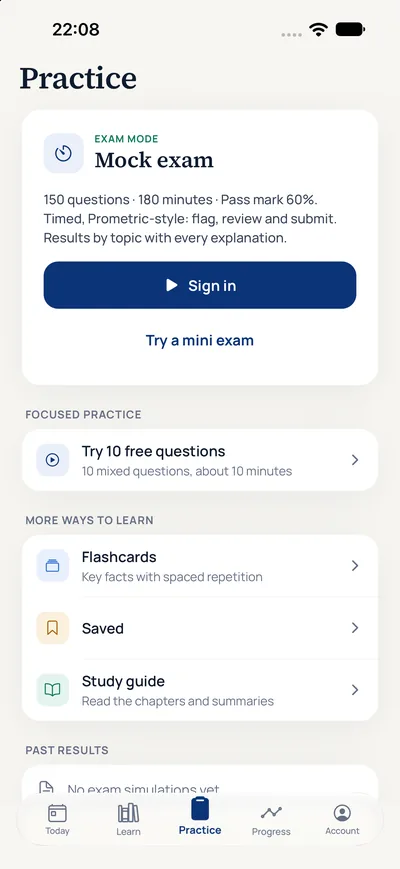
- Timed mock exams in the real exam format train your pace before the real day.
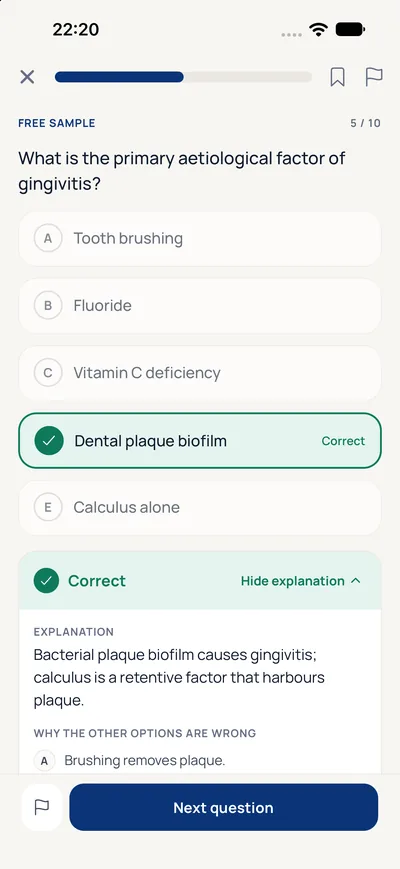
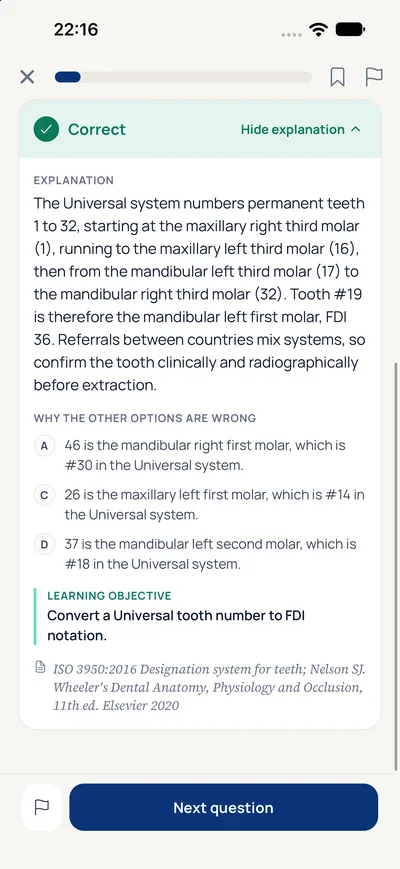
- Every answer is explained, including why the other options are wrong.
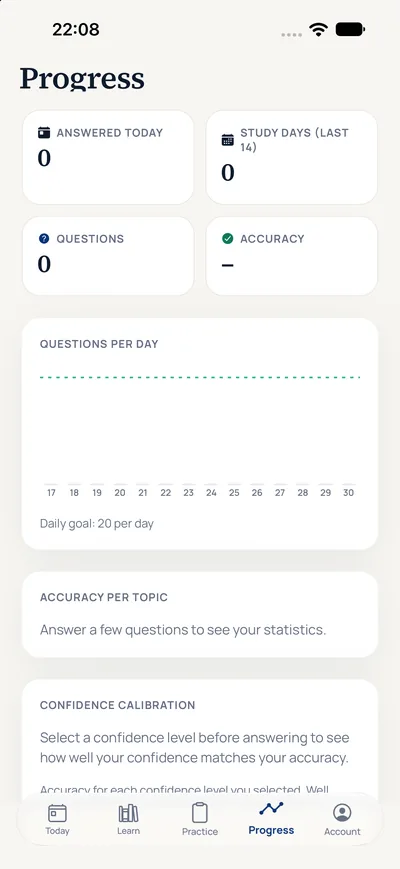
- A study plan up to your exam date tells you what to do each day and brings weak topics back for review.
Three steps to exam day
- 1
Try free questions and see the style of the exam.
- 2
Unlock the package and follow your study plan, topic by topic.
- 3
Take timed mock exams until your results are stable, then sit the exam.
What you can check
- 297 practice questions in 13 topics
- Question bank last updated on 30 October 2026
- Mock exams in the MEBEKO exam format
One package, one payment
CHF 59 for 3 months of access to this exam. One payment, no subscription, no automatic renewal. Web and app with one account.
Practice material only. MediFlow is independent of MEBEKO and cannot guarantee a result.
Exam at a glance
- Questions
- 150
- Duration
- 270 minutes
- Pass mark
- not published
- Sections
- One interdisciplinary MCQ exam: 150 items in 4.5 hours on tablets; type A (4 options, about two thirds) and Kprim; mostly case description and/or image · Blueprint: patient problems (pain, trauma, caries/erosion, growth, function, aesthetics, inflammation, other) × dental tasks (assessment, diagnosis/planning incl. emergencies, prevention, therapy, professionalism/law/radiation protection); children, elderly and special-needs patients at least 10 % each
- Exam type
- Written
- Language
- English
- Authority
- MEBEKO
Curriculum
Built from the question bank and updated automatically when new questions are added. 13 modules · 297 questions · Last updated: 30 October 2026
01Assessment: history, examination and imaging12 questions · 4 % of the bank
Chapters
- Grundlagen: Zahntypen, Milchzähne und bleibende Zähne
- Grundlagen: Innervation der Zähne und Leitungsanästhesie des N. alveolaris inferior
- Grundlagen: intraorale Röntgenaufnahmen und Panoramaschichtaufnahme
Sample question
Sample question1 / 1 · 0 correctEine Patientin gibt an, dass der Zahn 36 beim Kauen schmerzt. Welcher Zahn ist nach dem FDI-Schema gemeint?
Keys: 1–5 or A–E to choose, Enter to check and continue, F to mark.
02Aesthetics: restorative and prosthetic rehabilitation10 questions · 3.4 % of the bank
Chapters
- Grundlagen: Zahnflächen, Kavitätenklassen und minimalinvasives Vorgehen
- Grundlagen: direkte Füllungswerkstoffe
- Grundlagen: Brücken und stiftverankerte Kronen
- Grundlagen: Total- und Teilprothesen sowie Implantatkomponenten
Sample question
Sample question1 / 1 · 0 correctEine 28-jährige Patientin erhält an Zahn 21 eine Klasse-IV-Kompositrestauration. Welches Vorgehen bei der visuellen Farbbestimmung ist korrekt?
Keys: 1–5 or A–E to choose, Enter to check and continue, F to mark.
03Oral surgery and implantology12 questions · 4 % of the bank
Chapters
- Grundlagen: Extraktionszangen und retinierte Weisheitszähne
- Grundlagen: Ausbreitung odontogener Infektionen und Alveolitis sicca
- Grundlagen: Unterkieferfrakturen, Kiefergelenk und Mundschleimhautläsionen
- Grundlagen: Muster des Knochenabbaus an Zähnen und Implantaten
- Grundlagen: subgingivale Instrumentierung und Zugangslappenoperation
Sample question
Sample question1 / 1 · 0 correctBei einer 35-jährigen Patientin soll Zahn 46 extrahiert werden. Welche Anästhesietechnik ist im Unterkiefer-Seitenzahnbereich am ehesten ausreichend?
Keys: 1–5 or A–E to choose, Enter to check and continue, F to mark.
04Inflammation: periodontology, endodontics and oral mucosa20 questions · 6.7 % of the bank
Chapters
- Grundlagen: Anatomie von Zahn und Zahnhalteapparat
- Grundlagen: parodontale Gesundheit und Parodontitis
- Grundlagen: Karies, Pulpitis und apikale Erkrankungen
- Grundlagen: Wurzelkanalanatomie und Behandlungsprinzipien
Sample question
Sample question1 / 1 · 0 correctEine 24-jährige Patientin klagt über Zahnfleischbluten beim Zähneputzen. Klinisch zeigen sich gerötete, leicht geschwollene Papillen, reichlich Plaque und eine Blutung auf Sondierung an 45 % der Stellen. Die Sondierungstiefen betragen höchstens 3 mm, im Röntgenbild ist kein Knochenverlust erkennbar. Welche Diagnose ist am wahrscheinlichsten?
Keys: 1–5 or A–E to choose, Enter to check and continue, F to mark.
05Function: occlusion, TMJ and prosthodontics17 questions · 5.7 % of the bank
Chapters
- Grundlagen: Brücken und stiftverankerte Kronen
- Grundlagen: Total- und Teilprothesen sowie Implantatkomponenten
- Grundlagen: Angle-Klassifikation und kephalometrische Analyse
- Grundlagen: Zahnbewegung und kieferorthopädische Apparaturen
- Grundlagen: Gesichtswachstum und Retention
Sample question
Sample question1 / 1 · 0 correctWie bezeichnet man die Unterkieferposition, in der bei Zahnschluss die grösste Zahl an Okklusionskontakten besteht, unabhängig von der Lage der Kondylen?
Keys: 1–5 or A–E to choose, Enter to check and continue, F to mark.
06Caries and erosion: diagnosis and therapy18 questions · 6.1 % of the bank
Chapters
- Grundlagen: Zahnflächen, Kavitätenklassen und minimalinvasives Vorgehen
- Grundlagen: direkte Füllungswerkstoffe
- Grundlagen: Matrizenbänder und Kofferdam
07Diagnosis, treatment planning and emergencies50 questions · 16.8 % of the bank
Chapters
- Grundlagen: Zahntrauma und Pulpatherapie bei Kindern
- Grundlagen: Lückenhalter und Fissurenversiegelung
08Prevention and prophylaxis57 questions · 19.2 % of the bank
09Professionalism, law and radiation protection10 questions · 3.4 % of the bank
10Pain: odontogenic and orofacial pain15 questions · 5.1 % of the bank
Chapters
- Grundlagen: Karies, Pulpitis und apikale Erkrankungen
- Grundlagen: Wurzelkanalanatomie und Behandlungsprinzipien
- Grundlagen: Zahntypen, Milchzähne und bleibende Zähne
- Grundlagen: Innervation der Zähne und Leitungsanästhesie des N. alveolaris inferior
- Grundlagen: intraorale Röntgenaufnahmen und Panoramaschichtaufnahme
11Special patients: elderly, medically compromised and disabled50 questions · 16.8 % of the bank
12Trauma: dental injuries and jaw fractures12 questions · 4 % of the bank
Chapters
- Grundlagen: Zahntrauma und Pulpatherapie bei Kindern
- Grundlagen: Lückenhalter und Fissurenversiegelung
- Grundlagen: Extraktionszangen und retinierte Weisheitszähne
- Grundlagen: Ausbreitung odontogener Infektionen und Alveolitis sicca
- Grundlagen: Unterkieferfrakturen, Kiefergelenk und Mundschleimhautläsionen
13Growth and development: orthodontics and paediatric dentistry14 questions · 4.7 % of the bank
Chapters
- Grundlagen: Angle-Klassifikation und kephalometrische Analyse
- Grundlagen: Zahnbewegung und kieferorthopädische Apparaturen
- Grundlagen: Gesichtswachstum und Retention
- Grundlagen: Zahntrauma und Pulpatherapie bei Kindern
- Grundlagen: Lückenhalter und Fissurenversiegelung
Sample question
From the module Assessment: history, examination and imaging. Choose an answer to see the explanation.
Eine Patientin gibt an, dass der Zahn 36 beim Kauen schmerzt. Welcher Zahn ist nach dem FDI-Schema gemeint?
Keys: 1–5 or A–E to choose, Enter to check and continue, F to mark.
What you get
- Question bank with a detailed explanation for every answer
- Timed mock exams in the real exam format, with score report by topic
- Personal study plan up to your exam date and review of weak topics
- AI tutor that explains any question in plain words
- One account for the app (iPhone, iPad) and the browser
From registration to licence
The usual steps with MEBEKO. Details can change; check the current rules with MEBEKO before you register.
- Check eligibility and collect your documents (degree, experience, good standing).
- Create an account with MEBEKO and submit the application.
- Receive the exam eligibility and book a date with the test centre.
- Sit the exam. Results usually come within days.
- After passing: complete licensing (for example primary source verification) and receive your licence.
Frequently asked questions
How much does Swiss federal exam in dentistry (MCQ) preparation cost?
CHF 59 for 3 months of access to this exam. One payment, no subscription, no automatic renewal.
How long is my access?
Access runs for 90 days from purchase for this exam package.
Where can I buy it?
In the MediFlow Exam Prep app (App Store) or on mediflow.ae. Both unlock the same package for your MediFlow account.
Are these real exam questions?
No. MediFlow writes original questions based on the published exam content. We do not use recalled or leaked exam questions and we are not affiliated with MEBEKO.
Is the exam format up to date?
The format comes from the published information of MEBEKO. Check it with MEBEKO before your exam, as authorities can change it.
Ready to start
Begin with free questions or unlock the full package now.
MediFlow is an independent provider. We are not affiliated with any licensing authority or exam provider. Questions are written by MediFlow from published exam outlines; they are not questions from real exams. Always check the format with the authority before your exam.
One app for every exam
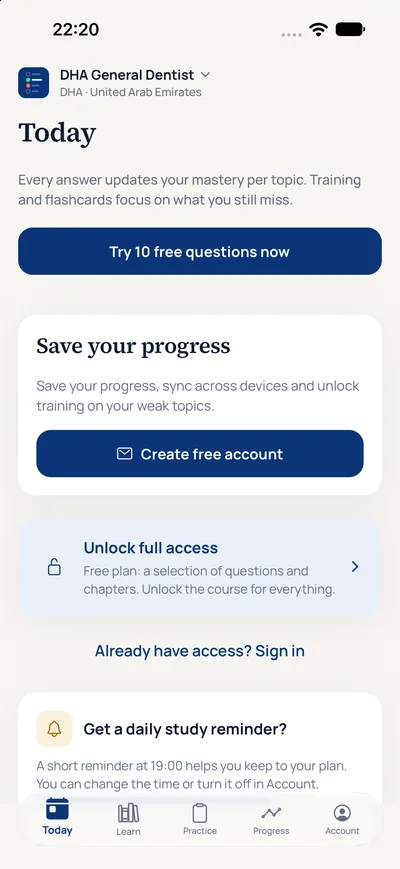
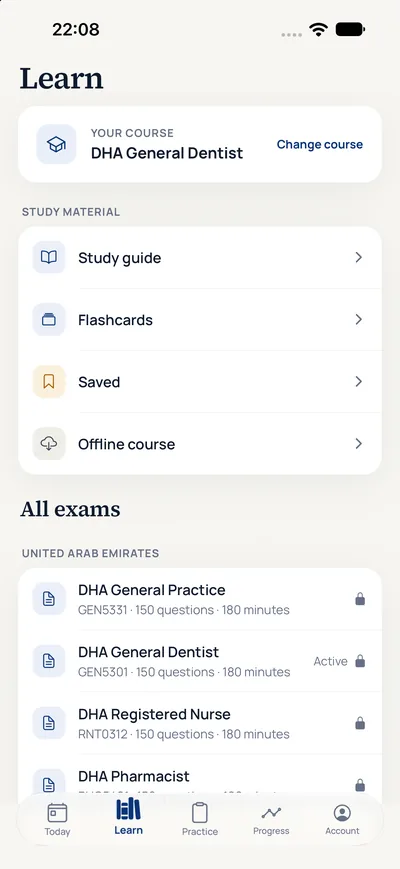
MediFlow Exam Prep on iPhone and iPad: choose your country, profession and exam. Practice questions with explanations, timed mock exams and a study plan. The same account works in the browser.