🇴🇲 OMSB · Oman
OMSB Exam for General Dentists (OEGD)
The OMSB Exam for General Dentists (OEGD): 100 questions, a pass mark of 65 %, and a licence that depends on it. MediFlow prepares you specifically for this exam: 2,682 practice questions across 20 topics, an explanation for every answer and timed mock exams in the real exam format.
- AED 199 · 3 months of access · one payment · no subscription
- 2,682 practice questions
- 100 questions · 150 minutes · pass mark 65 %

MediFlow Exam Prep
AIAI tutor explains every answer
2,682 practice questions
The challenge
The OMSB Exam for General Dentists (OEGD): 100 questions, a pass mark of 65 %, and a licence that depends on it.
- The exam covers every field of dentistry, from endodontics to oral surgery and practice law. Textbooks do not tell you what OMSB actually asks.
- 100 questions in 150 minutes leave about 90 seconds per question. Speed has to be trained, not hoped for.
- The question style is specific: clinical scenarios, best-answer choices and distractors that look right.
- Working full time leaves little room to plan revision, and a retake costs months of waiting and another exam fee.
How MediFlow solves it
- A question bank built on the published content of OMSB, organised by topic, so you know what matters.
- Timed mock exams in the real exam format train your pace before the real day.
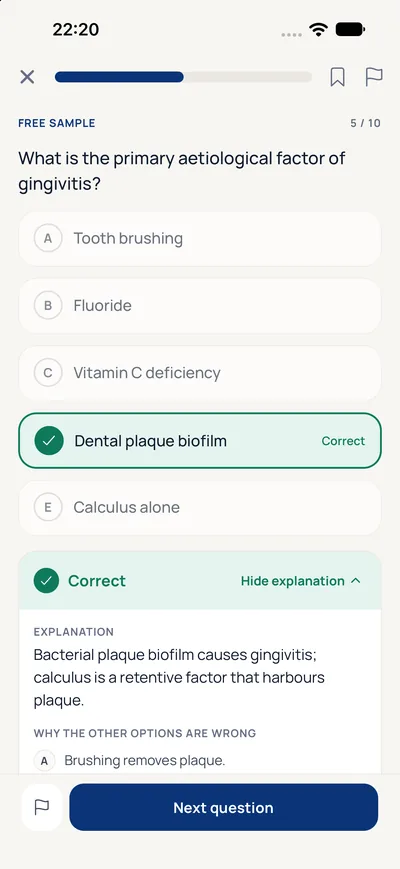
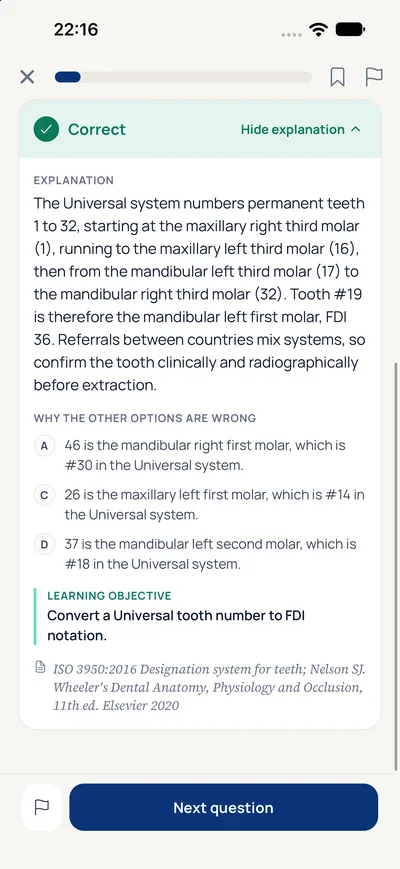
- Every answer is explained, including why the other options are wrong.
- A study plan up to your exam date tells you what to do each day and brings weak topics back for review.
Three steps to exam day
- 1
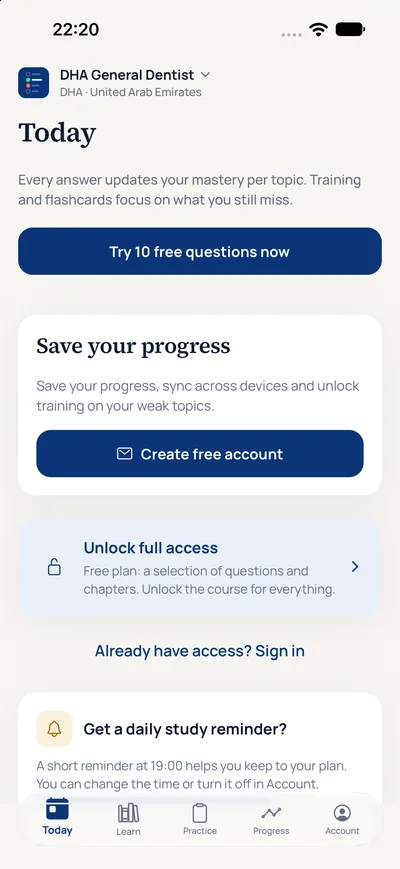
Try free questions and see the style of the exam.
- 2
Unlock the package and follow your study plan, topic by topic.
- 3
Take timed mock exams until your results are stable, then sit the exam.
What you can check
- 2,682 practice questions in 20 topics
- Question bank last updated on 29 October 2026
- Mock exams in the OMSB exam format
One package, one payment
AED 199 for 3 months of access to this exam. One payment, no subscription, no automatic renewal. Web and app with one account.
Practice material only. MediFlow is independent of OMSB and cannot guarantee a result.
Exam at a glance
- Questions
- 100
- Duration
- 150 minutes
- Pass mark
- 65 %
- Sections
- 1
- Exam type
- Written
- Language
- English
- Authority
- OMSB
Curriculum
Built from the question bank and updated automatically when new questions are added. 20 modules · 2,682 questions · Last updated: 29 October 2026
01Dental anatomy & occlusion100 questions · 3.7 % of the bank
Chapters
- Tooth notation, eruption and identifying teeth
- Root canal anatomy and developmental anomalies
- Occlusion, the TMJ and applied anatomy for local anaesthesia
- Foundations: tooth types, primary and permanent teeth
- Foundations: nerve supply of the teeth and the inferior alveolar nerve block
- Foundations: intraoral radiographs and the panoramic view
Sample question
Sample question1 / 1 · 0 correctA 34-year-old patient brings a referral letter from a clinic in the United States asking for extraction of tooth #19 (Universal system). Which FDI (ISO 3950) number is this tooth?
Keys: 1–5 or A–E to choose, Enter to check and continue, F to mark.
02Operative dentistry & cariology240 questions · 8.9 % of the bank
Chapters
- Caries as a disease: biofilm, critical pH and fluoride
- Detecting, classifying and managing lesions without drilling
- Instruments, isolation and the amalgam preparation
- Adhesion and resin composite placement
- Deep caries, the pulp, tooth wear and failing restorations
- Foundations: tooth surfaces, cavity classes and minimal intervention
- Foundations: direct restorative materials
- Foundations: matrix bands and rubber dam isolation
Sample question
Sample question1 / 1 · 0 correctBelow which approximate plaque-fluid pH (critical pH) does hydroxyapatite of sound enamel begin to dissolve under typical oral conditions?
Keys: 1–5 or A–E to choose, Enter to check and continue, F to mark.
03Dental materials128 questions · 4.8 % of the bank
Chapters
- Material properties: stress, strain, hardness and biocompatibility
- Impression materials and gypsum products
- Dental cements and resin composites
- Amalgam, casting alloys and investments
- Dental ceramics and denture base resins
Sample question
Sample question1 / 1 · 0 correctOn the stress–strain curve of a dental alloy, what does the area under the elastic portion of the curve, up to the proportional limit, represent?
Keys: 1–5 or A–E to choose, Enter to check and continue, F to mark.
04Endodontics301 questions · 11.2 % of the bank
Chapters
- Pulp and periapex: biology, pain and the diagnostic terminology
- Clinical examination: pulp tests, radiographs and finding the source of pain
- Root canal treatment step by step: anatomy, access, shaping, cleaning and obturation
- Vital pulp therapy, immature teeth, resorption and emergencies
- When treatment fails: retreatment, microsurgery, cracks and endo-perio lesions
- Dental trauma according to the IADT 2020 guidelines
- Foundations: caries, pulpitis and apical disease
- Foundations: root canal anatomy and treatment principles
- Foundations: access cavities, canal configurations and working length
- Foundations: obturation, root-end surgery and the cracked tooth
Sample question
Sample question1 / 1 · 0 correctA patient has spontaneous pain that lingers for minutes after a cold stimulus is removed. What is the most likely pulpal diagnosis?
Keys: 1–5 or A–E to choose, Enter to check and continue, F to mark.
05Periodontics262 questions · 9.8 % of the bank
Chapters
- The healthy periodontium: anatomy that explains the disease
- How periodontal disease develops: biofilm, host response and risk factors
- Periodontal examination and the 2017 AAP/EFP classification
- Treating periodontitis: the EFP S3 guideline step by step
- Periodontal surgery, acute conditions and peri-implant diseases
- Foundations: anatomy of the tooth and periodontium
- Foundations: periodontal health and periodontitis
- Foundations: patterns of bone loss around teeth and implants
- Foundations: subgingival instrumentation and access flap surgery
Sample question
Sample question1 / 1 · 0 correctWhat is the primary aetiological factor of gingivitis?
Keys: 1–5 or A–E to choose, Enter to check and continue, F to mark.
06Fixed prosthodontics128 questions · 4.8 % of the bank
Chapters
- Diagnosis and treatment planning: is this tooth a good abutment?
- Tooth preparation: retention, resistance, reduction and margins
- Root-filled teeth, provisional restorations and impressions
- Occlusion, jaw records and shade selection
- Materials and cementation: metal-ceramic, glass-ceramic and zirconia
- Fixed dental prosthesis design, pontics and complications
- Foundations: bridges and post-retained crowns
- Foundations: complete and partial dentures and implant components
07Removable prosthodontics & implants178 questions · 6.6 % of the bank
Chapters
- Partially edentulous arches: Kennedy classification and RPD components
- RPD design: surveying, clasps and distal-extension biomechanics
- Complete dentures I: anatomy, impressions and border problems
- Complete dentures II: jaw relations, tooth arrangement and delivery problems
- Maintaining dentures: relining, immediate dentures, overdentures and denture stomatitis
- Dental implants: osseointegration, planning, loading and peri-implant disease
- Foundations: bridges and post-retained crowns
- Foundations: complete and partial dentures and implant components
08Basic implantology140 questions · 5.2 % of the bank
Chapters
- Osseointegration, implant components and patient selection
- Assessment, CBCT planning and safe distances
- Timing, prosthetic options, peri-implant disease and complications
- Foundations: bridges and post-retained crowns
- Foundations: complete and partial dentures and implant components
09Oral surgery & local anaesthesia213 questions · 7.9 % of the bank
Chapters
- Local anaesthetics: how they work, the drugs, vasoconstrictors and dose calculation
- Injection techniques, failed anaesthesia and complications of local anaesthesia
- Exodontia: instruments, flaps, sutures and complications during and after extraction
- Impacted third molars: classification, indications, surgery and nerve injury
- Odontogenic infections and maxillofacial fractures
- The medically compromised surgical patient and the biopsy: antithrombotics, MRONJ and suspicious lesions
- Foundations: extraction forceps and impacted third molars
- Foundations: spread of odontogenic infection and dry socket
- Foundations: mandibular fractures, the TMJ and oral mucosal lesions
10Oral medicine68 questions · 2.5 % of the bank
Chapters
- Oral ulcers and blistering diseases
- White and red lesions, candidiasis and potentially malignant disorders
- Dry mouth, salivary disease and oral signs of systemic disease
- Orofacial pain and temporomandibular disorders
- The medically compromised patient: bleeding, bone-modifying drugs, radiotherapy, pregnancy and emergencies
11Oral pathology48 questions · 1.8 % of the bank
Chapters
- Odontogenic and non-odontogenic jaw cysts (WHO 2022)
- Odontogenic tumours: WHO 2022 classification and key entities
- Fibro-osseous, giant cell and other bone lesions of the jaws
- Salivary gland pathology
- Oral squamous cell carcinoma and its variants
- Developmental and inherited anomalies of the teeth
12Oral & maxillofacial radiology48 questions · 1.8 % of the bank
Chapters
- How an X-ray image is made: the tube, the beam and what the exposure settings do
- Radiation biology, radiation protection and choosing which radiographs to take
- Intraoral radiography: techniques, receptors, processing and error analysis
- Panoramic radiography and CBCT: how they work, positioning errors and artefacts
- Reading radiographs: normal anatomy, a systematic approach and periapical findings
- Cysts, tumours and warning signs: interpreting jaw lesions
- Foundations: tooth types, primary and permanent teeth
- Foundations: nerve supply of the teeth and the inferior alveolar nerve block
- Foundations: intraoral radiographs and the panoramic view
13Dental pharmacology & therapeutics98 questions · 3.7 % of the bank
Chapters
- Analgesics for dental pain: NSAIDs, paracetamol and opioids
- Local anaesthetics and vasoconstrictors
- Antimicrobials: antibiotics, antifungals, antivirals and antiseptics
- Endocarditis prophylaxis, prosthetic joints, anticoagulants and antiplatelets
- Drug interactions, oral adverse effects, MRONJ, pregnancy and breastfeeding
- Conscious sedation: nitrous oxide and benzodiazepines
14Medical emergencies in the dental office98 questions · 3.7 % of the bank
Chapters
- Prevention, preparedness and the collapsed patient
- Anaphylaxis and acute asthma
- Chest pain, acute coronary syndrome and stroke
- Cardiac arrest, basic life support, the AED, choking and aspiration
- Hypoglycaemia, seizures, adrenal crisis, local anaesthetic toxicity and hyperventilation
15Special care & medically compromised patients90 questions · 3.4 % of the bank
Chapters
- Bleeding risk: anticoagulants, antiplatelets and bleeding disorders
- Endocarditis, antiresorptive drugs and head and neck radiotherapy
- Diabetes, pregnancy, steroids and patients who need adapted care
16Paediatric dentistry128 questions · 4.8 % of the bank
Chapters
- Growth, eruption and the special anatomy of primary teeth
- Behaviour guidance, sedation and local anaesthesia in children
- Early childhood caries, risk assessment and prevention with fluoride and sealants
- Restoring primary teeth and treating the primary pulp
- Space maintenance and dental trauma in children (IADT 2020)
- Child protection and children with medical or special needs
- Foundations: dental trauma and pulp therapy in children
- Foundations: space maintainers and fissure sealants
17Orthodontics98 questions · 3.7 % of the bank
Chapters
- Craniofacial growth: where, how and when the face grows
- Development of the occlusion and the mixed dentition
- Diagnosis: classification, cephalometrics and treatment need (IOTN)
- Interceptive orthodontics: habits, crossbites, crowding, canines, clefts and early Class III
- Tooth movement, appliances, anchorage, risks and retention
- Foundations: Angle classification and cephalometric analysis
- Foundations: tooth movement and orthodontic appliances
- Foundations: facial growth and retention
18Infection control & occupational safety48 questions · 1.8 % of the bank
Chapters
- How infections spread in the dental clinic, and standard precautions
- Instrument reprocessing: the Spaulding classification and sterilisation methods
- Proving sterility, protecting packs, and cleaning surfaces
- Water, air and waste: dental unit waterlines, aerosols, mercury and clinical waste
- Sharps injuries and post-exposure management: hepatitis B, hepatitis C and HIV
- Occupational health: gloves and skin, ergonomics, noise and radiation protection
19Biomedical sciences for dentistry100 questions · 3.7 % of the bank
Chapters
- Head and neck anatomy: nerves, glands, spaces and lymph
- Oral tissues, physiology and general pathology
- Microbiology, immunology, pharmacology and evidence-based dentistry
20Ethics, law & community dentistry168 questions · 6.3 % of the bank
Chapters
- Ethical principles and professional conduct
- Consent, capacity, minors and refusal
- Confidentiality, records, negligence and safeguarding
- Measuring oral disease: caries, periodontal, hygiene and fluorosis indices
- Epidemiology and biostatistics for dentists
- Prevention and public health dentistry: levels of prevention, fluorides and community programmes
Sample question
From the module Dental anatomy & occlusion. Choose an answer to see the explanation.
A 34-year-old patient brings a referral letter from a clinic in the United States asking for extraction of tooth #19 (Universal system). Which FDI (ISO 3950) number is this tooth?
Keys: 1–5 or A–E to choose, Enter to check and continue, F to mark.
What you get
- Question bank with a detailed explanation for every answer
- Timed mock exams in the real exam format, with score report by topic
- Personal study plan up to your exam date and review of weak topics
- AI tutor that explains any question in plain words
- One account for the app (iPhone, iPad) and the browser
From registration to licence
The usual steps with OMSB. Details can change; check the current rules with OMSB before you register.
- Check eligibility and collect your documents (degree, experience, good standing).
- Create an account with OMSB and submit the application.
- Receive the exam eligibility and book a date with the test centre.
- Sit the exam. Results usually come within days.
- After passing: complete licensing (for example primary source verification) and receive your licence.
Frequently asked questions
How much does OMSB Exam for General Dentists (OEGD) preparation cost?
AED 199 for 3 months of access to this exam. One payment, no subscription, no automatic renewal.
How long is my access?
Access runs for 90 days from purchase for this exam package.
Where can I buy it?
In the MediFlow Exam Prep app (App Store) or on mediflow.ae. Both unlock the same package for your MediFlow account.
Are these real exam questions?
No. MediFlow writes original questions based on the published exam content. We do not use recalled or leaked exam questions and we are not affiliated with OMSB.
Is the exam format up to date?
The format comes from the published information of OMSB. Check it with OMSB before your exam, as authorities can change it.
Ready to start
Begin with free questions or unlock the full package now.
MediFlow is an independent provider. We are not affiliated with any licensing authority or exam provider. Questions are written by MediFlow from published exam outlines; they are not questions from real exams. Always check the format with the authority before your exam.
One app for every exam
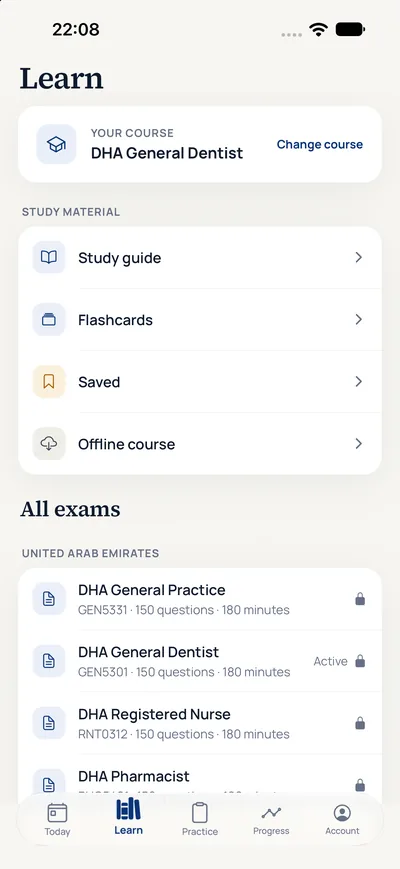
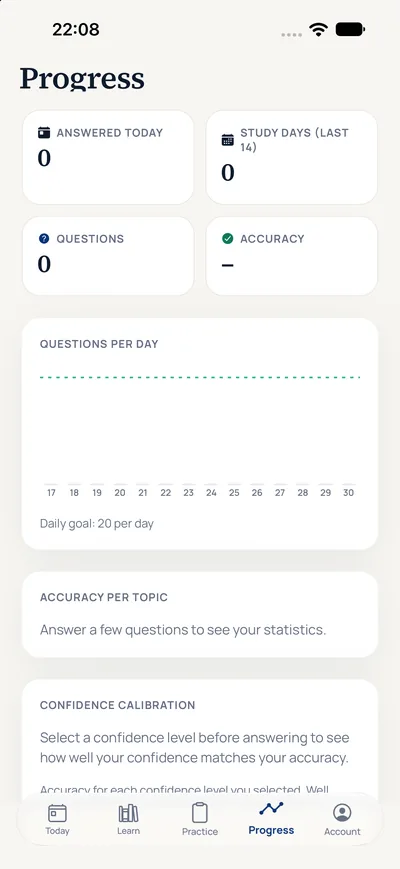
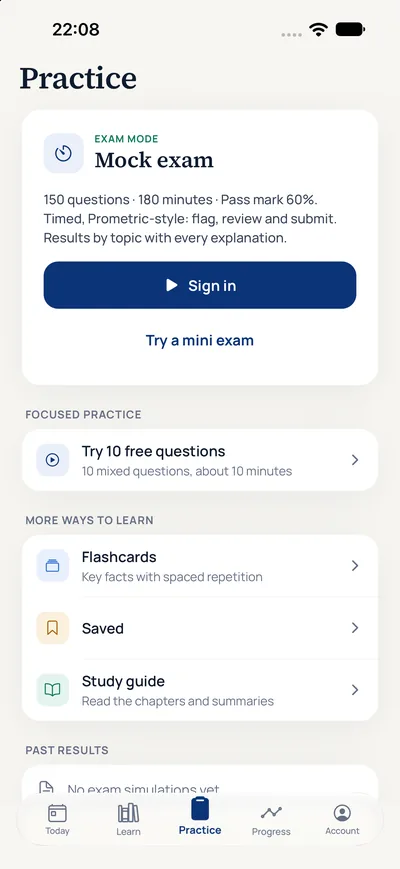
MediFlow Exam Prep on iPhone and iPad: choose your country, profession and exam. Practice questions with explanations, timed mock exams and a study plan. The same account works in the browser.