🇴🇲 OMSB · Oman
OMSB Exam for Pharmacists (OEP)
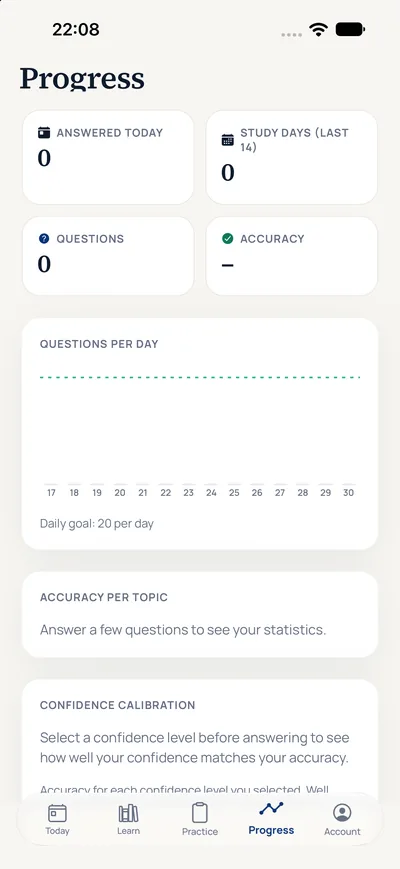
The OMSB Exam for Pharmacists (OEP): 100 questions, a pass mark of 60 %, and a licence that depends on it. MediFlow prepares you specifically for this exam: 2,258 practice questions across 16 topics, an explanation for every answer and timed mock exams in the real exam format.
- AED 199 · 3 months of access · one payment · no subscription
- 2,258 practice questions
- 100 questions · 150 minutes · pass mark 60 %
MediFlow Exam Prep
AIAI tutor explains every answer
2,258 practice questions
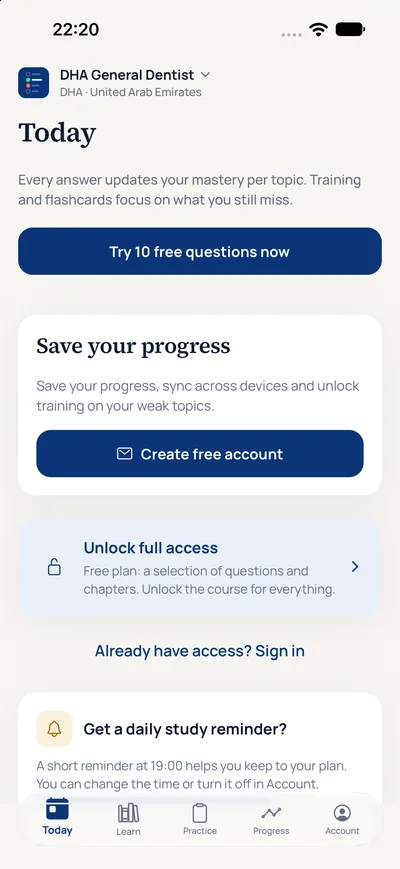
The challenge
The OMSB Exam for Pharmacists (OEP): 100 questions, a pass mark of 60 %, and a licence that depends on it.
- The exam covers pharmacology, calculations, dispensing and pharmacy law. Textbooks do not tell you what OMSB actually asks.
- 100 questions in 150 minutes leave about 90 seconds per question. Speed has to be trained, not hoped for.
- The question style is specific: clinical scenarios, best-answer choices and distractors that look right.
- Working full time leaves little room to plan revision, and a retake costs months of waiting and another exam fee.
How MediFlow solves it
- A question bank built on the published content of OMSB, organised by topic, so you know what matters.
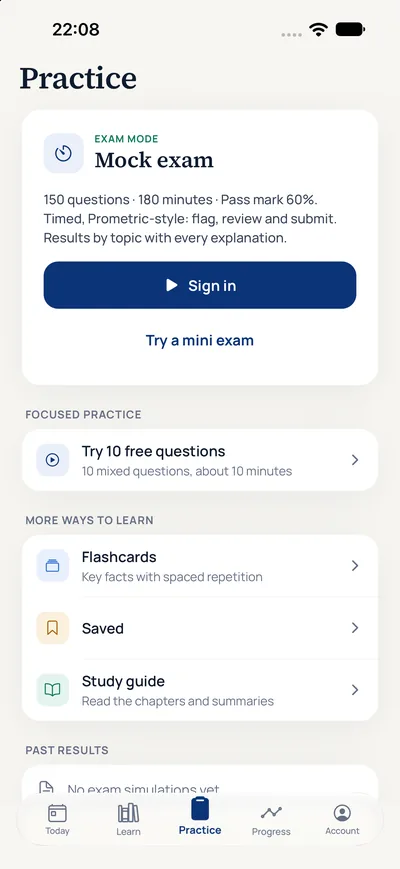
- Timed mock exams in the real exam format train your pace before the real day.
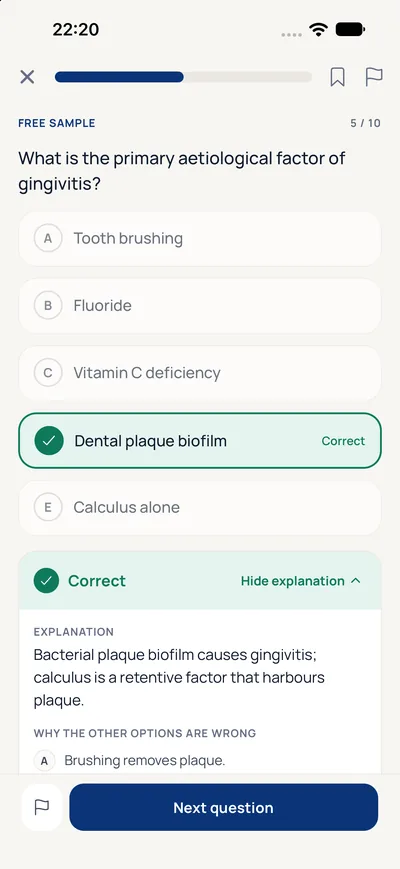
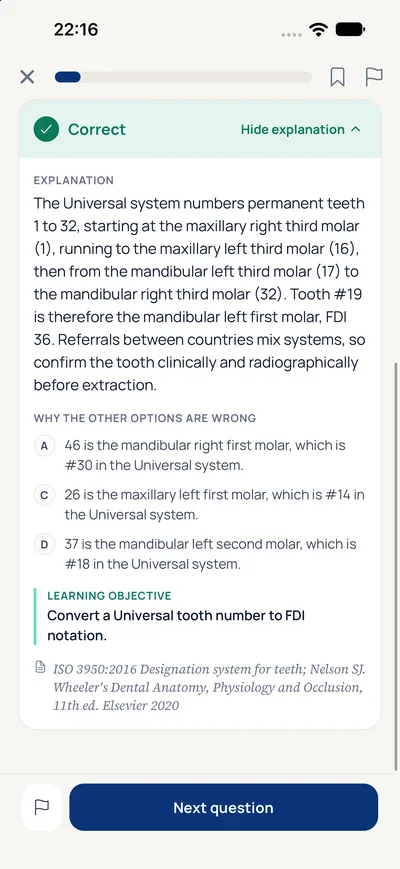
- Every answer is explained, including why the other options are wrong.
- A study plan up to your exam date tells you what to do each day and brings weak topics back for review.
Three steps to exam day
- 1
Try free questions and see the style of the exam.
- 2
Unlock the package and follow your study plan, topic by topic.
- 3
Take timed mock exams until your results are stable, then sit the exam.
What you can check
- 2,258 practice questions in 16 topics
- Question bank last updated on 29 October 2026
- Mock exams in the OMSB exam format
One package, one payment
AED 199 for 3 months of access to this exam. One payment, no subscription, no automatic renewal. Web and app with one account.
Practice material only. MediFlow is independent of OMSB and cannot guarantee a result.
Exam at a glance
- Questions
- 100
- Duration
- 150 minutes
- Pass mark
- 60 %
- Sections
- 1
- Exam type
- Written
- Language
- English
- Authority
- OMSB
Curriculum
Built from the question bank and updated automatically when new questions are added. 16 modules · 2,258 questions · Last updated: 29 October 2026
01Biomedical sciences100 questions · 4.4 % of the bank
Chapters
- Renal, cardiac and autonomic physiology for pharmacists
- Endocrine axes, gut physiology and the biochemistry behind drug action
- Microbiology and immunology that guide drug choice
- Foundations: anatomy of the respiratory tract
- Foundations: alveoli and gas exchange
- Foundations: mechanics and control of breathing
- Foundations: dosage forms and inhaler technique
- Foundations: the concentration–time curve and receptor types
Sample question
Sample question1 / 1 · 0 correctA 58-year-old man starts empagliflozin for type 2 diabetes and heart failure. He asks where in the kidney the drug works. Which site and transporter does it mainly inhibit?
Keys: 1–5 or A–E to choose, Enter to check and continue, F to mark.
02Medicinal chemistry100 questions · 4.4 % of the bank
Chapters
- Functional groups, stability and acid-base behaviour
- Stereochemistry and prodrugs in practice
- Structure-activity relationships, metabolism and drug design
Sample question
Sample question1 / 1 · 0 correctA mother asks why the amoxicillin suspension made up for her son expires about 2 weeks after reconstitution, although the dry powder lasts for years. What is the chemical reason?
Keys: 1–5 or A–E to choose, Enter to check and continue, F to mark.
03Pharmacokinetics135 questions · 6 % of the bank
Chapters
- Core pharmacokinetic parameters: Vd, clearance, half-life and bioavailability
- Dosing calculations: loading dose, maintenance dose, steady state and decay
- Therapeutic drug monitoring: aminoglycosides, vancomycin, digoxin, lithium, phenytoin, theophylline
- Special populations: renal and hepatic impairment, obesity, older people and bioequivalence
- Foundations: pharmacokinetics – what the body does to the drug
- Foundations: pharmacodynamics – what the drug does to the body
- Foundations: dosage forms and inhaler technique
- Foundations: the concentration–time curve and receptor types
Sample question
Sample question1 / 1 · 0 correctA drug has a half-life of 6 hours and is given regularly. After approximately how long will steady state be reached?
Keys: 1–5 or A–E to choose, Enter to check and continue, F to mark.
04Pharmaceutics & compounding178 questions · 7.9 % of the bank
Chapters
- Dosage forms, bioavailability and what not to crush
- Suspensions, emulsions and tablet excipients
- Stability, storage and packaging
- Sterile and hazardous compounding (USP 797 and 800)
- Non-sterile compounding and suppositories
- Foundations: dosage forms and inhaler technique
- Foundations: the concentration–time curve and receptor types
Sample question
Sample question1 / 1 · 0 correctDuring development, a new oral drug shows high aqueous solubility across pH 1.2–6.8 but low intestinal permeability. In which class of the Biopharmaceutics Classification System does it belong?
Keys: 1–5 or A–E to choose, Enter to check and continue, F to mark.
05Pharmaceutical calculations228 questions · 10.1 % of the bank
Chapters
- Units, percentages, ratios and dilutions
- Moles, milliequivalents, osmolarity and isotonicity
- Infusion rates and reconstitution
- Dosing by body size, kidney function and age
- Nutrition, supply quantities and safety checks
Sample question
Sample question1 / 1 · 0 correctA 45-year-old man needs a digital nerve block. The doctor draws up 5 mL of plain lidocaine 2% w/v. How many milligrams of lidocaine are in the syringe?
Keys: 1–5 or A–E to choose, Enter to check and continue, F to mark.
06Drug interactions & adverse effects102 questions · 4.5 % of the bank
Chapters
- How drug interactions happen: CYP enzymes, transporters and absorption
- High-risk interaction pairs every pharmacist must know
- Pharmacodynamic interactions: QT prolongation, serotonin syndrome and hypertensive crisis
- Adverse drug reactions: classification, causality assessment and reporting
07Anti-infectives129 questions · 5.7 % of the bank
Chapters
- Antibacterial basics: mechanisms, spectrum and beta-lactam allergy
- Common infections: urinary tract, pneumonia, MRSA and C. difficile
- Antifungals, tuberculosis and antimalarials
- Antivirals: influenza, herpes viruses, HIV and hepatitis B and C
- Foundations: bacteria, the Gram stain and antibiotic targets
- Foundations: infection prevention and antimicrobial stewardship
08Cardiovascular pharmacotherapy128 questions · 5.7 % of the bank
Chapters
- Hypertension and lipid-lowering therapy
- Heart failure with reduced ejection fraction
- Atrial fibrillation, antiarrhythmics and digoxin
- Anticoagulants, reversal, HIT and acute coronary syndromes
- Foundations: anatomy of the heart
- Foundations: conduction system and cardiac cycle
- Foundations: circulation and blood vessels
09CNS & pain pharmacotherapy108 questions · 4.8 % of the bank
Chapters
- Depression and antidepressants
- Antipsychotics, lithium and bipolar disorder
- Epilepsy, status epilepticus and Parkinson's disease
- Pain, opioids, migraine, ADHD and smoking cessation
10Endocrine & respiratory pharmacotherapy128 questions · 5.7 % of the bank
Chapters
- Type 2 diabetes: non-insulin drugs and organ protection
- Insulin, Ramadan fasting and the perioperative period
- Thyroid disease: levothyroxine and antithyroid drugs
- Corticosteroids, bone health and women's hormones
- Asthma, COPD and inhaler technique
- Foundations: endocrine glands and feedback control
- Foundations: the thyroid in the neck and endocrine emergencies
11Therapeutics & special populations200 questions · 8.9 % of the bank
Chapters
- Respiratory and gastrointestinal therapeutics
- Kidney, joints, pain, cancer support and drug monitoring
- Special populations
12Clinical pharmacy & OTC counselling228 questions · 10.1 % of the bank
Chapters
- The OTC consultation and respiratory symptoms
- Diarrhoea, constipation and dyspepsia
- Pain, headache, red eye and scabies
- Pregnancy, breastfeeding and children
- Smoking cessation, interactions and drug information
13Toxicology & antidotes80 questions · 3.5 % of the bank
Chapters
- Risk assessment, toxidromes and decontamination
- Antidotes, enhanced elimination and envenomation
14Pharmacognosy & supplements70 questions · 3.1 % of the bank
Chapters
- Plant-derived medicines and herbal interactions
- Supplements, product quality and counselling
15Pharmacy practice, law & ethics224 questions · 9.9 % of the bank
Chapters
- Prescriptions, forgery and controlled drugs
- Medication errors: response, classification and just culture
- Preventing errors: high-alert medicines and safe systems
- Pharmacovigilance and adverse drug reactions
- Ethics, confidentiality, counselling and substitution
16Biostatistics, pharmacoeconomics & practice management120 questions · 5.3 % of the bank
Chapters
- Study designs, bias and choosing a statistical test
- Effect measures, significance and critical appraisal
- Pharmacoeconomics, pharmacovigilance and practice management
Sample question
From the module Biomedical sciences. Choose an answer to see the explanation.
A 58-year-old man starts empagliflozin for type 2 diabetes and heart failure. He asks where in the kidney the drug works. Which site and transporter does it mainly inhibit?
Keys: 1–5 or A–E to choose, Enter to check and continue, F to mark.
What you get
- Question bank with a detailed explanation for every answer
- Timed mock exams in the real exam format, with score report by topic
- Personal study plan up to your exam date and review of weak topics
- AI tutor that explains any question in plain words
- One account for the app (iPhone, iPad) and the browser
From registration to licence
The usual steps with OMSB. Details can change; check the current rules with OMSB before you register.
- Check eligibility and collect your documents (degree, experience, good standing).
- Create an account with OMSB and submit the application.
- Receive the exam eligibility and book a date with the test centre.
- Sit the exam. Results usually come within days.
- After passing: complete licensing (for example primary source verification) and receive your licence.
Frequently asked questions
How much does OMSB Exam for Pharmacists (OEP) preparation cost?
AED 199 for 3 months of access to this exam. One payment, no subscription, no automatic renewal.
How long is my access?
Access runs for 90 days from purchase for this exam package.
Where can I buy it?
In the MediFlow Exam Prep app (App Store) or on mediflow.ae. Both unlock the same package for your MediFlow account.
Are these real exam questions?
No. MediFlow writes original questions based on the published exam content. We do not use recalled or leaked exam questions and we are not affiliated with OMSB.
Is the exam format up to date?
The format comes from the published information of OMSB. Check it with OMSB before your exam, as authorities can change it.
Ready to start
Begin with free questions or unlock the full package now.
MediFlow is an independent provider. We are not affiliated with any licensing authority or exam provider. Questions are written by MediFlow from published exam outlines; they are not questions from real exams. Always check the format with the authority before your exam.
One app for every exam
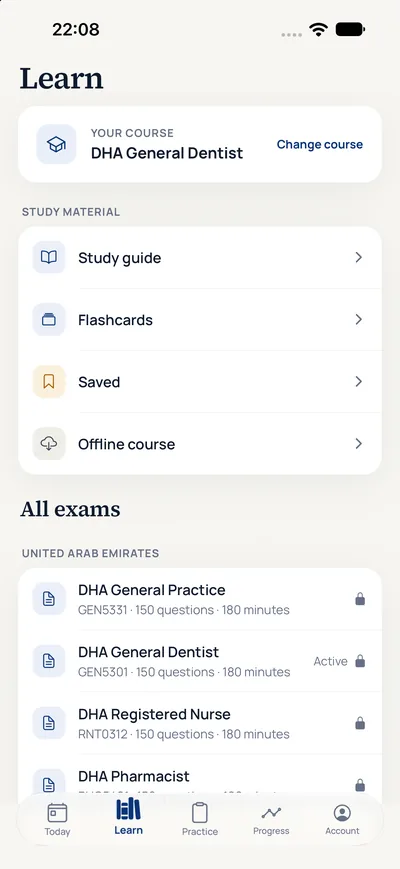
MediFlow Exam Prep on iPhone and iPad: choose your country, profession and exam. Practice questions with explanations, timed mock exams and a study plan. The same account works in the browser.