🇨🇭 MEBEKO · Switzerland
Swiss federal exam in human medicine with a non-EU/EFTA diploma (MEBEKO admission)
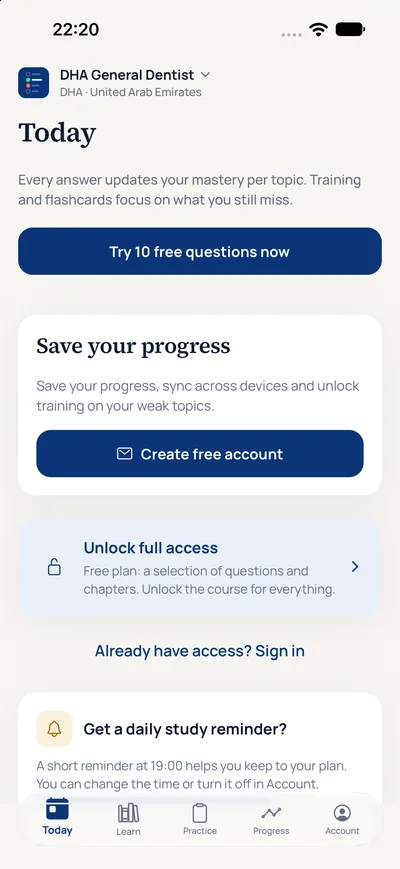
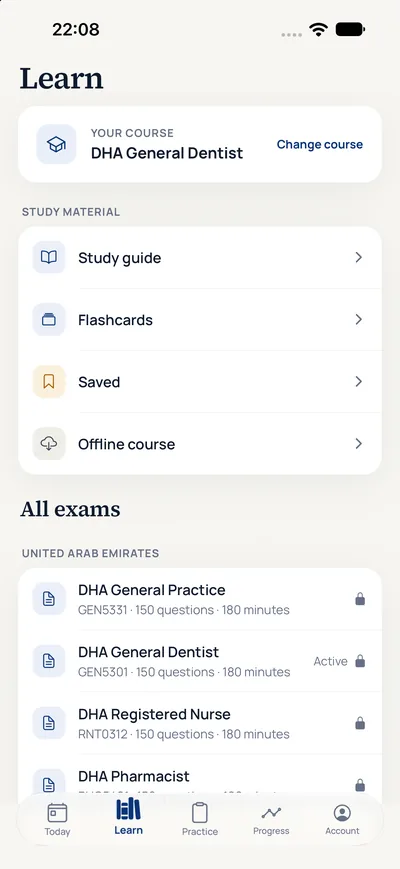
The Swiss federal exam in human medicine with a non-EU/EFTA diploma (MEBEKO admission): 240 questions in a fixed time, and a licence that depends on the result. MediFlow prepares you specifically for this exam: 300 practice questions across 14 topics, an explanation for every answer and timed mock exams in the real exam format.
- CHF 79 · 3 months of access · one payment · no subscription
- 300 practice questions
- 240 questions · 390 minutes

MediFlow Exam Prep
AIAI tutor explains every answer
300 practice questions
The challenge
The Swiss federal exam in human medicine with a non-EU/EFTA diploma (MEBEKO admission): 240 questions in a fixed time, and a licence that depends on the result.
- The exam covers the whole breadth of clinical medicine, from emergencies to rare diagnoses. Textbooks do not tell you what MEBEKO actually asks.
- 240 questions in 390 minutes leave about 98 seconds per question. Speed has to be trained, not hoped for.
- The question style is specific: clinical scenarios, best-answer choices and distractors that look right.
- Working full time leaves little room to plan revision, and a retake costs months of waiting and another exam fee.
How MediFlow solves it
- A question bank built on the published content of MEBEKO, organised by topic, so you know what matters.
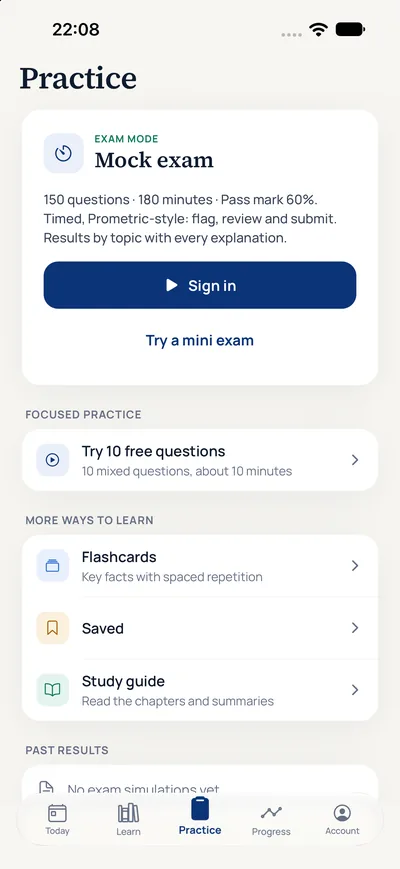
- Timed mock exams in the real exam format train your pace before the real day.
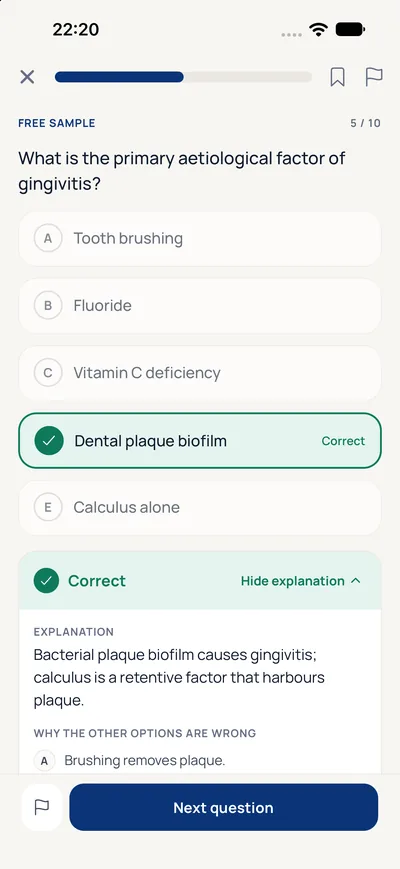
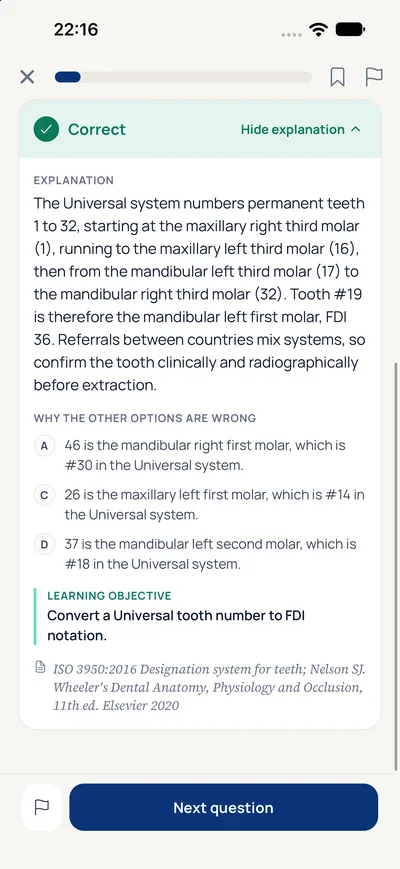
- Every answer is explained, including why the other options are wrong.
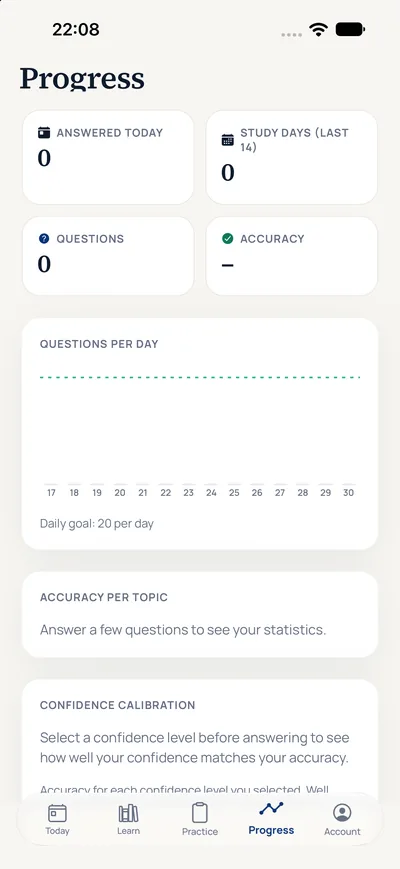
- A study plan up to your exam date tells you what to do each day and brings weak topics back for review.
Three steps to exam day
- 1
Try free questions and see the style of the exam.
- 2
Unlock the package and follow your study plan, topic by topic.
- 3
Take timed mock exams until your results are stable, then sit the exam.
What you can check
- 300 practice questions in 14 topics
- Question bank last updated on 30 October 2026
- Mock exams in the MEBEKO exam format
One package, one payment
CHF 79 for 3 months of access to this exam. One payment, no subscription, no automatic renewal. Web and app with one account.
Practice material only. MediFlow is independent of MEBEKO and cannot guarantee a result.
Exam at a glance
- Questions
- 240
- Duration
- 390 minutes
- Pass mark
- not published
- Sections
- Teilprüfung 1: 120 · 195 min / Teilprüfung 2: 120 · 195 min
- Exam type
- Written
- Language
- English
- Authority
- MEBEKO
Curriculum
Built from the question bank and updated automatically when new questions are added. 14 modules · 300 questions · Last updated: 30 October 2026
01Surgery, trauma and musculoskeletal24 questions · 8 % of the bank
Chapters
- Grundlagen: Bauchanatomie und akutes Abdomen
- Grundlagen: Hernien und Gallenwege
- Grundlagen: Wundheilung und perioperative Grundlagen
- Grundlagen: Skelett, Wirbelsäule und Becken
- Grundlagen: Schulter, Handgelenk und Hand
- Grundlagen: hüftnahe Femurfrakturen, Knie- und Sprunggelenkbänder
Sample question
Sample question1 / 1 · 0 correctEin 59-jähriger Mann, der seit Jahren regelmässig Ibuprofen wegen Rückenschmerzen einnimmt, kommt mit plötzlich einsetzenden stärksten Oberbauchschmerzen. Das Abdomen ist bretthart gespannt, Puls 112/min, Blutdruck 105/65 mmHg. Im Röntgen Thorax im Stehen zeigt sich freie Luft subdiaphragmal. Was ist am wahrscheinlichsten und welches Vorgehen ist indiziert?
Keys: 1–5 or A–E to choose, Enter to check and continue, F to mark.
02Endocrinology and metabolism24 questions · 8 % of the bank
Chapters
- Grundlagen: endokrine Drüsen und Rückkopplungsregelung
- Grundlagen: die Schilddrüse am Hals und endokrine Notfälle
Sample question
Sample question1 / 1 · 0 correctEine 38-jährige Frau ohne Symptome hat bei einer Routinekontrolle ein TSH von 6,8 mIU/l bei normalem fT4. Eine Schwangerschaft ist nicht geplant, eine Schilddrüsenerkrankung ist nicht bekannt. Welches Vorgehen ist am ehesten angezeigt?
Keys: 1–5 or A–E to choose, Enter to check and continue, F to mark.
03Gastroenterology and hepatology24 questions · 8 % of the bank
Chapters
- Grundlagen: Verdauungstrakt, Verdauung und Resorption
- Grundlagen: peptische Ulkuskrankheit und obere gastrointestinale Blutung
Sample question
Sample question1 / 1 · 0 correctEin 45-jähriger Mann ohne Alarmsymptome klagt über nüchtern und nachts auftretende epigastrische Schmerzen, die nach dem Essen nachlassen. Der Stuhlantigentest auf Helicobacter pylori ist positiv. Welches Vorgehen ist am ehesten angezeigt?
Keys: 1–5 or A–E to choose, Enter to check and continue, F to mark.
04Obstetrics and gynaecology21 questions · 7 % of the bank
Chapters
- Grundlagen: Anatomie des weiblichen Beckens
- Grundlagen: Plazenta, Schwangerschaftsphysiologie und fetaler Kreislauf
- Grundlagen: Geburt und kindlicher Schädel
- Grundlagen: der Menstruationszyklus in Ovar, Endometrium und Zervix
- Grundlagen: Anatomie und Lymphabfluss der Brust
Sample question
Sample question1 / 1 · 0 correctEine gesunde 29-jährige Frau ist in der 22. SSW. Welche Impfung empfiehlt der Schweizerische Impfplan in jeder Schwangerschaft routinemässig?
Keys: 1–5 or A–E to choose, Enter to check and continue, F to mark.
05Haematology and oncology18 questions · 6 % of the bank
Chapters
- Grundlagen: Blutzellen, Hämatopoese und Hämostase
- Grundlagen: Tumorwachstum, Ausbreitung und Staging
Sample question
Sample question1 / 1 · 0 correctEine 34-jährige Frau stellt sich in der Hausarztpraxis wegen Müdigkeit und Belastungsdyspnoe vor. Sie hat seit Jahren starke Menstruationsblutungen. Befunde: Hb 95 g/l, MCV 72 fl, Ferritin 6 µg/l, übrige Laborwerte unauffällig. Welches Vorgehen ist am ehesten angezeigt?
Keys: 1–5 or A–E to choose, Enter to check and continue, F to mark.
06Infectious diseases and vaccination24 questions · 8 % of the bank
Chapters
- Grundlagen: Bakterien, Gram-Färbung und Angriffspunkte von Antibiotika
- Grundlagen: Infektionsprävention und Antibiotic Stewardship
07Cardiovascular30 questions · 10 % of the bank
Chapters
- Grundlagen: Anatomie des Herzens
- Grundlagen: Erregungsleitungssystem und Herzzyklus
- Grundlagen: Kreislauf und Blutgefäße
08Kidney, electrolytes and urology18 questions · 6 % of the bank
Chapters
- Grundlagen: Aufbau und Funktion der Niere
- Grundlagen: Wasser- und Elektrolythaushalt
- Grundlagen: männliche Harnwege, Prostata und Hoden
09Neurology21 questions · 7 % of the bank
Chapters
- Grundlagen: Anatomie des Gehirns und klinische Lokalisation
- Grundlagen: Reflexe, Rückenmark und Zeichen des ersten und zweiten Motoneurons
- Grundlagen: Rückenmarkbahnen und Hirnnerven
- Grundlagen: der Circulus arteriosus Willisii und intrakranielle Blutungen
10Emergency and critical care15 questions · 5 % of the bank
Chapters
- Grundlagen: ABCDE-Schema und Atemwegsgrundlagen
- Grundlagen: lebensbedrohliche Notfälle des Thorax
- Grundlagen: Schock, Verbrennungen und Sepsis
11Paediatrics21 questions · 7 % of the bank
Chapters
- Grundlagen: das Neugeborene und die postnatale Adaptation
- Grundlagen: Wachstum und Entwicklung
- Grundlagen: Atemweg, Vitalparameter und Reanimation beim Kind
12Respiratory24 questions · 8 % of the bank
Chapters
- Grundlagen: Anatomie der Atemwege
- Grundlagen: Alveolen und Gasaustausch
- Grundlagen: Atemmechanik und Atemregulation
13Psychiatry18 questions · 6 % of the bank
14Ethics, law and public health18 questions · 6 % of the bank
Sample question
From the module Surgery, trauma and musculoskeletal. Choose an answer to see the explanation.
Ein 59-jähriger Mann, der seit Jahren regelmässig Ibuprofen wegen Rückenschmerzen einnimmt, kommt mit plötzlich einsetzenden stärksten Oberbauchschmerzen. Das Abdomen ist bretthart gespannt, Puls 112/min, Blutdruck 105/65 mmHg. Im Röntgen Thorax im Stehen zeigt sich freie Luft subdiaphragmal. Was ist am wahrscheinlichsten und welches Vorgehen ist indiziert?
Keys: 1–5 or A–E to choose, Enter to check and continue, F to mark.
What you get
- Question bank with a detailed explanation for every answer
- Timed mock exams in the real exam format, with score report by topic
- Personal study plan up to your exam date and review of weak topics
- AI tutor that explains any question in plain words
- One account for the app (iPhone, iPad) and the browser
From registration to licence
The usual steps with MEBEKO. Details can change; check the current rules with MEBEKO before you register.
- Check eligibility and collect your documents (degree, experience, good standing).
- Create an account with MEBEKO and submit the application.
- Receive the exam eligibility and book a date with the test centre.
- Sit the exam. Results usually come within days.
- After passing: complete licensing (for example primary source verification) and receive your licence.
Frequently asked questions
How much does Swiss federal exam in human medicine with a non-EU/EFTA diploma (MEBEKO admission) preparation cost?
CHF 79 for 3 months of access to this exam. One payment, no subscription, no automatic renewal.
How long is my access?
Access runs for 90 days from purchase for this exam package.
Where can I buy it?
In the MediFlow Exam Prep app (App Store) or on mediflow.ae. Both unlock the same package for your MediFlow account.
Are these real exam questions?
No. MediFlow writes original questions based on the published exam content. We do not use recalled or leaked exam questions and we are not affiliated with MEBEKO.
Is the exam format up to date?
The format comes from the published information of MEBEKO. Check it with MEBEKO before your exam, as authorities can change it.
Ready to start
Begin with free questions or unlock the full package now.
MediFlow is an independent provider. We are not affiliated with any licensing authority or exam provider. Questions are written by MediFlow from published exam outlines; they are not questions from real exams. Always check the format with the authority before your exam.
Related exams
- Swiss federal exam in human medicine: Clinical Knowledge (CK, MCQ)MEBEKO · CK · 300 practice questions240 questions · 390 minutesCHF 79BuyDetails
- Swiss federal exam in human medicine: Clinical Skills (CS, OSCE)MEBEKO · CS · 300 practice questionsCHF 79BuyDetails
- Swiss board exam in general internal medicine (SGAIM)SIWF · 322 practice questions · +137 new in 30 days120 questions · 300 minutesCHF 79BuyDetails
- Swiss board exam in paediatricsSIWF · 347 practice questions · +145 new in 30 daysCHF 99BuyDetails
- Swiss board exam in obstetrics and gynaecologySIWF · 366 practice questions · +161 new in 30 daysCHF 99BuyDetails
- Swiss board exam in surgerySIWF · 265 practice questionsCHF 99BuyDetails
- Language proof for doctors (MedReg and health insurance admission)Kanton · 332 practice questions · +156 new in 30 daysCHF 39BuyDetails
- Swiss board exam in psychiatry and psychotherapySIWFIn preparation
| Exam | Format | Price (3 months) | |
|---|---|---|---|
| Swiss federal exam in human medicine: Clinical Knowledge (CK, MCQ) MEBEKO · CK · 300 practice questions | 240 questions · 390 minutes | CHF 79 | BuyApp Store |
| Swiss federal exam in human medicine: Clinical Skills (CS, OSCE) MEBEKO · CS · 300 practice questions | CHF 79 | BuyApp Store | |
| Swiss board exam in general internal medicine (SGAIM) SIWF · 322 practice questions · +137 new in 30 days | 120 questions · 300 minutes | CHF 79 | BuyApp Store |
| Swiss board exam in paediatrics SIWF · 347 practice questions · +145 new in 30 days | CHF 99 | BuyApp Store | |
| Swiss board exam in obstetrics and gynaecology SIWF · 366 practice questions · +161 new in 30 days | CHF 99 | BuyApp Store | |
| Swiss board exam in surgery SIWF · 265 practice questions | CHF 99 | BuyApp Store | |
| Language proof for doctors (MedReg and health insurance admission) Kanton · 332 practice questions · +156 new in 30 days | CHF 39 | BuyApp Store | |
| Swiss board exam in psychiatry and psychotherapy SIWF | — | In preparation |
One app for every exam
MediFlow Exam Prep on iPhone and iPad: choose your country, profession and exam. Practice questions with explanations, timed mock exams and a study plan. The same account works in the browser.