🇮🇳 NBEMS · India
NEET MDS
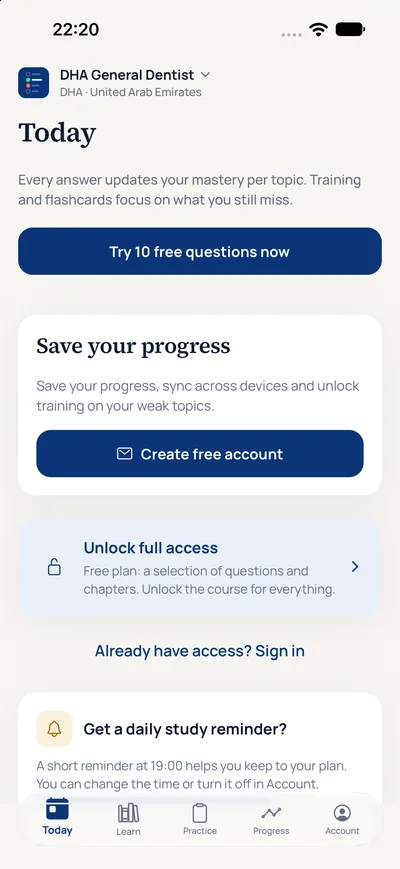
The NEET MDS: 240 questions in a fixed time, and a licence that depends on the result. MediFlow prepares you specifically for this exam: 300 practice questions across 15 topics, an explanation for every answer and timed mock exams in the real exam format.
- ₹1,499 · 3 months of access · one payment · no subscription
- 300 practice questions
- 240 questions · 180 minutes

MediFlow Exam Prep
AIAI tutor explains every answer
300 practice questions
The challenge
The NEET MDS: 240 questions in a fixed time, and a licence that depends on the result.
- The exam covers every field of dentistry, from endodontics to oral surgery and practice law. Textbooks do not tell you what NBEMS actually asks.
- 240 questions in 180 minutes leave about 45 seconds per question. Speed has to be trained, not hoped for.
- The question style is specific: clinical scenarios, best-answer choices and distractors that look right.
- Working full time leaves little room to plan revision, and a retake costs months of waiting and another exam fee.
How MediFlow solves it
- A question bank built on the published content of NBEMS, organised by topic, so you know what matters.
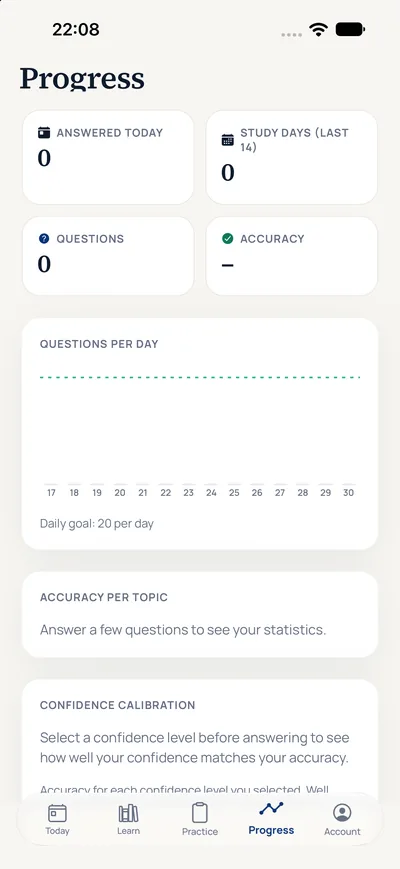
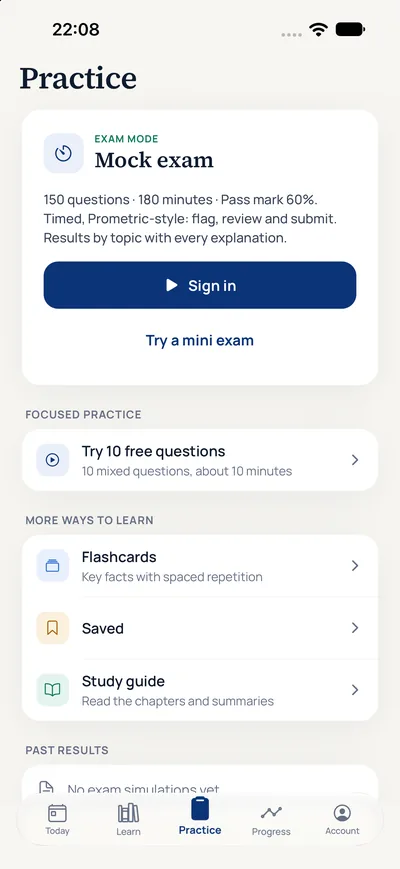
- Timed mock exams in the real exam format train your pace before the real day.
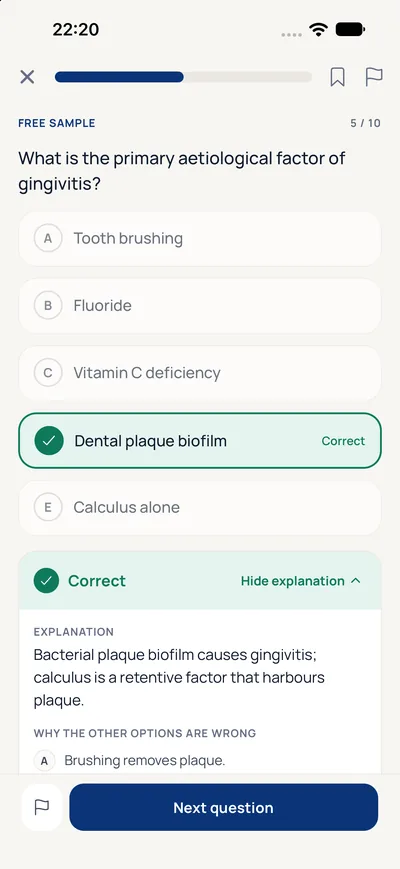
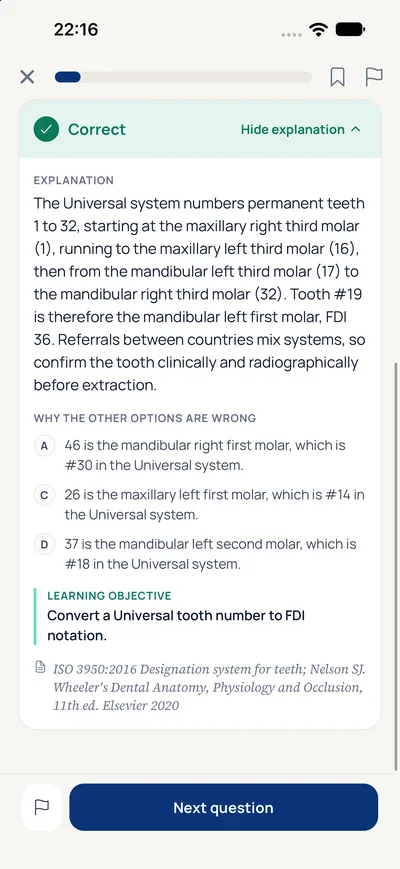
- Every answer is explained, including why the other options are wrong.
- A study plan up to your exam date tells you what to do each day and brings weak topics back for review.
Three steps to exam day
- 1
Try free questions and see the style of the exam.
- 2
Unlock the package and follow your study plan, topic by topic.
- 3
Take timed mock exams until your results are stable, then sit the exam.
What you can check
- 300 practice questions in 15 topics
- Question bank last updated on 30 October 2026
- Mock exams in the NBEMS exam format
One package, one payment
₹1,499 for 3 months of access to this exam. One payment, no subscription, no automatic renewal. Web and app with one account.
Practice material only. MediFlow is independent of NBEMS and cannot guarantee a result.
Exam at a glance
- Questions
- 240
- Duration
- 180 minutes
- Pass mark
- not published
- Sections
- Part A: 100 · 75 min / Part B: 140 · 105 min
- Exam type
- Written
- Language
- English
- Authority
- NBEMS
Curriculum
Built from the question bank and updated automatically when new questions are added. 15 modules · 300 questions · Last updated: 30 October 2026
01Conservative Dentistry and Endodontics (Part B)24 questions · 8 % of the bank
Chapters
- Foundations: tooth surfaces, cavity classes and minimal intervention
- Foundations: direct restorative materials
- Foundations: caries, pulpitis and apical disease
- Foundations: root canal anatomy and treatment principles
- Foundations: access cavities, canal configurations and working length
- Foundations: obturation, root-end surgery and the cracked tooth
Sample question
Sample question1 / 1 · 0 correctWhich crystalline phase of gutta-percha predominates in commercially available obturating cones?
Keys: 1–5 or A–E to choose, Enter to check and continue, F to mark.
02Dental Anatomy, Oral Histology, Embryology and Oral Physiology (Part A)30 questions · 10 % of the bank
Chapters
- Foundations: tooth types, primary and permanent teeth
- Foundations: nerve supply of the teeth and the inferior alveolar nerve block
- Foundations: intraoral radiographs and the panoramic view
- Foundations: anatomy of the tooth and periodontium
- Foundations: periodontal health and periodontitis
Sample question
Sample question1 / 1 · 0 correctA student notices a small cusp-like projection on the mesiolingual surface of the mesiolingual cusp of a permanent molar in a 20-year-old patient. Which tooth most commonly shows this trait?
Keys: 1–5 or A–E to choose, Enter to check and continue, F to mark.
03Dental Materials (Part A)21 questions · 7 % of the bank
Chapters
- Foundations: tooth surfaces, cavity classes and minimal intervention
- Foundations: direct restorative materials
Sample question
Sample question1 / 1 · 0 correctWhich phase of a set conventional low-copper amalgam is the weakest and the most susceptible to corrosion, leading to marginal breakdown?
Keys: 1–5 or A–E to choose, Enter to check and continue, F to mark.
04General Human Anatomy, Embryology and Histology (Part A)18 questions · 6 % of the bank
Chapters
- Foundations: spinal cord tracts and the cranial nerves
- Foundations: the circle of Willis and intracranial haemorrhage
- Foundations: the eye and the visual pathway
- Foundations: the ear and the larynx
- Foundations: paranasal sinuses and neck lymph nodes
Sample question
Sample question1 / 1 · 0 correctA 3.8 kg newborn is delivered after shoulder dystocia at a PHC. The right arm lies adducted, medially rotated and extended, with the forearm pronated, but the hand grasp is preserved. Which nerve roots are most likely injured?
Keys: 1–5 or A–E to choose, Enter to check and continue, F to mark.
05Oral and Maxillofacial Surgery (Part B)24 questions · 8 % of the bank
Chapters
- Foundations: extraction forceps and impacted third molars
- Foundations: spread of odontogenic infection and dry socket
- Foundations: mandibular fractures, the TMJ and oral mucosal lesions
Sample question
Sample question1 / 1 · 0 correctA dentist plans to extract a mandibular first molar after an inferior alveolar nerve block. The lip, chin and tongue are numb, but the patient still feels pain when the buccal gingiva near the molar is retracted. Which nerve needs additional anaesthesia by local infiltration?
Keys: 1–5 or A–E to choose, Enter to check and continue, F to mark.
06Oral Medicine and Oral Radiology (Part B)18 questions · 6 % of the bank
Chapters
- Foundations: tooth types, primary and permanent teeth
- Foundations: nerve supply of the teeth and the inferior alveolar nerve block
- Foundations: intraoral radiographs and the panoramic view
- Foundations: extraction forceps and impacted third molars
- Foundations: spread of odontogenic infection and dry socket
- Foundations: mandibular fractures, the TMJ and oral mucosal lesions
07Oral Pathology, Oral Microbiology and Forensic Odontology (Part B)21 questions · 7 % of the bank
Chapters
- Foundations: extraction forceps and impacted third molars
- Foundations: spread of odontogenic infection and dry socket
- Foundations: mandibular fractures, the TMJ and oral mucosal lesions
08Orthodontics and Dentofacial Orthopaedics (Part B)18 questions · 6 % of the bank
Chapters
- Foundations: Angle classification and cephalometric analysis
- Foundations: tooth movement and orthodontic appliances
- Foundations: facial growth and retention
09General Pathology and Microbiology (Part A)21 questions · 7 % of the bank
Chapters
- Foundations: bacteria, the Gram stain and antibiotic targets
- Foundations: infection prevention and antimicrobial stewardship
10Paediatric and Preventive Dentistry (Part B)15 questions · 5 % of the bank
Chapters
- Foundations: dental trauma and pulp therapy in children
- Foundations: space maintainers and fissure sealants
11Periodontology (Part B)18 questions · 6 % of the bank
Chapters
- Foundations: anatomy of the tooth and periodontium
- Foundations: periodontal health and periodontitis
- Foundations: patterns of bone loss around teeth and implants
- Foundations: subgingival instrumentation and access flap surgery
12Pharmacology, Anaesthesia and Medical Emergencies (Part A)15 questions · 5 % of the bank
Chapters
- Foundations: tooth types, primary and permanent teeth
- Foundations: nerve supply of the teeth and the inferior alveolar nerve block
- Foundations: intraoral radiographs and the panoramic view
13General Physiology and Biochemistry (Part A)21 questions · 7 % of the bank
14Prosthodontics: Fixed, Removable, Complete Dentures and Implantology (Part B)24 questions · 8 % of the bank
Chapters
- Foundations: bridges and post-retained crowns
- Foundations: complete and partial dentures and implant components
15Public Health Dentistry, Biostatistics, Ethics and Dental Law (Part B)12 questions · 4 % of the bank
Sample question
From the module Conservative Dentistry and Endodontics (Part B). Choose an answer to see the explanation.
Which crystalline phase of gutta-percha predominates in commercially available obturating cones?
Keys: 1–5 or A–E to choose, Enter to check and continue, F to mark.
What you get
- Question bank with a detailed explanation for every answer
- Timed mock exams in the real exam format, with score report by topic
- Personal study plan up to your exam date and review of weak topics
- AI tutor that explains any question in plain words
- One account for the app (iPhone, iPad) and the browser
From registration to licence
The usual steps with NBEMS. Details can change; check the current rules with NBEMS before you register.
- Check eligibility and collect your documents (degree, experience, good standing).
- Create an account with NBEMS and submit the application.
- Receive the exam eligibility and book a date with the test centre.
- Sit the exam. Results usually come within days.
- After passing: complete licensing (for example primary source verification) and receive your licence.
Frequently asked questions
How much does NEET MDS preparation cost?
₹1,499 for 3 months of access to this exam. One payment, no subscription, no automatic renewal.
How long is my access?
Access runs for 90 days from purchase for this exam package.
Where can I buy it?
In the MediFlow Exam Prep app (App Store) or on mediflow.ae. Both unlock the same package for your MediFlow account.
Are these real exam questions?
No. MediFlow writes original questions based on the published exam content. We do not use recalled or leaked exam questions and we are not affiliated with NBEMS.
Is the exam format up to date?
The format comes from the published information of NBEMS. Check it with NBEMS before your exam, as authorities can change it.
Ready to start
Begin with free questions or unlock the full package now.
MediFlow is an independent provider. We are not affiliated with any licensing authority or exam provider. Questions are written by MediFlow from published exam outlines; they are not questions from real exams. Always check the format with the authority before your exam.
Related exams
- FDST (foreign dental graduates, BDS)NBEMS · FDST250 questions · 300 minutes · pass mark 50 %In preparation
- Dental National Exit Test – not yet heldNDC · NExTIn preparation
| Exam | Format | Price (3 months) | |
|---|---|---|---|
| FDST (foreign dental graduates, BDS) NBEMS · FDST | 250 questions · 300 minutes · pass mark 50 % | — | In preparation |
| Dental National Exit Test – not yet held NDC · NExT | — | In preparation |
One app for every exam
MediFlow Exam Prep on iPhone and iPad: choose your country, profession and exam. Practice questions with explanations, timed mock exams and a study plan. The same account works in the browser.