🇮🇳 NBEMS · Indien
NEET SS Pädiatrie
NEET SS Pädiatrie: 150 Fragen in fester Zeit, und davon hängt Ihre Zulassung ab. MediFlow bereitet Sie gezielt auf diese Prüfung vor: 299 Übungsfragen in 12 Themen, eine Erklärung zu jeder Antwort und Prüfungssimulationen mit Zeitlimit im echten Prüfungsformat.
- 2.999 ₹ · 3 Monate Zugang · eine Zahlung · kein Abo
- 299 Übungsfragen
- 150 Fragen · 150 Minuten
MediFlow Exam Prep
KIKI-Tutor erklärt jede Antwort
299 Übungsfragen+136 neu in den letzten 30 Tagen
Die Herausforderung
NEET SS Pädiatrie: 150 Fragen in fester Zeit, und davon hängt Ihre Zulassung ab.
- Geprüft wird die ganze Breite der klinischen Medizin, vom Notfall bis zur seltenen Diagnose. Lehrbücher sagen nicht, was NBEMS tatsächlich fragt.
- 150 Fragen in 150 Minuten lassen etwa 60 Sekunden pro Frage. Tempo muss man üben.
- Der Fragestil ist eigen: Fallvignetten, beste Antwort und Ablenker, die richtig aussehen.
- Neben dem Beruf bleibt wenig Zeit zum Planen, und eine Wiederholung kostet Monate Wartezeit und eine weitere Prüfungsgebühr.
So löst MediFlow das
- Eine Fragenbank auf Basis der veröffentlichten Inhalte von NBEMS, nach Themen geordnet, damit Sie wissen, worauf es ankommt.
- Prüfungssimulationen mit Zeitlimit im echten Prüfungsformat trainieren Ihr Tempo vor dem Prüfungstag.
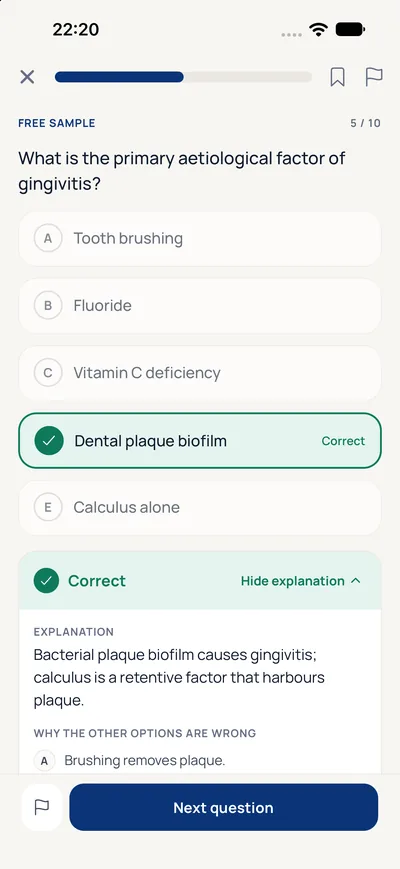
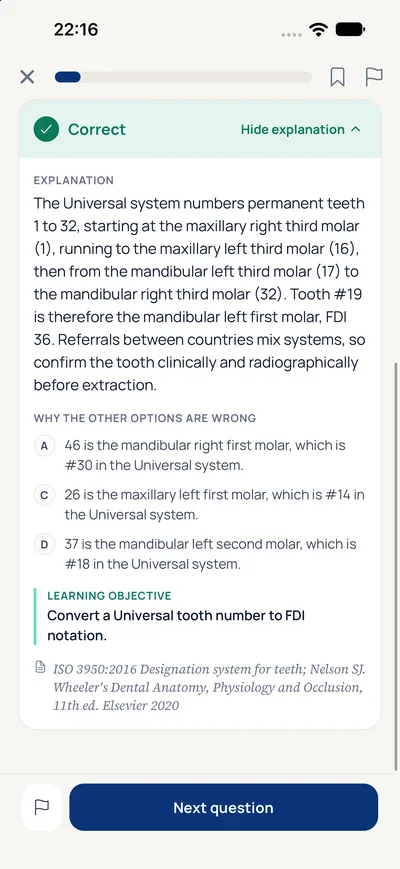
- Jede Antwort ist erklärt, auch warum die anderen Antworten falsch sind.
- Ein Lernplan bis zum Prüfungstermin sagt Ihnen täglich, was dran ist, und holt schwache Themen zurück.
In drei Schritten zur Prüfung
- 1
Kostenlose Fragen testen und den Stil der Prüfung kennenlernen.
- 2
Paket freischalten und dem Lernplan Thema für Thema folgen.
- 3
Prüfungssimulationen mit Zeitlimit, bis die Ergebnisse stabil sind, dann zur Prüfung.
Was Sie prüfen können
- 299 Übungsfragen in 12 Themen
- Fragenbank zuletzt aktualisiert am 30. Oktober 2026
- Prüfungssimulationen im Prüfungsformat von NBEMS
Ein Paket, eine Zahlung
2.999 ₹ für 3 Monate Zugang zu dieser Prüfung. Eine Zahlung, kein Abo, keine automatische Verlängerung. Web und App mit einem Konto.
Übungsmaterial. MediFlow ist unabhängig von NBEMS und kann kein Ergebnis garantieren.
Prüfung auf einen Blick
- Fragen
- 150
- Dauer
- 150 Minuten
- Bestehensgrenze
- nicht veröffentlicht
- Teile
- Section 1–3 (each): 50 · 50 min
- Prüfungsart
- Schriftlich
- Sprache
- English
- Prüfungsstelle
- NBEMS
Lehrplan
Aus der Fragenbank erstellt und automatisch aktualisiert, sobald neue Fragen dazukommen. 12 Module · 299 Fragen · Zuletzt aktualisiert: 30. Oktober 2026
01Pädiatrische Kardiologie27 Fragen · 9 % der Bank
Kapitel
- Foundations: anatomy of the heart
- Foundations: conduction system and cardiac cycle
- Foundations: circulation and blood vessels
- Foundations: female pelvic anatomy
- Foundations: placenta, pregnancy physiology and fetal circulation
- Foundations: labour and the fetal skull
Beispielfrage
Beispielfrage1 / 1 · 0 richtigA 5-year-old girl with no symptoms is referred from a school screening camp (RBSK) for a murmur. There is a soft continuous hum below the right clavicle that is louder when she sits upright. It disappears when she lies supine or when the neck veins are compressed or the head is turned. Pulses, second heart sound, ECG and chest X-ray are normal. What is the most appropriate management?
Tasten: 1–5 oder A–E wählen, Enter prüft und geht weiter, F markiert.
02Pädiatrische Endokrinologie19 Fragen · 6.4 % der Bank
Kapitel
- Foundations: endocrine glands and feedback control
- Foundations: the thyroid in the neck and endocrine emergencies
Beispielfrage
Beispielfrage1 / 1 · 0 richtigA 10-year-old girl has three months of weight loss, tremor, sweating and poor school performance. She has a diffuse goitre and heart rate of 128/min. TSH is below 0.01 mIU/L, free T4 6.2 ng/dL and TRAb is positive. Liver enzymes are normal. Which is the preferred initial treatment?
Tasten: 1–5 oder A–E wählen, Enter prüft und geht weiter, F markiert.
03Pädiatrische Gastroenterologie und Hepatologie20 Fragen · 6.7 % der Bank
Kapitel
- Foundations: the digestive tract, digestion and absorption
- Foundations: peptic ulcer disease and upper GI bleeding
Beispielfrage
Beispielfrage1 / 1 · 0 richtigA term newborn passed meconium only on day 3 after rectal stimulation. At 5 days he has abdominal distension and reluctance to feed. On digital rectal examination there is a tight anal canal, followed by an explosive release of gas and stool. There are no dysmorphic features. Which investigation confirms the suspected diagnosis?
Tasten: 1–5 oder A–E wählen, Enter prüft und geht weiter, F markiert.
04Genetik und angeborene Stoffwechselstörungen18 Fragen · 6 % der Bank
Beispielfrage
Beispielfrage1 / 1 · 0 richtigA term male neonate, well for the first 3 days, develops poor feeding, vomiting, lethargy and then seizures on day 4. Findings: tachypnoea, pH 7.52, pCO2 22 mmHg, normal anion gap, glucose 72 mg/dL, no urine ketones, ammonia 780 µmol/L. Plasma citrulline is very low and urine orotic acid is markedly raised. A maternal uncle died in the neonatal period. What is the most likely diagnosis?
Tasten: 1–5 oder A–E wählen, Enter prüft und geht weiter, F markiert.
05Wachstum, Entwicklung und Ernährung15 Fragen · 5 % der Bank
Kapitel
- Foundations: the newborn and the transition after birth
- Foundations: growth and development
- Foundations: the child's airway, vital signs and resuscitation
Beispielfrage
Beispielfrage1 / 1 · 0 richtigAt an Anganwadi screening, a 20-month-old boy has MUAC 118 mm and weight-for-height z-score −2.7. There is no bipedal oedema. He is alert with a good appetite and has no fever, cough or diarrhoea. What is the most appropriate classification and plan?
Tasten: 1–5 oder A–E wählen, Enter prüft und geht weiter, F markiert.
06Pädiatrische Hämatologie und Onkologie21 Fragen · 7 % der Bank
Kapitel
- Foundations: blood cells, haematopoiesis and haemostasis
- Foundations: tumour growth, spread and staging
07Pädiatrische Infektiologie und Impfungen19 Fragen · 6.4 % der Bank
Kapitel
- Foundations: bacteria, the Gram stain and antibiotic targets
- Foundations: infection prevention and antimicrobial stewardship
08Neonatologie32 Fragen · 10.7 % der Bank
Kapitel
- Foundations: the newborn and the transition after birth
- Foundations: growth and development
- Foundations: the child's airway, vital signs and resuscitation
- Foundations: female pelvic anatomy
- Foundations: placenta, pregnancy physiology and fetal circulation
- Foundations: labour and the fetal skull
09Pädiatrische Nephrologie23 Fragen · 7.7 % der Bank
Kapitel
- Foundations: structure and function of the kidney
- Foundations: fluids and electrolytes
10Pädiatrische Neurologie21 Fragen · 7 % der Bank
Kapitel
- Foundations: brain anatomy and clinical localisation
- Foundations: reflexes, the spinal cord and upper versus lower motor neuron signs
11Pädiatrische Intensivmedizin und Notfallmedizin64 Fragen · 21.4 % der Bank
Kapitel
- Foundations: the newborn and the transition after birth
- Foundations: growth and development
- Foundations: the child's airway, vital signs and resuscitation
- Foundations: ABCDE approach and airway basics
- Foundations: life-threatening chest emergencies
- Foundations: shock, burns and sepsis
12Pädiatrische Pneumologie20 Fragen · 6.7 % der Bank
Kapitel
- Foundations: anatomy of the respiratory tract
- Foundations: alveoli and gas exchange
- Foundations: mechanics and control of breathing
Beispielfrage
Aus dem Modul Pädiatrische Kardiologie. Wählen Sie eine Antwort, um die Erklärung zu sehen.
A 5-year-old girl with no symptoms is referred from a school screening camp (RBSK) for a murmur. There is a soft continuous hum below the right clavicle that is louder when she sits upright. It disappears when she lies supine or when the neck veins are compressed or the head is turned. Pulses, second heart sound, ECG and chest X-ray are normal. What is the most appropriate management?
Tasten: 1–5 oder A–E wählen, Enter prüft und geht weiter, F markiert.
Das ist enthalten
- Fragenbank mit ausführlicher Erklärung zu jeder Antwort
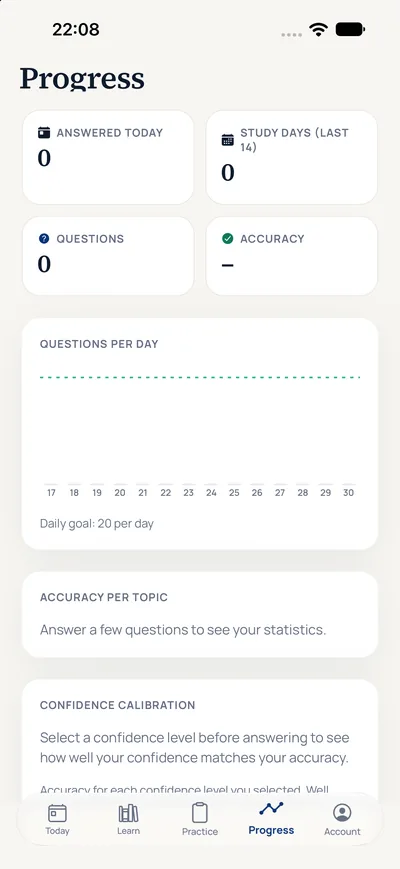
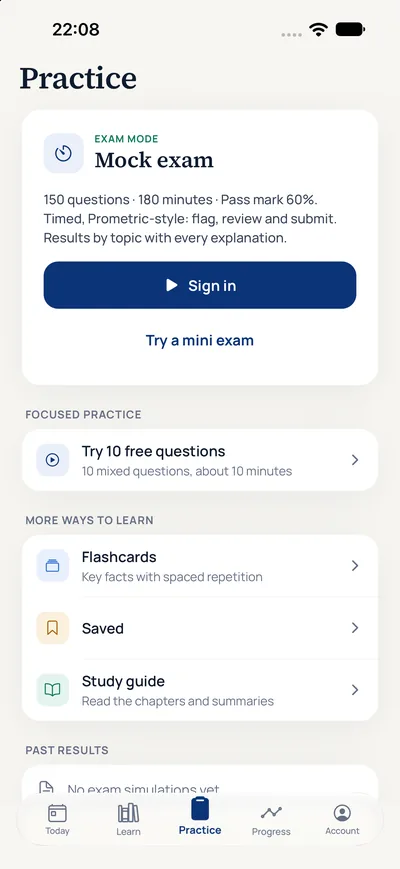
- Prüfungssimulationen mit Zeitlimit im echten Prüfungsformat, Auswertung nach Themen
- Persönlicher Lernplan bis zum Prüfungstermin und Wiederholung schwacher Themen
- KI-Tutor, der jede Frage verständlich erklärt
- Ein Konto für App (iPhone, iPad) und Browser
Von der Anmeldung zur Zulassung
Die üblichen Schritte bei NBEMS. Einzelheiten können sich ändern; prüfen Sie die aktuellen Regeln bei NBEMS vor der Anmeldung.
- Voraussetzungen prüfen und Unterlagen sammeln (Abschluss, Berufserfahrung, Unbedenklichkeit).
- Konto bei NBEMS anlegen und Antrag stellen.
- Prüfungszulassung erhalten und Termin beim Prüfungszentrum buchen.
- Prüfung ablegen. Das Ergebnis kommt meist nach wenigen Tagen.
- Nach dem Bestehen: Zulassung abschließen (z. B. Prüfung der Dokumente an der Quelle) und Lizenz erhalten.
Häufige Fragen
Was kostet die Vorbereitung auf NEET SS Pädiatrie?
2.999 ₹ für 3 Monate Zugang zu dieser Prüfung. Eine Zahlung, kein Abo, keine automatische Verlängerung.
Wie lange habe ich Zugang?
Der Zugang gilt 90 Tage ab Kauf für dieses Prüfungspaket.
Wo kann ich kaufen?
In der App MediFlow Exam Prep (App Store) oder auf mediflow.ae. Beides schaltet dasselbe Paket für Ihr MediFlow-Konto frei.
Sind das echte Prüfungsfragen?
Nein. MediFlow schreibt eigene Fragen anhand der veröffentlichten Prüfungsinhalte. Wir nutzen keine Erinnerungsprotokolle oder geleakten Fragen und sind nicht mit NBEMS verbunden.
Ist das Prüfungsformat aktuell?
Das Format stammt aus den veröffentlichten Angaben von NBEMS. Bitte prüfen Sie es vor der Prüfung dort, Behörden können es ändern.
Bereit für den Start
Beginnen Sie mit kostenlosen Fragen oder schalten Sie das ganze Paket jetzt frei.
MediFlow ist ein unabhängiger Anbieter und nicht mit Behörden oder Prüfungsanbietern verbunden. Die Fragen schreibt MediFlow anhand veröffentlichter Prüfungsinhalte; es sind keine Fragen aus echten Prüfungen. Bitte prüfen Sie das Format vor der Prüfung bei der zuständigen Stelle.
Verwandte Prüfungen
- NEET PGNBEMS · NEET PG · 599 Übungsfragen180 Fragen · 210 Minuten2.499 ₹KaufenDetails
- INI-CETAIIMS · INI-CET · 599 Übungsfragen200 Fragen · 180 Minuten2.499 ₹KaufenDetails
- UPSC Combined Medical ServicesUPSC · CMS · 599 Übungsfragen240 Fragen · 240 Minuten2.499 ₹KaufenDetails
- FMGE (Screening-Test für Auslandsabsolventen)NBEMS · FMGE · 300 Übungsfragen300 Fragen · 306 Minuten · Bestehensgrenze 50 %2.499 ₹KaufenDetails
- NEET SS Innere MedizinNBEMS · NEET SS · 298 Übungsfragen · +133 neu in 30 Tagen150 Fragen · 150 Minuten2.999 ₹KaufenDetails
- NEET SS ChirurgieNBEMS · NEET SS · 300 Übungsfragen · +148 neu in 30 Tagen150 Fragen · 150 Minuten2.999 ₹KaufenDetails
- National Exit Test (NExT) – noch nicht eingeführtNMC · NExTIn Vorbereitung
- NEET SS weitere GruppenNBEMS · NEET SS150 Fragen · 150 MinutenIn Vorbereitung
| Prüfung | Format | Preis (3 Monate) | |
|---|---|---|---|
| NEET PG NBEMS · NEET PG · 599 Übungsfragen | 180 Fragen · 210 Minuten | 2.499 ₹ | KaufenApp Store |
| INI-CET AIIMS · INI-CET · 599 Übungsfragen | 200 Fragen · 180 Minuten | 2.499 ₹ | KaufenApp Store |
| UPSC Combined Medical Services UPSC · CMS · 599 Übungsfragen | 240 Fragen · 240 Minuten | 2.499 ₹ | KaufenApp Store |
| FMGE (Screening-Test für Auslandsabsolventen) NBEMS · FMGE · 300 Übungsfragen | 300 Fragen · 306 Minuten · Bestehensgrenze 50 % | 2.499 ₹ | KaufenApp Store |
| NEET SS Innere Medizin NBEMS · NEET SS · 298 Übungsfragen · +133 neu in 30 Tagen | 150 Fragen · 150 Minuten | 2.999 ₹ | KaufenApp Store |
| NEET SS Chirurgie NBEMS · NEET SS · 300 Übungsfragen · +148 neu in 30 Tagen | 150 Fragen · 150 Minuten | 2.999 ₹ | KaufenApp Store |
| National Exit Test (NExT) – noch nicht eingeführt NMC · NExT | — | In Vorbereitung | |
| NEET SS weitere Gruppen NBEMS · NEET SS | 150 Fragen · 150 Minuten | — | In Vorbereitung |
Eine App für jede Prüfung
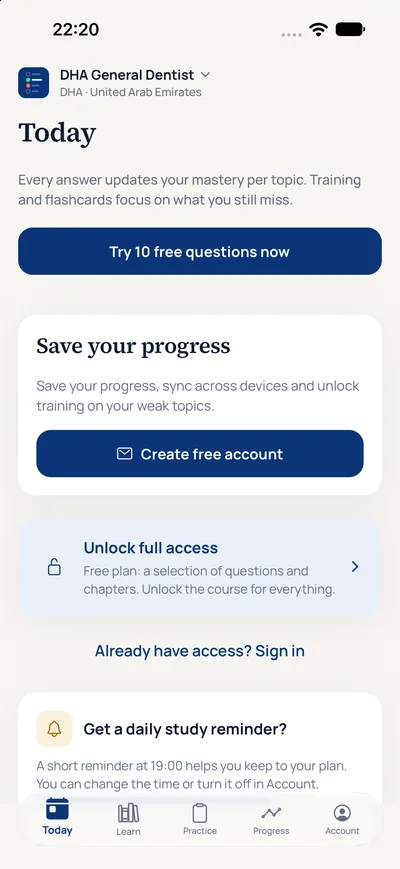
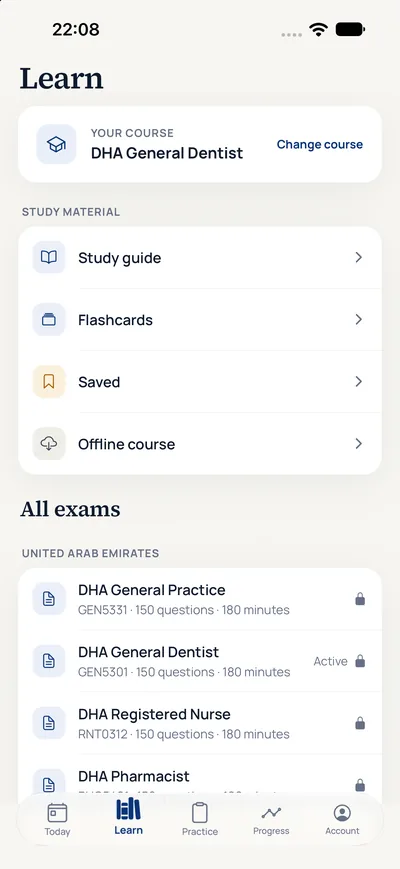
MediFlow Exam Prep auf iPhone und iPad: Land, Beruf und Prüfung wählen. Übungsfragen mit Erklärungen, Prüfungssimulationen mit Zeitlimit und ein Lernplan. Dasselbe Konto gilt im Browser.