🇴🇲 OMSB · Oman
OMSB-Prüfung Allgemeinzahnarzt (OEGD)
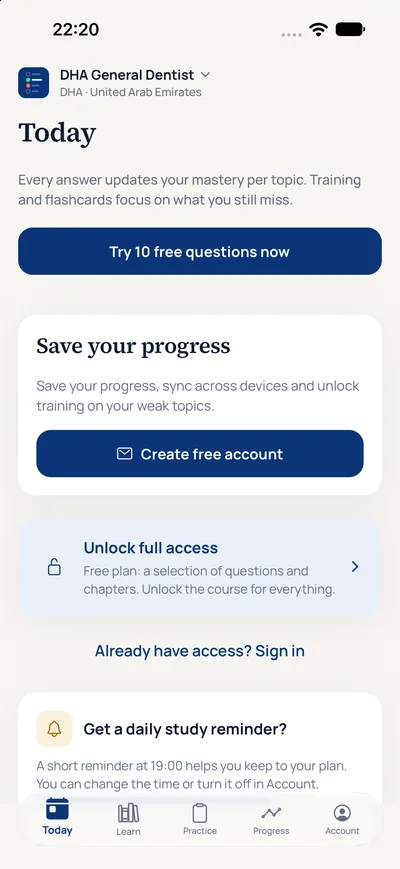
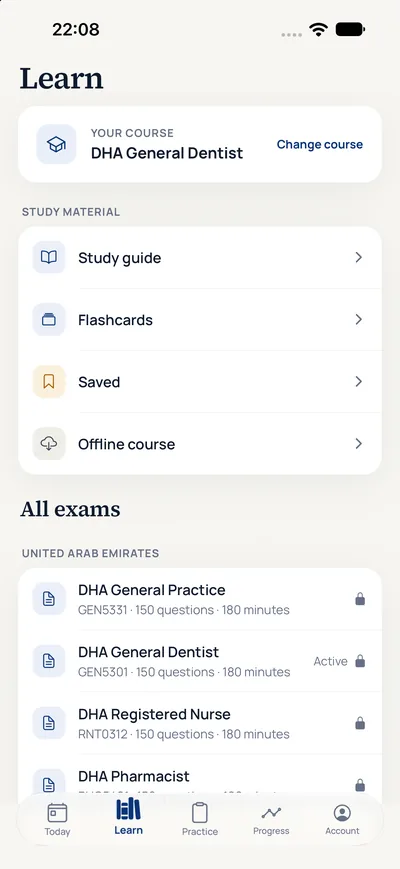
OMSB-Prüfung Allgemeinzahnarzt (OEGD): 100 Fragen, Bestehensgrenze 65 %, und davon hängt Ihre Zulassung ab. MediFlow bereitet Sie gezielt auf diese Prüfung vor: 2.682 Übungsfragen in 20 Themen, eine Erklärung zu jeder Antwort und Prüfungssimulationen mit Zeitlimit im echten Prüfungsformat.
- 199 AED · 3 Monate Zugang · eine Zahlung · kein Abo
- 2.682 Übungsfragen
- 100 Fragen · 150 Minuten · Bestehensgrenze 65 %

MediFlow Exam Prep
KIKI-Tutor erklärt jede Antwort
2.682 Übungsfragen
Die Herausforderung
OMSB-Prüfung Allgemeinzahnarzt (OEGD): 100 Fragen, Bestehensgrenze 65 %, und davon hängt Ihre Zulassung ab.
- Geprüft wird alle Fächer der Zahnmedizin, von Endodontie bis Oralchirurgie und Berufsrecht. Lehrbücher sagen nicht, was OMSB tatsächlich fragt.
- 100 Fragen in 150 Minuten lassen etwa 90 Sekunden pro Frage. Tempo muss man üben.
- Der Fragestil ist eigen: Fallvignetten, beste Antwort und Ablenker, die richtig aussehen.
- Neben dem Beruf bleibt wenig Zeit zum Planen, und eine Wiederholung kostet Monate Wartezeit und eine weitere Prüfungsgebühr.
So löst MediFlow das
- Eine Fragenbank auf Basis der veröffentlichten Inhalte von OMSB, nach Themen geordnet, damit Sie wissen, worauf es ankommt.
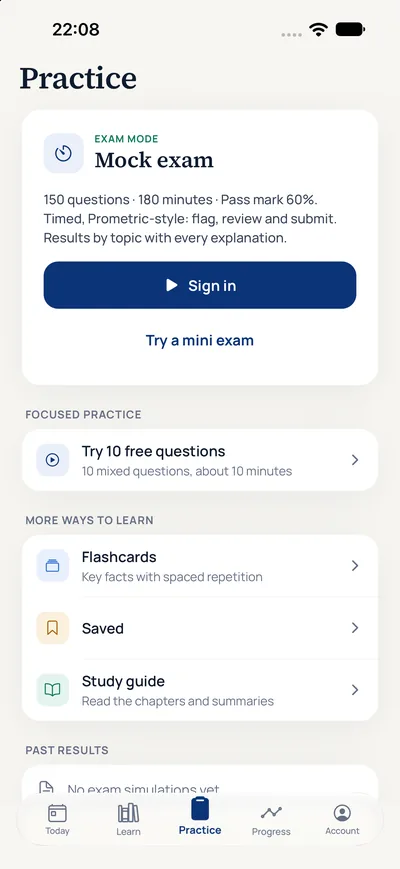
- Prüfungssimulationen mit Zeitlimit im echten Prüfungsformat trainieren Ihr Tempo vor dem Prüfungstag.
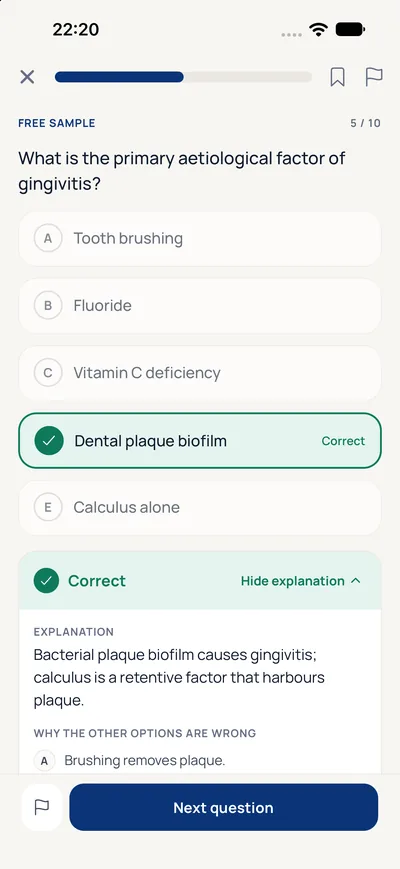
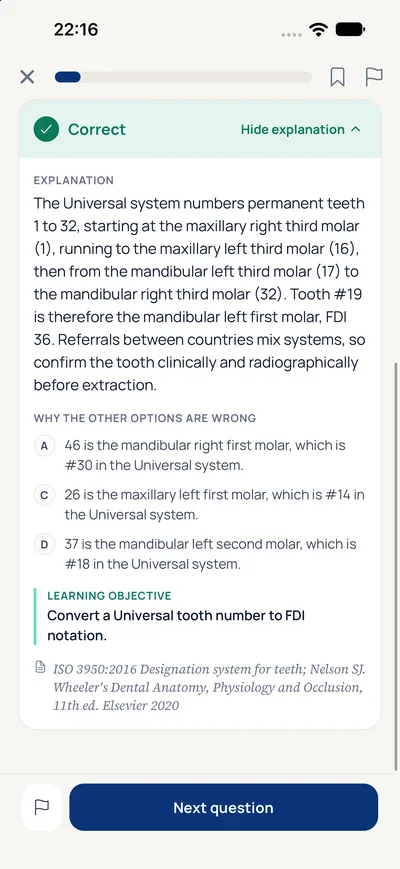
- Jede Antwort ist erklärt, auch warum die anderen Antworten falsch sind.
- Ein Lernplan bis zum Prüfungstermin sagt Ihnen täglich, was dran ist, und holt schwache Themen zurück.
In drei Schritten zur Prüfung
- 1
Kostenlose Fragen testen und den Stil der Prüfung kennenlernen.
- 2
Paket freischalten und dem Lernplan Thema für Thema folgen.
- 3
Prüfungssimulationen mit Zeitlimit, bis die Ergebnisse stabil sind, dann zur Prüfung.
Was Sie prüfen können
- 2.682 Übungsfragen in 20 Themen
- Fragenbank zuletzt aktualisiert am 29. Oktober 2026
- Prüfungssimulationen im Prüfungsformat von OMSB
Ein Paket, eine Zahlung
199 AED für 3 Monate Zugang zu dieser Prüfung. Eine Zahlung, kein Abo, keine automatische Verlängerung. Web und App mit einem Konto.
Übungsmaterial. MediFlow ist unabhängig von OMSB und kann kein Ergebnis garantieren.
Prüfung auf einen Blick
- Fragen
- 100
- Dauer
- 150 Minuten
- Bestehensgrenze
- 65 %
- Teile
- 1
- Prüfungsart
- Schriftlich
- Sprache
- English
- Prüfungsstelle
- OMSB
Lehrplan
Aus der Fragenbank erstellt und automatisch aktualisiert, sobald neue Fragen dazukommen. 20 Module · 2,682 Fragen · Zuletzt aktualisiert: 29. Oktober 2026
01Dental anatomy & occlusion100 Fragen · 3.7 % der Bank
Kapitel
- Tooth notation, eruption and identifying teeth
- Root canal anatomy and developmental anomalies
- Occlusion, the TMJ and applied anatomy for local anaesthesia
- Foundations: tooth types, primary and permanent teeth
- Foundations: nerve supply of the teeth and the inferior alveolar nerve block
- Foundations: intraoral radiographs and the panoramic view
Beispielfrage
Beispielfrage1 / 1 · 0 richtigA 34-year-old patient brings a referral letter from a clinic in the United States asking for extraction of tooth #19 (Universal system). Which FDI (ISO 3950) number is this tooth?
Tasten: 1–5 oder A–E wählen, Enter prüft und geht weiter, F markiert.
02Zahnerhaltung & Kariologie240 Fragen · 8.9 % der Bank
Kapitel
- Caries as a disease: biofilm, critical pH and fluoride
- Detecting, classifying and managing lesions without drilling
- Instruments, isolation and the amalgam preparation
- Adhesion and resin composite placement
- Deep caries, the pulp, tooth wear and failing restorations
- Foundations: tooth surfaces, cavity classes and minimal intervention
- Foundations: direct restorative materials
- Foundations: matrix bands and rubber dam isolation
Beispielfrage
Beispielfrage1 / 1 · 0 richtigBelow which approximate plaque-fluid pH (critical pH) does hydroxyapatite of sound enamel begin to dissolve under typical oral conditions?
Tasten: 1–5 oder A–E wählen, Enter prüft und geht weiter, F markiert.
03Zahnärztliche Werkstoffe128 Fragen · 4.8 % der Bank
Kapitel
- Material properties: stress, strain, hardness and biocompatibility
- Impression materials and gypsum products
- Dental cements and resin composites
- Amalgam, casting alloys and investments
- Dental ceramics and denture base resins
Beispielfrage
Beispielfrage1 / 1 · 0 richtigOn the stress–strain curve of a dental alloy, what does the area under the elastic portion of the curve, up to the proportional limit, represent?
Tasten: 1–5 oder A–E wählen, Enter prüft und geht weiter, F markiert.
04Endodontie301 Fragen · 11.2 % der Bank
Kapitel
- Pulp and periapex: biology, pain and the diagnostic terminology
- Clinical examination: pulp tests, radiographs and finding the source of pain
- Root canal treatment step by step: anatomy, access, shaping, cleaning and obturation
- Vital pulp therapy, immature teeth, resorption and emergencies
- When treatment fails: retreatment, microsurgery, cracks and endo-perio lesions
- Dental trauma according to the IADT 2020 guidelines
- Foundations: caries, pulpitis and apical disease
- Foundations: root canal anatomy and treatment principles
- Foundations: access cavities, canal configurations and working length
- Foundations: obturation, root-end surgery and the cracked tooth
Beispielfrage
Beispielfrage1 / 1 · 0 richtigA patient has spontaneous pain that lingers for minutes after a cold stimulus is removed. What is the most likely pulpal diagnosis?
Tasten: 1–5 oder A–E wählen, Enter prüft und geht weiter, F markiert.
05Parodontologie262 Fragen · 9.8 % der Bank
Kapitel
- The healthy periodontium: anatomy that explains the disease
- How periodontal disease develops: biofilm, host response and risk factors
- Periodontal examination and the 2017 AAP/EFP classification
- Treating periodontitis: the EFP S3 guideline step by step
- Periodontal surgery, acute conditions and peri-implant diseases
- Foundations: anatomy of the tooth and periodontium
- Foundations: periodontal health and periodontitis
- Foundations: patterns of bone loss around teeth and implants
- Foundations: subgingival instrumentation and access flap surgery
Beispielfrage
Beispielfrage1 / 1 · 0 richtigWhat is the primary aetiological factor of gingivitis?
Tasten: 1–5 oder A–E wählen, Enter prüft und geht weiter, F markiert.
06Festsitzende Prothetik128 Fragen · 4.8 % der Bank
Kapitel
- Diagnosis and treatment planning: is this tooth a good abutment?
- Tooth preparation: retention, resistance, reduction and margins
- Root-filled teeth, provisional restorations and impressions
- Occlusion, jaw records and shade selection
- Materials and cementation: metal-ceramic, glass-ceramic and zirconia
- Fixed dental prosthesis design, pontics and complications
- Foundations: bridges and post-retained crowns
- Foundations: complete and partial dentures and implant components
07Herausnehmbare Prothetik & Implantologie178 Fragen · 6.6 % der Bank
Kapitel
- Partially edentulous arches: Kennedy classification and RPD components
- RPD design: surveying, clasps and distal-extension biomechanics
- Complete dentures I: anatomy, impressions and border problems
- Complete dentures II: jaw relations, tooth arrangement and delivery problems
- Maintaining dentures: relining, immediate dentures, overdentures and denture stomatitis
- Dental implants: osseointegration, planning, loading and peri-implant disease
- Foundations: bridges and post-retained crowns
- Foundations: complete and partial dentures and implant components
08Basic implantology140 Fragen · 5.2 % der Bank
Kapitel
- Osseointegration, implant components and patient selection
- Assessment, CBCT planning and safe distances
- Timing, prosthetic options, peri-implant disease and complications
- Foundations: bridges and post-retained crowns
- Foundations: complete and partial dentures and implant components
09Oralchirurgie & Lokalanästhesie213 Fragen · 7.9 % der Bank
Kapitel
- Local anaesthetics: how they work, the drugs, vasoconstrictors and dose calculation
- Injection techniques, failed anaesthesia and complications of local anaesthesia
- Exodontia: instruments, flaps, sutures and complications during and after extraction
- Impacted third molars: classification, indications, surgery and nerve injury
- Odontogenic infections and maxillofacial fractures
- The medically compromised surgical patient and the biopsy: antithrombotics, MRONJ and suspicious lesions
- Foundations: extraction forceps and impacted third molars
- Foundations: spread of odontogenic infection and dry socket
- Foundations: mandibular fractures, the TMJ and oral mucosal lesions
10Orale Medizin68 Fragen · 2.5 % der Bank
Kapitel
- Oral ulcers and blistering diseases
- White and red lesions, candidiasis and potentially malignant disorders
- Dry mouth, salivary disease and oral signs of systemic disease
- Orofacial pain and temporomandibular disorders
- The medically compromised patient: bleeding, bone-modifying drugs, radiotherapy, pregnancy and emergencies
11Orale Pathologie48 Fragen · 1.8 % der Bank
Kapitel
- Odontogenic and non-odontogenic jaw cysts (WHO 2022)
- Odontogenic tumours: WHO 2022 classification and key entities
- Fibro-osseous, giant cell and other bone lesions of the jaws
- Salivary gland pathology
- Oral squamous cell carcinoma and its variants
- Developmental and inherited anomalies of the teeth
12Zahnärztliche Radiologie48 Fragen · 1.8 % der Bank
Kapitel
- How an X-ray image is made: the tube, the beam and what the exposure settings do
- Radiation biology, radiation protection and choosing which radiographs to take
- Intraoral radiography: techniques, receptors, processing and error analysis
- Panoramic radiography and CBCT: how they work, positioning errors and artefacts
- Reading radiographs: normal anatomy, a systematic approach and periapical findings
- Cysts, tumours and warning signs: interpreting jaw lesions
- Foundations: tooth types, primary and permanent teeth
- Foundations: nerve supply of the teeth and the inferior alveolar nerve block
- Foundations: intraoral radiographs and the panoramic view
13Zahnärztliche Pharmakologie98 Fragen · 3.7 % der Bank
Kapitel
- Analgesics for dental pain: NSAIDs, paracetamol and opioids
- Local anaesthetics and vasoconstrictors
- Antimicrobials: antibiotics, antifungals, antivirals and antiseptics
- Endocarditis prophylaxis, prosthetic joints, anticoagulants and antiplatelets
- Drug interactions, oral adverse effects, MRONJ, pregnancy and breastfeeding
- Conscious sedation: nitrous oxide and benzodiazepines
14Medizinische Notfälle in der Zahnarztpraxis98 Fragen · 3.7 % der Bank
Kapitel
- Prevention, preparedness and the collapsed patient
- Anaphylaxis and acute asthma
- Chest pain, acute coronary syndrome and stroke
- Cardiac arrest, basic life support, the AED, choking and aspiration
- Hypoglycaemia, seizures, adrenal crisis, local anaesthetic toxicity and hyperventilation
15Special care & medically compromised patients90 Fragen · 3.4 % der Bank
Kapitel
- Bleeding risk: anticoagulants, antiplatelets and bleeding disorders
- Endocarditis, antiresorptive drugs and head and neck radiotherapy
- Diabetes, pregnancy, steroids and patients who need adapted care
16Kinderzahnheilkunde128 Fragen · 4.8 % der Bank
Kapitel
- Growth, eruption and the special anatomy of primary teeth
- Behaviour guidance, sedation and local anaesthesia in children
- Early childhood caries, risk assessment and prevention with fluoride and sealants
- Restoring primary teeth and treating the primary pulp
- Space maintenance and dental trauma in children (IADT 2020)
- Child protection and children with medical or special needs
- Foundations: dental trauma and pulp therapy in children
- Foundations: space maintainers and fissure sealants
17Kieferorthopädie98 Fragen · 3.7 % der Bank
Kapitel
- Craniofacial growth: where, how and when the face grows
- Development of the occlusion and the mixed dentition
- Diagnosis: classification, cephalometrics and treatment need (IOTN)
- Interceptive orthodontics: habits, crossbites, crowding, canines, clefts and early Class III
- Tooth movement, appliances, anchorage, risks and retention
- Foundations: Angle classification and cephalometric analysis
- Foundations: tooth movement and orthodontic appliances
- Foundations: facial growth and retention
18Hygiene & Arbeitsschutz48 Fragen · 1.8 % der Bank
Kapitel
- How infections spread in the dental clinic, and standard precautions
- Instrument reprocessing: the Spaulding classification and sterilisation methods
- Proving sterility, protecting packs, and cleaning surfaces
- Water, air and waste: dental unit waterlines, aerosols, mercury and clinical waste
- Sharps injuries and post-exposure management: hepatitis B, hepatitis C and HIV
- Occupational health: gloves and skin, ergonomics, noise and radiation protection
19Biomedical sciences for dentistry100 Fragen · 3.7 % der Bank
Kapitel
- Head and neck anatomy: nerves, glands, spaces and lymph
- Oral tissues, physiology and general pathology
- Microbiology, immunology, pharmacology and evidence-based dentistry
20Ethik, Recht & Gemeinschaftszahnmedizin168 Fragen · 6.3 % der Bank
Kapitel
- Ethical principles and professional conduct
- Consent, capacity, minors and refusal
- Confidentiality, records, negligence and safeguarding
- Measuring oral disease: caries, periodontal, hygiene and fluorosis indices
- Epidemiology and biostatistics for dentists
- Prevention and public health dentistry: levels of prevention, fluorides and community programmes
Beispielfrage
Aus dem Modul Dental anatomy & occlusion. Wählen Sie eine Antwort, um die Erklärung zu sehen.
A 34-year-old patient brings a referral letter from a clinic in the United States asking for extraction of tooth #19 (Universal system). Which FDI (ISO 3950) number is this tooth?
Tasten: 1–5 oder A–E wählen, Enter prüft und geht weiter, F markiert.
Das ist enthalten
- Fragenbank mit ausführlicher Erklärung zu jeder Antwort
- Prüfungssimulationen mit Zeitlimit im echten Prüfungsformat, Auswertung nach Themen
- Persönlicher Lernplan bis zum Prüfungstermin und Wiederholung schwacher Themen
- KI-Tutor, der jede Frage verständlich erklärt
- Ein Konto für App (iPhone, iPad) und Browser
Von der Anmeldung zur Zulassung
Die üblichen Schritte bei OMSB. Einzelheiten können sich ändern; prüfen Sie die aktuellen Regeln bei OMSB vor der Anmeldung.
- Voraussetzungen prüfen und Unterlagen sammeln (Abschluss, Berufserfahrung, Unbedenklichkeit).
- Konto bei OMSB anlegen und Antrag stellen.
- Prüfungszulassung erhalten und Termin beim Prüfungszentrum buchen.
- Prüfung ablegen. Das Ergebnis kommt meist nach wenigen Tagen.
- Nach dem Bestehen: Zulassung abschließen (z. B. Prüfung der Dokumente an der Quelle) und Lizenz erhalten.
Häufige Fragen
Was kostet die Vorbereitung auf OMSB-Prüfung Allgemeinzahnarzt (OEGD)?
199 AED für 3 Monate Zugang zu dieser Prüfung. Eine Zahlung, kein Abo, keine automatische Verlängerung.
Wie lange habe ich Zugang?
Der Zugang gilt 90 Tage ab Kauf für dieses Prüfungspaket.
Wo kann ich kaufen?
In der App MediFlow Exam Prep (App Store) oder auf mediflow.ae. Beides schaltet dasselbe Paket für Ihr MediFlow-Konto frei.
Sind das echte Prüfungsfragen?
Nein. MediFlow schreibt eigene Fragen anhand der veröffentlichten Prüfungsinhalte. Wir nutzen keine Erinnerungsprotokolle oder geleakten Fragen und sind nicht mit OMSB verbunden.
Ist das Prüfungsformat aktuell?
Das Format stammt aus den veröffentlichten Angaben von OMSB. Bitte prüfen Sie es vor der Prüfung dort, Behörden können es ändern.
Bereit für den Start
Beginnen Sie mit kostenlosen Fragen oder schalten Sie das ganze Paket jetzt frei.
MediFlow ist ein unabhängiger Anbieter und nicht mit Behörden oder Prüfungsanbietern verbunden. Die Fragen schreibt MediFlow anhand veröffentlichter Prüfungsinhalte; es sind keine Fragen aus echten Prüfungen. Bitte prüfen Sie das Format vor der Prüfung bei der zuständigen Stelle.
Eine App für jede Prüfung
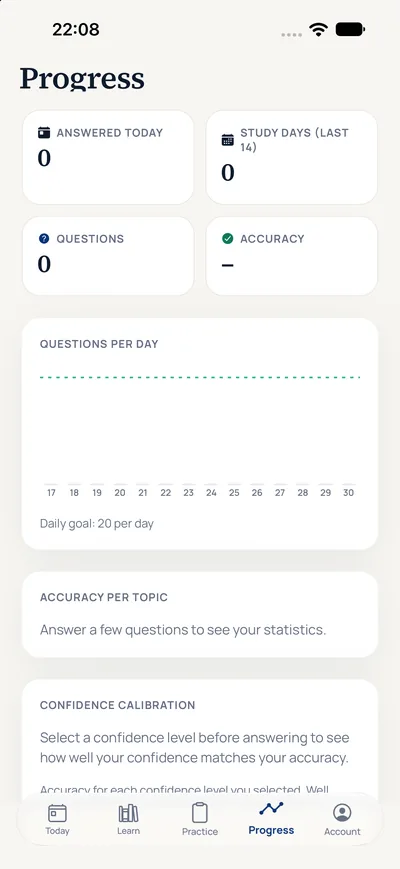
MediFlow Exam Prep auf iPhone und iPad: Land, Beruf und Prüfung wählen. Übungsfragen mit Erklärungen, Prüfungssimulationen mit Zeitlimit und ein Lernplan. Dasselbe Konto gilt im Browser.