🇩🇪 Landesärztekammer · Germany
Additional qualification exam: Emergency Medicine (Notfallmedizin)
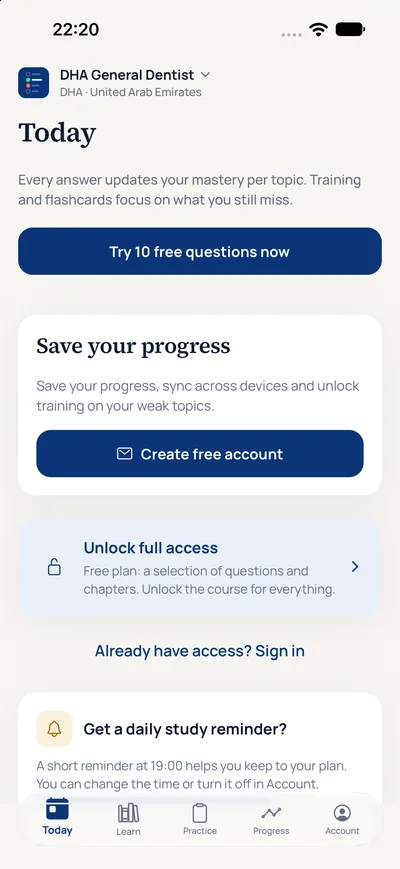
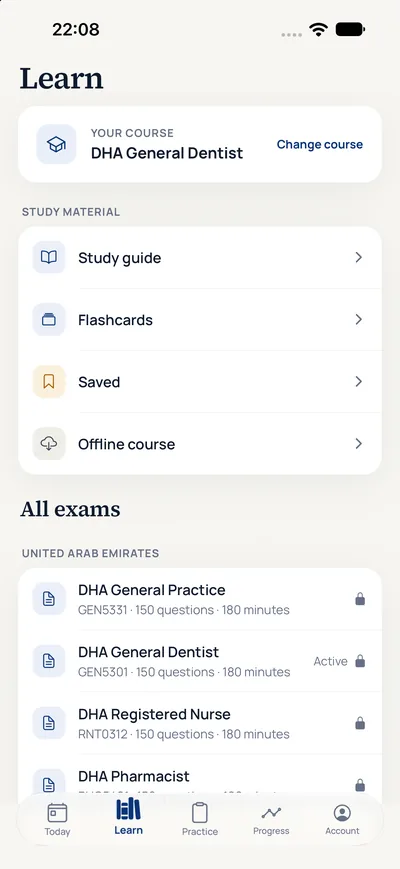
The Additional qualification exam: Emergency Medicine (Notfallmedizin) decides whether Landesärztekammer grants your licence. MediFlow prepares you specifically for this exam: 369 practice questions across 13 topics, an explanation for every answer and timed mock exams in the real exam format.
- €99.99 · 3 months of access · one payment · no subscription
- 369 practice questions
MediFlow Exam Prep
AIAI tutor explains every answer
369 practice questions+155 new in the last 30 days
The challenge
The Additional qualification exam: Emergency Medicine (Notfallmedizin) decides whether Landesärztekammer grants your licence.
- The exam covers the whole breadth of clinical medicine, from emergencies to rare diagnoses. Textbooks do not tell you what Landesärztekammer actually asks.
- Time pressure in the exam is real, and pacing has to be trained in advance.
- The question style is specific: clinical scenarios, best-answer choices and distractors that look right.
- Working full time leaves little room to plan revision, and a retake costs months of waiting and another exam fee.
- The oral or practical part is hard to practise alone.
How MediFlow solves it
- A question bank built on the published content of Landesärztekammer, organised by topic, so you know what matters.
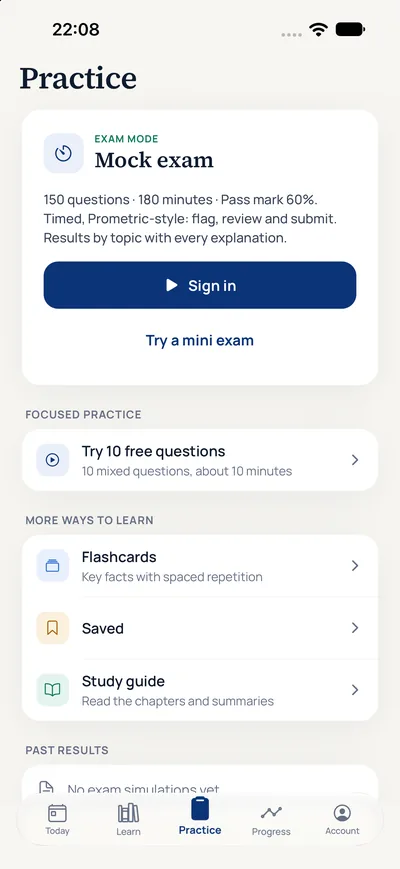
- Timed mock exams in the real exam format train your pace before the real day.
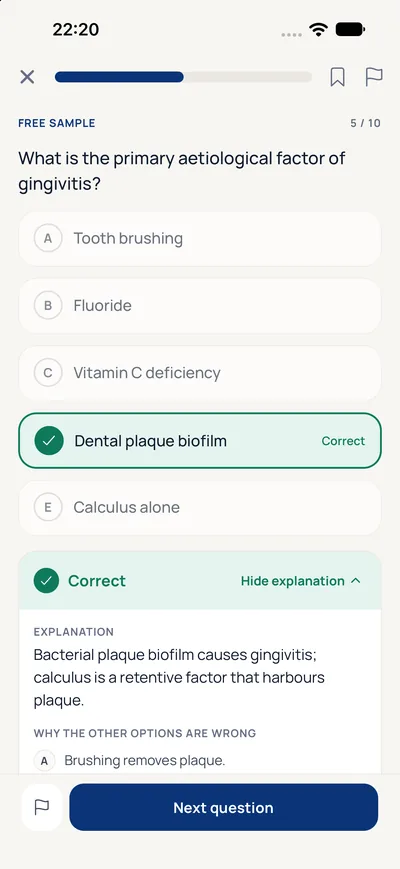
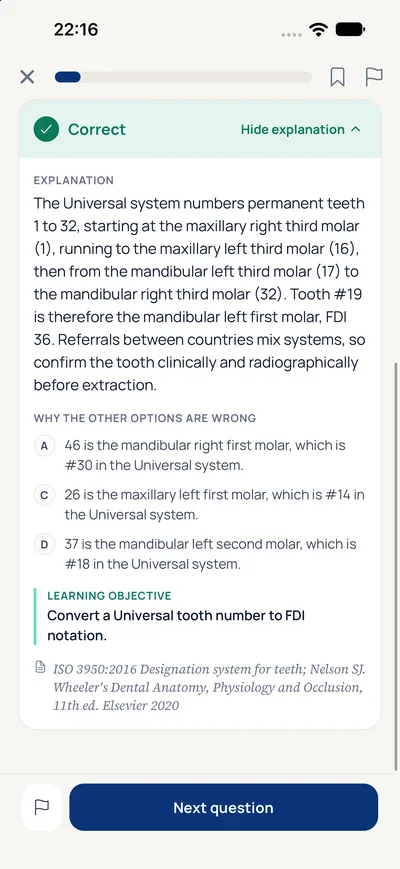
- Every answer is explained, including why the other options are wrong.
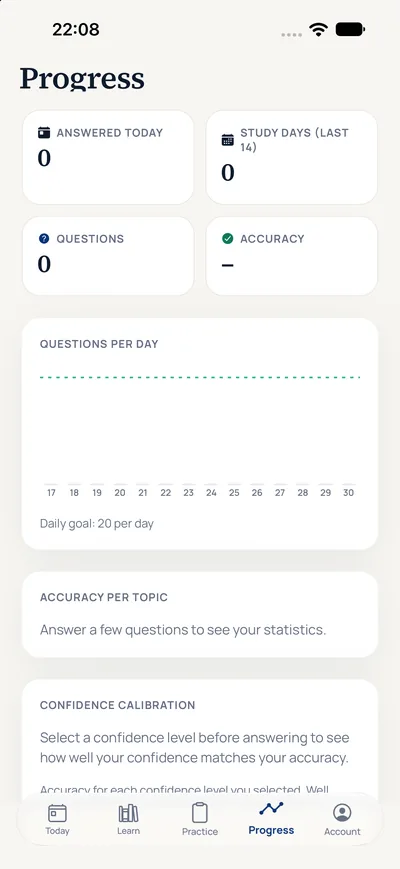
- A study plan up to your exam date tells you what to do each day and brings weak topics back for review.
- An AI examiner lets you rehearse the oral or practical part at any time.
Three steps to exam day
- 1
Try free questions and see the style of the exam.
- 2
Unlock the package and follow your study plan, topic by topic.
- 3
Take timed mock exams until your results are stable, then sit the exam.
What you can check
- 369 practice questions in 13 topics
- Question bank last updated on 30 October 2026
One package, one payment
€99.99 for 3 months of access to this exam. One payment, no subscription, no automatic renewal. Web and app with one account.
Practice material only. MediFlow is independent of Landesärztekammer and cannot guarantee a result.
Exam at a glance
- Questions
- not published
- Duration
- not published
- Pass mark
- not published
- Sections
- Prerequisites: 24 months inpatient training incl. 6 months ICU/anaesthesia/ED; 80-hour course; then 50 supervised physician-staffed EMS missions (up to 25 via standardised simulation) · Oral examination ('Fachgespräch') before the chamber committee (3 physicians, 2 holding the qualification), at least 30 min, closed; may cover all training content
- Exam type
- Oral
- Language
- English
- Authority
- Landesärztekammer
Curriculum
Built from the question bank and updated automatically when new questions are added. 13 modules · 369 questions · Last updated: 30 October 2026
01Prehospital analgesia and sedation20 questions · 5.4 % of the bank
Sample question
Sample question1 / 1 · 0 correctEin 70 kg schwerer Mann mit eingeklemmtem Unterschenkel soll mit Esketamin analgesiert werden. Welche Initialdosis i. v. liegt im üblichen analgetischen Bereich?
Keys: 1–5 or A–E to choose, Enter to check and continue, F to mark.
02Airway management, emergency anaesthesia and ventilation36 questions · 9.8 % of the bank
Chapters
- Prähospitale Notfallnarkose
- Schwieriger Atemweg und Notfallkoniotomie
- Grundlagen: ABCDE-Schema und Atemwegsgrundlagen
- Grundlagen: lebensbedrohliche Notfälle des Thorax
- Grundlagen: Schock, Verbrennungen und Sepsis
- Grundlagen: Anatomie der Atemwege
- Grundlagen: Alveolen und Gasaustausch
- Grundlagen: Atemmechanik und Atemregulation
Sample question
Sample question1 / 1 · 0 correctWelche Dosis Rocuronium wird zur Rapid Sequence Induction beim Erwachsenen empfohlen?
Keys: 1–5 or A–E to choose, Enter to check and continue, F to mark.
03Respiratory emergencies26 questions · 7 % of the bank
Chapters
- Grundlagen: Anatomie der Atemwege
- Grundlagen: Alveolen und Gasaustausch
- Grundlagen: Atemmechanik und Atemregulation
- Grundlagen: ABCDE-Schema und Atemwegsgrundlagen
- Grundlagen: lebensbedrohliche Notfälle des Thorax
- Grundlagen: Schock, Verbrennungen und Sepsis
Sample question
Sample question1 / 1 · 0 correctWelcher SpO2-Zielbereich gilt nach der deutschen S3-Leitlinie für akut kranke Erwachsene ohne Risiko einer Hyperkapnie?
Keys: 1–5 or A–E to choose, Enter to check and continue, F to mark.
04Obstetric and gynaecological emergencies20 questions · 5.4 % of the bank
Chapters
- Grundlagen: Anatomie des weiblichen Beckens
- Grundlagen: Plazenta, Schwangerschaftsphysiologie und fetaler Kreislauf
- Grundlagen: Geburt und kindlicher Schädel
Sample question
Sample question1 / 1 · 0 correctEine 31-jährige Drittgebärende hat in der 39. SSW Presswehen alle 2 Minuten; der kindliche Kopf ist in der Vulva sichtbar. Die Geburtsklinik ist 30 Minuten entfernt. Welches Vorgehen ist am ehesten richtig?
Keys: 1–5 or A–E to choose, Enter to check and continue, F to mark.
05Poisoning and environmental emergencies29 questions · 7.9 % of the bank
Sample question
Sample question1 / 1 · 0 correctEin 30-jähriger Elektriker hat beim Arbeiten an einer Haushaltssteckdose (230 V) einen kurzen Stromschlag erlitten. Er war nicht bewusstlos, hat keine Beschwerden, keine Strommarken und ein normales 12-Kanal-EKG. Welches Vorgehen ist am ehesten angemessen?
Keys: 1–5 or A–E to choose, Enter to check and continue, F to mark.
06Cardiovascular emergencies32 questions · 8.7 % of the bank
Chapters
- Grundlagen: Anatomie des Herzens
- Grundlagen: Erregungsleitungssystem und Herzzyklus
- Grundlagen: Kreislauf und Blutgefäße
- Grundlagen: ABCDE-Schema und Atemwegsgrundlagen
- Grundlagen: lebensbedrohliche Notfälle des Thorax
- Grundlagen: Schock, Verbrennungen und Sepsis
07Paediatric emergencies29 questions · 7.9 % of the bank
Chapters
- Grundlagen: das Neugeborene und die postnatale Adaptation
- Grundlagen: Wachstum und Entwicklung
- Grundlagen: Atemweg, Vitalparameter und Reanimation beim Kind
08Scene management, mass casualty incidents and hygiene23 questions · 6.2 % of the bank
09Neurological emergencies29 questions · 7.9 % of the bank
Chapters
- Grundlagen: Rückenmarkbahnen und Hirnnerven
- Grundlagen: der Circulus arteriosus Willisii und intrakranielle Blutungen
10Adult resuscitation and post-resuscitation care37 questions · 10 % of the bank
Chapters
- Erweiterte Reanimation des Erwachsenen
- Reversible Ursachen, Postreanimationsbehandlung und Abbruch
- Grundlagen: ABCDE-Schema und Atemwegsgrundlagen
- Grundlagen: lebensbedrohliche Notfälle des Thorax
- Grundlagen: Schock, Verbrennungen und Sepsis
11Psychiatric emergencies and legal issues26 questions · 7 % of the bank
12Shock and anaphylaxis25 questions · 6.8 % of the bank
Chapters
- Grundlagen: ABCDE-Schema und Atemwegsgrundlagen
- Grundlagen: lebensbedrohliche Notfälle des Thorax
- Grundlagen: Schock, Verbrennungen und Sepsis
13Prehospital trauma and multiple injuries37 questions · 10 % of the bank
Chapters
- Erstversorgung nach cABCDE
- Thoraxtrauma, Schädel-Hirn-Trauma und Wirbelsäule
- Grundlagen: ABCDE-Schema und Atemwegsgrundlagen
- Grundlagen: lebensbedrohliche Notfälle des Thorax
- Grundlagen: Schock, Verbrennungen und Sepsis
- Grundlagen: Skelett, Wirbelsäule und Becken
- Grundlagen: Schulter, Handgelenk und Hand
- Grundlagen: hüftnahe Femurfrakturen, Knie- und Sprunggelenkbänder
Sample question
From the module Prehospital analgesia and sedation. Choose an answer to see the explanation.
Ein 70 kg schwerer Mann mit eingeklemmtem Unterschenkel soll mit Esketamin analgesiert werden. Welche Initialdosis i. v. liegt im üblichen analgetischen Bereich?
Keys: 1–5 or A–E to choose, Enter to check and continue, F to mark.
What you get
- Question bank with a detailed explanation for every answer
- Timed mock exams in the real exam format, with score report by topic
- Personal study plan up to your exam date and review of weak topics
- AI tutor that explains any question in plain words
- One account for the app (iPhone, iPad) and the browser
- AI oral examiner for practising the oral or practical part
From registration to licence
The usual steps with Landesärztekammer. Details can change; check the current rules with Landesärztekammer before you register.
- Check eligibility and collect your documents (degree, experience, good standing).
- Create an account with Landesärztekammer and submit the application.
- Receive the exam eligibility and book a date with the test centre.
- Sit the exam. Results usually come within days.
- After passing: complete licensing (for example primary source verification) and receive your licence.
Frequently asked questions
How much does Additional qualification exam: Emergency Medicine (Notfallmedizin) preparation cost?
€99.99 for 3 months of access to this exam. One payment, no subscription, no automatic renewal.
How long is my access?
Access runs for 90 days from purchase for this exam package.
Where can I buy it?
In the MediFlow Exam Prep app (App Store) or on mediflow.ae. Both unlock the same package for your MediFlow account.
Are these real exam questions?
No. MediFlow writes original questions based on the published exam content. We do not use recalled or leaked exam questions and we are not affiliated with Landesärztekammer.
Is the exam format up to date?
The format comes from the published information of Landesärztekammer. Check it with Landesärztekammer before your exam, as authorities can change it.
Ready to start
Begin with free questions or unlock the full package now.
MediFlow is an independent provider. We are not affiliated with any licensing authority or exam provider. Questions are written by MediFlow from published exam outlines; they are not questions from real exams. Always check the format with the authority before your exam.
Related exams
- First State Examination in Medicine (M1)IMPP · M1 · 927 practice questions320 questions · 480 minutes · pass mark 60 %€79.99BuyDetails
- Second State Examination in Medicine (M2, written)IMPP · M2 · 1,811 practice questions320 questions · 900 minutes · pass mark 60 %€79.99BuyDetails
- Third State Examination in Medicine (M3, oral-practical)Landesprüfungsamt · M3 · 1,811 practice questions€79.99BuyDetails
- Medical knowledge test for third-country physicians (Kenntnisprüfung)Landesprüfungsamt · KP · 1,811 practice questions€79.99BuyDetails
- Medical German language exam for physicians (C1)Landesärztekammer · FSP · 723 practice questions · +196 new in 30 days€39.99BuyDetails
- Specialist board exam: Internal MedicineLandesärztekammer · 324 practice questions · +124 new in 30 days€99.99BuyDetails
- Specialist board exam: General Practice / Family MedicineLandesärztekammer · 345 practice questions · +121 new in 30 days€99.99BuyDetails
- Specialist board exam: General SurgeryLandesärztekammer · 333 practice questions · +124 new in 30 days€99.99BuyDetails
| Exam | Format | Price (3 months) | |
|---|---|---|---|
| First State Examination in Medicine (M1) IMPP (Aufgaben) / Landesprüfungsamt (Durchführung) · M1 · 927 practice questions | 320 questions · 480 minutes · pass mark 60 % | €79.99 | BuyApp Store |
| Second State Examination in Medicine (M2, written) IMPP (Aufgaben) / Landesprüfungsamt (Durchführung) · M2 · 1,811 practice questions | 320 questions · 900 minutes · pass mark 60 % | €79.99 | BuyApp Store |
| Third State Examination in Medicine (M3, oral-practical) Landesprüfungsamt · M3 · 1,811 practice questions | €79.99 | BuyApp Store | |
| Medical knowledge test for third-country physicians (Kenntnisprüfung) Landesprüfungsamt / Approbationsbehörde des Landes · KP · 1,811 practice questions | €79.99 | BuyApp Store | |
| Medical German language exam for physicians (C1) Landesärztekammer (in einzelnen Ländern Landesbehörde) · FSP · 723 practice questions · +196 new in 30 days | €39.99 | BuyApp Store | |
| Specialist board exam: Internal Medicine Landesärztekammer · 324 practice questions · +124 new in 30 days | €99.99 | BuyApp Store | |
| Specialist board exam: General Practice / Family Medicine Landesärztekammer · 345 practice questions · +121 new in 30 days | €99.99 | BuyApp Store | |
| Specialist board exam: General Surgery Landesärztekammer · 333 practice questions · +124 new in 30 days | €99.99 | BuyApp Store |
One app for every exam
MediFlow Exam Prep on iPhone and iPad: choose your country, profession and exam. Practice questions with explanations, timed mock exams and a study plan. The same account works in the browser.