Acute & critical care
Anaesthesiology
Every operating theatre, labour ward and intensive care unit depends on anaesthetists. Learn how your anaesthesia training is assessed for a licence in the Gulf and which exams you may need to prepare for.

What anaesthetists do
Anaesthesiologists make surgery and many invasive procedures possible. They assess patients before an operation, plan and deliver general and regional anaesthesia, monitor and stabilise vital functions during surgery and manage pain and recovery afterwards. Airway management, haemodynamic support and the safe use of potent drugs are at the core of the specialty.
Beyond the operating theatre, anaesthetists work in several areas:
- Obstetric anaesthesia – epidurals for labour and anaesthesia for caesarean sections
- Paediatric and cardiac anaesthesia – for children and for heart and major vascular surgery
- Intensive care medicine – in many systems closely linked to anaesthesia
- Pain medicine – acute pain services and chronic pain clinics
- Regional anaesthesia – ultrasound-guided nerve blocks
- Sedation outside the theatre – endoscopy, radiology and day surgery
In the Gulf, anaesthetists frequently care for patients with obesity, type 2 diabetes and obstructive sleep apnoea, which makes airway planning and perioperative risk assessment particularly important. Busy obstetric units and a growing number of bariatric and day-case procedures shape the daily workload.
Anaesthesia training worldwide
Specialist training in anaesthesiology generally lasts several years after medical school and includes rotations in general, obstetric, paediatric and cardiac anaesthesia as well as intensive care. Main routes are:
- Germany: the Weiterbildung zum Facharzt für Anästhesiologie includes a substantial period of intensive care medicine and ends with the examination at the medical chamber. Additional qualifications such as Spezielle Intensivmedizin or Schmerzmedizin can follow.
- United Kingdom: specialty training with the Primary and Final FRCA examinations, completed with the CCT.
- United States: an anaesthesiology residency followed by the staged examinations of the American Board of Anesthesiology; fellowships in areas such as critical care, cardiac or paediatric anaesthesia and pain.
- Arab and Saudi Boards: residency programmes in anaesthesia with board examinations.
- India and Pakistan: MD or DNB in Anaesthesiology in India, FCPS in Pakistan.
- Other European routes: the European Diploma in Anaesthesiology and Intensive Care (EDAIC) is often held in addition to a national title.
Regulators look at the breadth of your training: documented experience in obstetric, paediatric and critical care anaesthesia is often relevant to the scope of practice you receive.
Recognition of your anaesthesia qualification
In the DHA, DOH and MOHAP systems, physicians are assigned to professional grades. For anaesthetists, the key levels are Specialist and Consultant. The decision depends on your qualification and on the experience you have gained since completing specialist training. Consultant level usually requires a higher qualification or extended experience as an independent senior anaesthetist, for example running lists alone, supervising trainees or leading a subspecialty service.
All documents are checked through Primary Source Verification, typically by DataFlow. Universities, training authorities and hospitals confirm your degree, specialist certificate, licences and periods of employment. If you also work in intensive care, make sure your ICU experience is clearly stated in employment letters.
After verification, the authority decides on equivalence. You may need to sit the specialist exam or attend an interview, or you may be exempt depending on your qualification. Some authorities license intensive care separately or expect specific ICU training for critical care roles. Details differ between authorities and change over time; MediFlow reviews your individual case before you apply.
Career outlook for anaesthetists
As surgical capacity expands in the Gulf, the need for anaesthetists grows with it. New hospitals, day-surgery centres and specialised units for cardiac, bariatric and orthopaedic surgery all require anaesthesia cover, as do busy maternity services offering epidural analgesia around the clock.
Anaesthetists with additional skills in intensive care, paediatric or cardiac anaesthesia, or ultrasound-guided regional techniques are particularly in demand. Pain medicine is also developing as hospitals build dedicated pain services.
The specialty offers flexibility: anaesthetists can work in large tertiary centres, private hospitals or outpatient facilities. Experience in the Gulf, with complex patients and modern equipment, is recognised as valuable when moving on to other countries.
Exams in anaesthesiology and preparation
Relevant assessments may include:
- DHA specialist exam in anaesthesiology
- DOH or MOHAP evaluation, with a written exam or interview where required
- SCFHS classification in Saudi Arabia
- International exams such as FRCA, EDAIC, the American Board of Anesthesiology examinations or the German Facharzt examination, which influence your grading
Typical exam content includes pharmacology of anaesthetic agents, physiology, airway management and the difficult airway, regional anaesthesia, obstetric and paediatric anaesthesia, perioperative assessment, management of malignant hyperthermia and anaphylaxis, resuscitation and core intensive care topics.
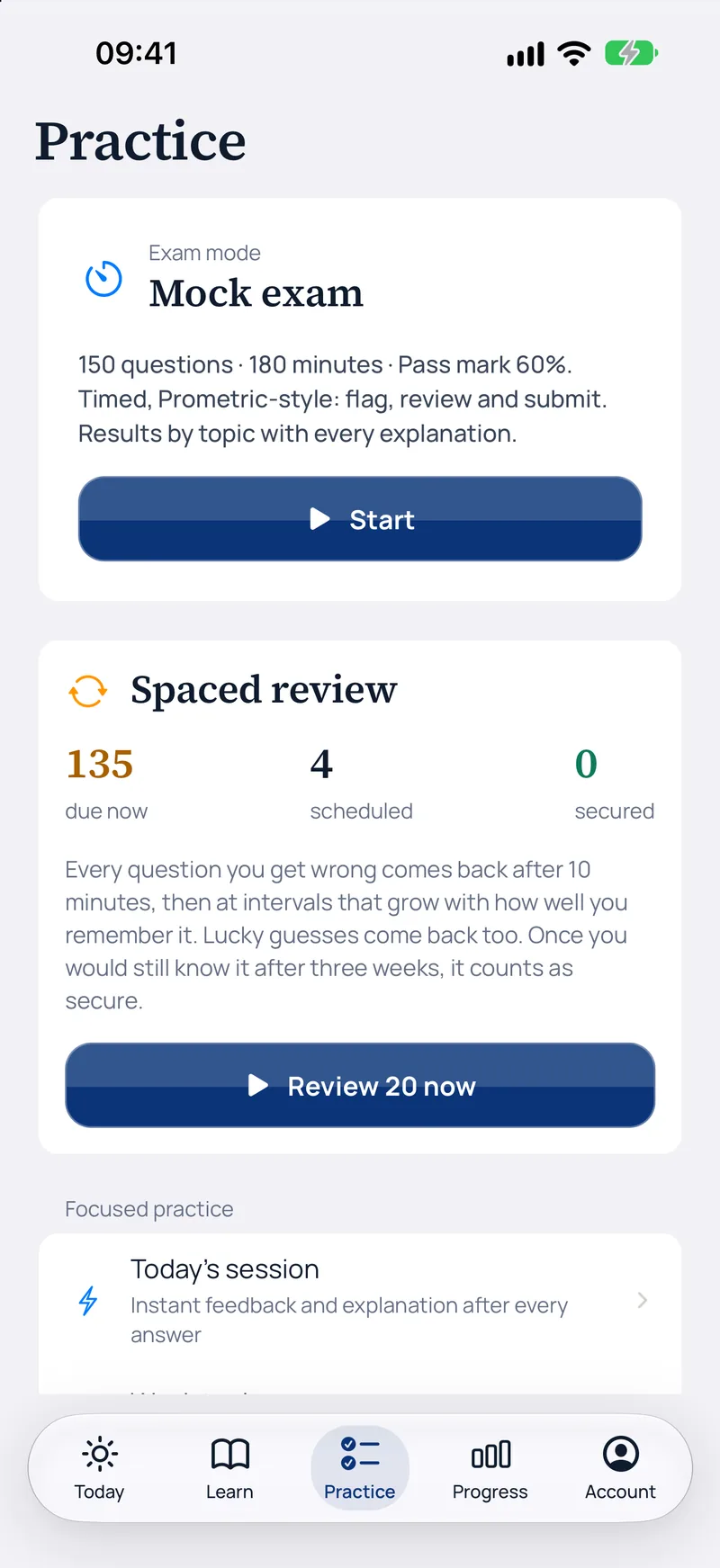
MediFlow Exam Prep offers an anaesthesiology question bank with clinical scenarios and basic science questions, explanations for each answer and timed mock exams that follow the structure of the specialist exams. You can concentrate on weaker topics and review difficult questions repeatedly.
Matching exams and courses
Prepare with question banks and timed mock exams in the format of the respective exam.
- DHADHA Specialist AnesthesiaView course
- LandesärztekammerSpecialist board exam: AnaesthesiologyView course
- SIWFSwiss board exam in anaesthesiologyView course
- ÖÄKBoard exam anaesthesiologyView course
- CNGEVC physicians: anaesthesiology and critical careView course
- DOHDOH Specialist/Consultant physician CBT (Anesthesia, Dermatology, Internal Medicine, Family Medicine, Pediatrics, ENT, General Surgery, OB/GYN; consultant also Ophthalmology)View course
- SCFHSSCFHS Physician specialty classification exams (Internal Medicine, Family Medicine, Pediatrics, OB/GYN, General Surgery, Anesthesia, Emergency, Psychiatry and others)View course
- DHPQatar specialist physician qualifying exams (34 specialties)View course
Frequently asked questions
Can I work as a Consultant Anaesthetist in Dubai with a German Facharzt?
A German Facharzt für Anästhesiologie is a strong qualification, but the grade depends on your experience after qualifying and the authority's assessment. Doctors with several years as Oberarzt, independent responsibility and possibly additional qualifications in intensive care or pain medicine have better prospects for Consultant level. MediFlow reviews your documents and explains which grade is realistic.
Can I work in intensive care with an anaesthesia licence?
In many hospitals anaesthetists cover intensive care, but the rules differ. Some authorities and hospitals require documented intensive care training or a separate critical care qualification for ICU roles. If you hold an additional qualification such as Spezielle Intensivmedizin or a critical care fellowship, include it in your application.
Is the FRCA required to practise in the Gulf?
No. The FRCA is well known, but authorities also assess European specialist titles, the EDAIC, American boards, Arab and Saudi Boards and Indian or Pakistani degrees. Whether you need an additional exam depends on your qualification and the authority. MediFlow can explain which route matches your training.
Do I need experience in obstetric and paediatric anaesthesia?
Documented experience in obstetric and paediatric anaesthesia is very useful, because many Gulf hospitals have busy maternity units and treat a large number of children. Hospitals use this evidence when granting privileges. A logbook or letter listing your experience in these areas helps.
Which topics are important for the anaesthesiology exam?
Core topics include pharmacology, physiology, airway management, regional anaesthesia, obstetric and paediatric anaesthesia, perioperative risk assessment, anaesthetic emergencies and intensive care. Questions mix clinical cases with basic science. The MediFlow Exam Prep question bank covers these areas with explanations and mock exams.