Acute & critical care
Critical Care / ICU
Expanding hospitals, trauma services and complex surgery have made critical care one of the busiest specialties in the Gulf. Find out how intensivists trained abroad are assessed, graded and prepared for licensing exams.

What intensivists do
Intensivists lead the care of patients whose vital organ functions are failing or at immediate risk. They work around the clock in intensive care units, coordinate multidisciplinary teams and make rapid decisions on ventilation, circulation support and organ replacement.
Typical patient groups include:
- Sepsis and septic shock, including source control and haemodynamic management
- Acute respiratory failure and ARDS, with invasive and non-invasive ventilation, prone positioning and, in some centres, ECMO
- Polytrauma, frequently after road traffic and workplace accidents
- Postoperative care after cardiac, neurosurgical, transplant and major abdominal surgery
- Neurocritical care after stroke, intracranial haemorrhage or traumatic brain injury
- Multi-organ failure, with continuous renal replacement therapy and complex fluid and drug management
Intensivists also run rapid response and outreach teams, perform procedures such as central lines, arterial lines, percutaneous tracheostomy and point-of-care ultrasound, and lead end-of-life conversations with families, which requires cultural sensitivity in a multinational setting. Subspecialty areas include cardiac, neuro, paediatric and neonatal intensive care.
Training routes worldwide
Critical care is reached through different base specialties, which makes the training landscape particularly varied.
- Germany: Intensivmedizin is an additional qualification (Zusatz-Weiterbildung) built on a Facharzt in anaesthesiology, internal medicine, surgery, neurology or another base specialty.
- United Kingdom: a dedicated Intensive Care Medicine CCT, often as dual training with anaesthesia or medicine, including the FFICM examination.
- United States: critical care fellowships after internal medicine, anaesthesiology, surgery or emergency medicine, each with its own board pathway.
- Europe: the European Diploma in Intensive Care (EDIC) is widely used as an additional proof of competence.
- Arab and Saudi Boards: critical care fellowships following a base board, typically in internal medicine or anaesthesia.
- India: DM or DNB in critical care medicine, or IDCCM-type fellowships after a base MD.
Because critical care is sometimes a full specialty and sometimes an add-on, Gulf authorities pay close attention to the type of qualification and the documented ICU time.
Recognition of your specialist title in the Gulf
Authorities in the UAE and the wider Gulf grade physicians as Specialist or Consultant. The grade reflects your qualification and your experience after specialist training. For a Consultant intensivist, a higher-level qualification and several years of independent ICU practice, ideally with leadership responsibility, are generally expected. Doctors at an earlier stage usually start at Specialist level.
Key steps include:
- Primary source verification of your degree, specialist titles, additional qualifications and employment history, usually through DataFlow
- An equivalence assessment, in which the authority decides whether to list you in critical care, in your base specialty or both
- An assessment step, such as a specialist exam, an interview or an exemption, depending on your qualification and the authority
For holders of an additional qualification, such as the German Zusatz-Weiterbildung, the base specialty and the documented time in intensive care are particularly important. Rules differ between DHA, DOH and MOHAP and can change. MediFlow assesses your case individually before you apply.
Demand and career prospects
The Gulf has invested heavily in tertiary hospitals with cardiac surgery, transplantation, neurosurgery and trauma services, all of which depend on strong intensive care. A growing population, chronic diseases such as diabetes and heart disease, and medical tourism further increase the need for ICU capacity.
Intensivists work in government and military hospitals, large private hospital groups and specialised cardiac or trauma centres. Skills in ECMO, neurocritical care, paediatric intensive care or ICU ultrasound can open specialised roles, while experienced Consultants often take on leadership of units, quality programmes or teaching.
Gulf ICU experience with diverse, complex cases is well regarded in Europe, Australia and North America.
Relevant exams and how MediFlow Exam Prep helps
Depending on your training, these assessments may be relevant:
- DHA specialist examination in critical care or your base specialty, unless an exemption applies
- DOH and MOHAP assessment through an exam or structured interview
- SCFHS classification in Saudi Arabia, in some cases with an assessment exam
- International exams such as FFICM, EDIC, the US critical care boards or the German exam for the Zusatz-Weiterbildung Intensivmedizin
Typical content includes ventilation strategies and weaning, haemodynamic monitoring and vasopressors, sepsis bundles, acid-base and electrolyte problems, sedation and delirium, renal replacement therapy, brain death and organ donation, transfusion and ethics.
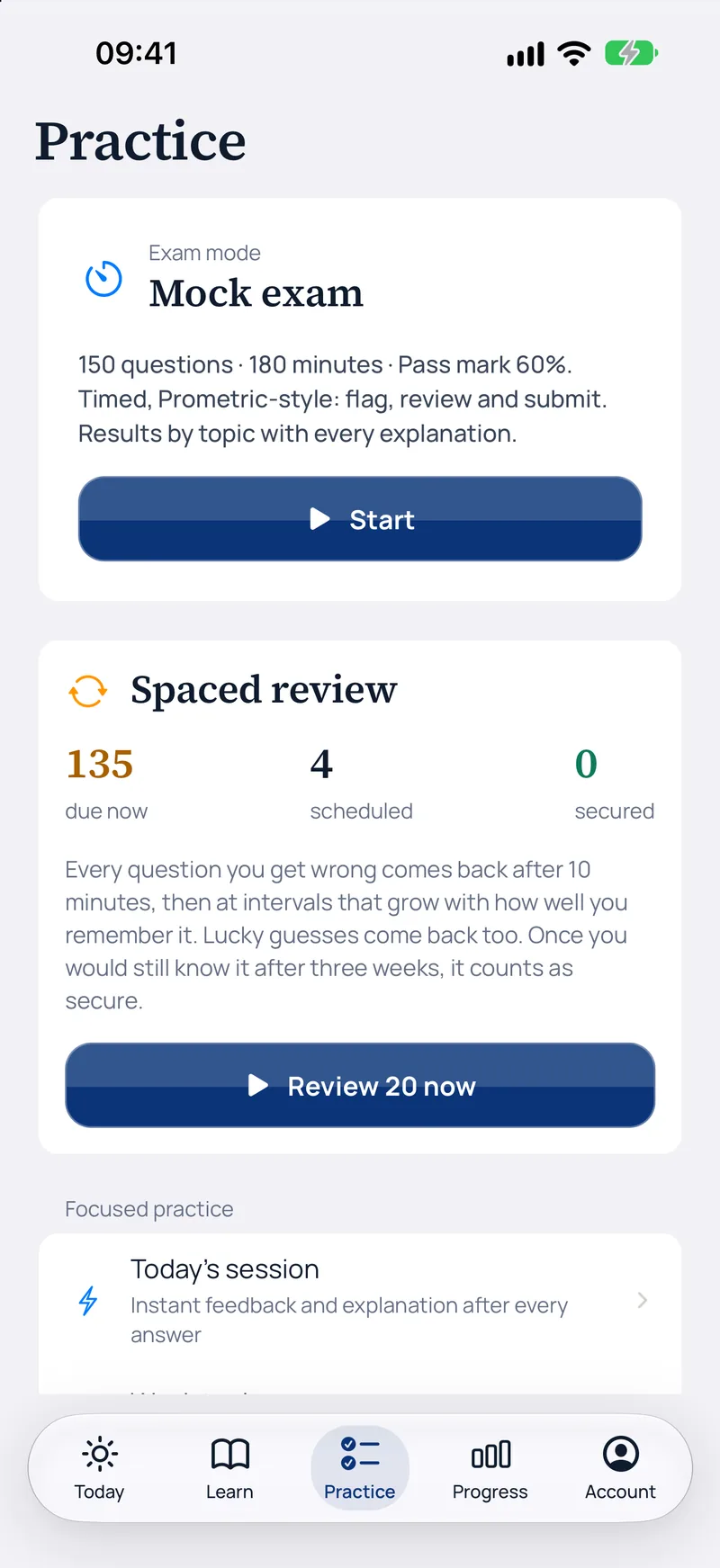
MediFlow Exam Prep provides a question bank with in-depth explanations, case-based practice and mock exams in the format of Gulf licensing exams, so you can prepare efficiently alongside demanding shift work.
Matching exams and courses
Prepare with question banks and timed mock exams in the format of the respective exam.
- DHADHA Specialist Critical Care MedicineView course
- DOHDOH Specialist/Consultant physician CBT (Anesthesia, Dermatology, Internal Medicine, Family Medicine, Pediatrics, ENT, General Surgery, OB/GYN; consultant also Ophthalmology)View course
- SCFHSSCFHS Physician specialty classification exams (Internal Medicine, Family Medicine, Pediatrics, OB/GYN, General Surgery, Anesthesia, Emergency, Psychiatry and others)View course
- DHPQatar specialist physician qualifying exams (34 specialties)View course
Frequently asked questions
Can I work as an ICU Consultant in Dubai with the German Zusatz-Weiterbildung Intensivmedizin?
It is possible, but the authority looks at your base Facharzt, the additional qualification and your years of independent ICU work, for example as an Oberarzt on an intensive care unit. Some applicants are first listed in their base specialty or graded as Specialist in critical care. MediFlow reviews your documents and explains the most realistic route.
I am an anaesthetist with ICU experience. Should I apply in anaesthesia or critical care?
That depends on your qualifications and career goals. Without a formal critical care title, licensing in anaesthesia is often more straightforward, with ICU duties possible depending on the hospital. With a dedicated qualification such as FFICM or EDIC, applying in critical care can be an option. MediFlow helps you weigh both routes.
Does EDIC help with Gulf licensing?
The European Diploma in Intensive Care is widely known and can strengthen your profile, especially alongside a base specialist title. On its own it does not replace a specialist qualification. How much weight it carries depends on the authority and your overall training, so it is assessed as part of your full file.
What topics are central in the critical care licensing exam?
Expect detailed questions on mechanical ventilation, ARDS, sepsis, shock and vasopressors, acid-base interpretation, acute kidney injury and renal replacement therapy, neurocritical care, sedation and ICU pharmacology. Many questions present ICU scenarios with monitoring data, blood gases or ventilator settings. MediFlow can help you plan your preparation around these points.
Can paediatric intensivists use the same process?
Paediatric and neonatal intensivists are usually assessed within paediatrics or neonatology with an intensive care component. The documents, required experience and exam content therefore differ from adult critical care. MediFlow checks which category fits your training before primary source verification starts.